Parallel-Crankshaft Twin
Parallel-Crankshaft TWIN
DALE HERBRANDSON
In the May issue of Cycle World we prefaced Dale Herbrandson's article, Engine Balance, with some of our observations about him, among them his nuts-and-bolts approach to engine design. And, Dale's subject for this article, his parallel-crankshaft twin, clearly attests to this practical facet of his engineering philosophy. — Ed.
THIS ENGINE PROJECT began in 1962, when I tried to increase the available power in a small motorcycle. The approach was to simply connect a second engine to the first through a chain drive. Both engines were identical oversquare single-cylinder two-strokes. Because the bike was not wide enough to allow a side-by-side setup, the alternative was to mount one engine behind the other. The chain-driven shafts were oriented in the same fashion as the geared engine that will be discussed later in this article. Crankshaft phasing was set up for 180degree firing, and no alterations were made to either engine.
This built-up twin made a nice compact package. It was no wider than the original engine, and it did have twice the output. Tuning was simple because each cylinder could still be run independently. But, although the twin had many favorable features, it had problems caused by hasty design.
To make a long story short, the trouble areas involved mainly engine vibration and chain wear. Breakdown, the main problem of the hybrid, was not caused by
the irritating imbalance; all failures were centered around the chain drive. Because crankshaft rotation is not constant during the engine cycle, and with 180-degree phasing, the cranks did not follow one another closely. As a consequence, the crankshafts were fighting one another through the chain drive. The resulting tension was much greater than that produced by the average engine torque, and as soon as the links wore enough to produce a slack chain, the chain would break.
The engine (or engines) was run for only a few weekends and given up as hopeless. This parellel-crankshaft approach had problems not found in the conventional twin, but the weaknesses were interesting problems because the basic engine plan had possibilities.
About two years later, the concept was again looked at, but for reasons other than just increased power. The main objective this time was to create a highly balanced engine. A study was made, using the ideas that appeared in “Engine Balance” — CYCLE WORLD (May ’67). The figures showed that the balance of the original chain-driven twin could be improved by changing only the counterweight on the crankshafts. As a matter of fact, the resulting balance is theoretically better than any vertical twin motorcycle engine in production. This one feature made the engine look promising, and the reliability of the first engine seemed easy to solve by better design.
ENGINE DESIGN
With new enthusiasm, another engine was laid out using the experience of the past on the problem areas. Both a rugged crankshaft and drive train were musts. After much looking, the 47mm x 42mm bore and stroke, Yamaha 80 was selected as the single-cylinder “building block.”
It satisfied the first design requirement with a geared primary drive mounted on a healthy crankshaft. In addition, it had a rotary disc intake valve that was to offer a new feature on the parallel-crankshaft approach.
To create the required stiffness between the two cranks, a three-piece crankcase was designed. The largest of the three sections supports both crankshafts and the clutch shaft. Each crank runs in a sealed area within the common crankcase block. Consequently, each cylinder can be assembled, run, or disassembled separately from the other.
The unusual exhaust port location was decided upon after much debate. The system used on the second design was attendant to the decision to use the Yamaha engines.
The particular system chosen for the geared design has merit in that the hot exhaust ports are at opposite ends of the engine, where cooling is best. The cramped space between the cylinder runs reasonably cool, because each cylinder has two of its four scavenge ports located here. Some heat is removed internally by the moving air-fuel mixture. The disadvantage of this exhaust port arrangement accrues from piston side thrust against the cylinder wall. One outlet port is sealed by thrust, while on the other cylinder, the situation is reversed. The cylinder with favorable piston thrust against the port will produce a little more power.
ENGINE CONSTRUCTION
As can be seen most of the engine hardware is taken from the 73cc Yamaha. The head, cylinder, piston, connecting rod and crankshaft are production items. Initially, the engine also used a set of stock drive gears. The stock multi-plate wet clutch was found to have adequate capacity for the twin. The crankcase, rotary valve housing, and gear case were machined from aluminum billet. Sand blasting removed the tool marks, giving the homemade parts a finished look.
The only major modification to the Yamaha components was to increase the “percent balance” on each crankshaft. The required 100 percent figure is quite a bit more than the 30 percent used on the production single-cylinder engine. Although this gives a heavy, difficult-to-build crankshaft, the results are rewarding, as
seen by comparing the overall effect for the parallel-crank twin against the current production engine.
Here we find that in both the twoand four-stroke conventional vertical twins, compromises must be made when balancing the crankshafts. A reduction of shake in one direction unfortunately
causes an increased imbalance in another direction. Good overall balance is, therefore, not achieved. The parallel-crankshaft engine requires no compromise; it must have, exactly, the difficult-to-achieve 100 percent reciprocating balance figure.
This high “percent balance” figure limits the bore/stroke ratio if the twin is a two-stroke. It is not practical to build the cranks for an oversquare design that retains a high crankcase compression ratio. The heavy, big-bore piston requires too much mass to be designed into the relatively small crankshaft radius. The crankshaft for such an engine must have lead-filled counterweights, making fullcircle cranks very difficult (if not impossible) to build. The parallel-crankshaft approach should only be used with square to undersquare configurations if good balance is to be retained.
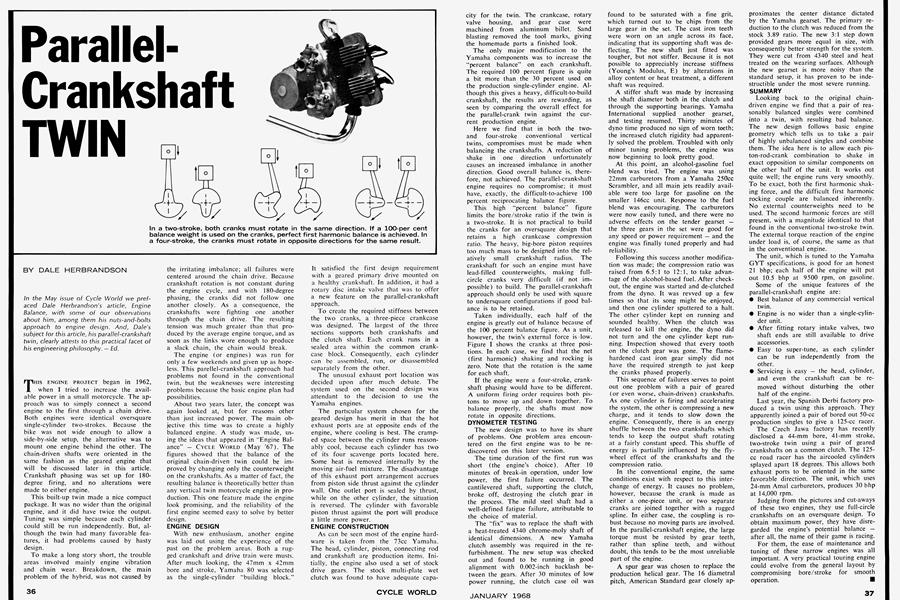
Taken individually, each half of the engine is greatly out of balance because of the 100 percent balance figure. As a unit, however, the twin’s external force is low. Figure I shows the cranks at three positions. In each case, we find that the net (first harmonic) shaking and rocking is zero. Note that the rotation is the same for each shaft.
If the engine were a four-stroke, crankshaft phasing would have to be different. A uniform firing order requires both pistons to move up and down together. To balance properly, the shafts must now rotate in opposite directions.
DYNOMETER TESTING
The new design was to have its share of problems. One problem area encountered on the first engine was to be rediscovered on this later version.
The time duration of the first run was short (the engine’s choice). After 10 minutes of break-in operation, under low power, the first failure occurred. The cantilevered shaft, supporting the clutch, broke off, destroying the clutch gear in the process. The mild steel shaft had a well-defined fatigue failure, attributable to the choice of material.
The “fix” was to replace the shaft with a heat-treated 4340 chrome-moly shaft of identical dimensions. A new Yamaha clutch assembly was required in the refurbishment. The new setup was checked out and found to be running in good alignment with 0.002-inch backlash between the gears. After 30 minutes of low power running, the clutch case oil was
found to be saturated with a fine grit, which turned out to be chips from the large gear in the set. The cast iron teeth were worn on an angle across its face, indicating that its supporting shaft was deflecting. The new shaft just fitted was tougher, but not stiffer. Because it is not possible to appreciably increase stiffness (Young’s Modulus, E) by alterations in alloy content or heat treatment, a different shaft was required.
A stiffer shaft was made by increasing the shaft diameter both in the clutch and through the supporting bearings. Yamaha International supplied another gearset, and testing resumed. Thirty minutes of dyno time produced no sign of worn teeth; the increased clutch rigidity had apparently solved the problem. Troubled with only minor tuning problems, the engine was now beginning to look pretty good.
At this point, an alcohol-gasoline fuel blend was tried. The engine was using 22mm carburetors from a Yamaha 250cc Scrambler, and all main jets readily available were too large for gasoline on the smaller 146cc unit. Response to the fuel blend was encouraging. The carburetors were now easily tuned, and there were no adverse effects on the tender gearset — the three gears in the set were good for any speed or power requirement — and the engine was finally tuned properly and had reliability.
Following this success another modification was made; the compression ratio was raised from 6.5:1 to 12:1, to take advantage of the alcohol-based fuel. After checkout, the engine was started and de-clutched from the dyno. It was revved up a few times so that its song might be enjoyed, and then one cylinder sputtered to a halt. The other cylinder kept on running and sounded healthy. When the clutch was released to kill the engine, the dyno did not turn and the one cylinder kept running. Inspection showed that every tooth on the clutch gear was gone. The flamehardened cast iron gear simply did not have the required strength to just keep the cranks phased properly.
This sequence of failures serves to point out one problem with a pair of geared (or even worse, chain-driven) crankshafts. As one cylinder is firing and accelerating the system, the other is compressing a new charge, and it tends to slow down the engine. Consequently, there is an energy shuffle between the two crankshafts which tends to keep the output shaft rotating at a fairly constant speed. This shuffle of energy is partially influenced by the flywheel effect of the crankshafts and the compression ratio.
In the conventional engine, the same conditions exist with respect to this interchange of energy. It causes no problem, however, because the crank is made as either a one-piece unit, or two separate cranks are joined together with a rugged spline. In either case, the coupling is robust because no moving parts are involved. In the parallel-crankshaft engine, the large torque must be resisted by gear teeth, rather than spline teeth, and without doubt, this tends to be the most unreliable part of the engine.
A spur gear was chosen to replace the production helical gear. The 16 diametral pitch, American Standard gear closely ap-
proximates the center distance dictated by the Yamaha gearset. The primary reduction to the clutch was reduced from the stock 3.89 ratio. The new 3:1 step down provided gears more equal in size, with consequently better strength for the system. They were cut from 4340 steel and heat treated on the wearing surfaces. Although the new gearset is more noisy than the standard setup, it has proven to be indestructible under the most severe running.
SUMMARY
Looking back to the original chaindriven engine we find that a pair of reasonably balanced singles were combined into a twin, with resulting bad balance. The new design follows basic engine geometry which tells us to take a pair of highly unbalanced singles and combine them. The idea here is to allow each piston-rod-crank combination to shake in exact opposition to similar components on the other half of the unit. It works out quite well; the engine runs very smoothly. To be exact, both the first harmonic shaking force, and the difficult first harmonic rocking couple are balanced inherently. No external counterweights need to be used. The second harmonic forces are still present, with a magnitude identical to that found in the conventional two-stroke twin. The external torque reaction of the engine under load is, of course, the same as that in the conventional engine.
The unit, which is tuned to the Yamaha GYT specifications, is good for an honest 21 bhp; each half of the engine will put out 10.5 bhp at 9500 rpm, on gasoline.
Some of the unique features of the parallel-crankshaft engine are:
• Best balance of any commercial vertical twin.
• Engine is no wider than a single-cylinder unit.
• After fitting rotary intake valves, two shaft ends are still available to drive accessories.
• Easy to super-tune, as each cylinder can be run independently from the other.
• Servicing is easy — the head, cylinder, and even the crankshaft can be removed without disturbing the other half of the engine.
Last year, the Spanish Derbi factory produced a twin using this approach. They apparently joined a pair of bored out 50-cc production singles to give a 125-cc racer.
The Czech Jawa factory has recently disclosed a 44-mm bore, 41-mm stroke, two-stroke twin using a pair of geared crankshafts on a common clutch. The 125cc road racer has the aircooled cylinders splayed apart 18 degrees. This allows both exhaust ports to be oriented in the same favorable direction. The unit, which uses 24-mm Amal carburetors, produces 30 bhp at 14,000 rpm.
Judging from the pictures and cut-aways of these two engines, they use full-circle crankshafts on an oversquare design. To obtain maximum power, they have disregarded the engine’s potential balance — after all, the name of their game is racing.
For them, the ease of maintenance and tuning of these narrow engines was all important. A very practical touring engine could evolve from the general layout by compromising bore/stroke for smooth operation.