Looking Back: 1962 Triumph Bonneville
LOOKING BACK: 1962 TRIUMPH BONNEVILLE
25TH ANNIVERSARY
On an old Bonnie, you can go home again
STEVE ANDERSON
AUGUST, 1962: A HOT, MIDwestern summer is winding down. A burr-cut seven-year-old, dark from the Indiana sun, I soon have to report to school, and my third-grade teacher, Mrs. Christman. My summer freedom is vanishing into the orderliness of the classroom.
Seventy miles south, Richard Johnston has just left his job as service manager of a Louisville, Kentucky, Harley-Davidson shop, a change that brings him a new freedom. Years earlier, at a half-mile dirt track, he saw a Triumph wallop a field of Harleys, and he was impressed. Now no longer compelled to ride a Milwaukee product, he buys a new Triumph 650 Bonneville.
After a few weeks of break-in, Johnston takes his Bonneville on its maiden voyage; a trip to the Springfield Mile. Perhaps he passes through my home town on the way. Afterwards, he continues to ride the Triumph, racking up miles, but all the while maintaining it as only someone who’s been repairing bikes for more than 15 years can; Johnston has been fiddling with and fixing bikes even before he went to a trade school at the Springfield, Massachusetts, Indian plant in 1947. He and the Triumph grow older, but show little wear.
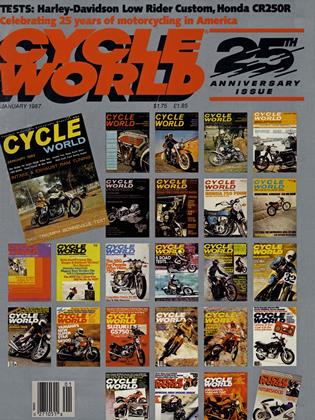
OCTOBER, 1986: CYCLE WORLD’S 25th anniversary nears. Our first issue, January, 1962, contained our first motorcycle test, an evaluation of a 1962 Triumph Bonneville. We decide to reprint that original in our silver-anniversary issue, and run with it an impression of the same model from a modern perspective. But where to find a bike?
It’s my story, so I start looking for an answer by running up our phone bill. The dealers, distributors and parts manufacturers that maintain the British-bike community on the West Coast are my first targets. Do they know of an original-condition 1962 Bonneville? If not, could they suggest someone who might?
A week on the telephone, and I’ve found several 1961 Bonnevilles, and
a 1962 TR6, but not the right 1962 Bonneville. I expand the search to include the entire country. A Bostonarea dealer can offer no help, and Jonathan White of Cincinnati’s DomiRacer tells me that they don’t have a ‘62 model in their inventory of British classics. Almost as an aside, Jonathan tells me that one of his parts customers, a motorcycle shop owner, has a showroom-fresh 1962 Bonny. “But he’s in Louisville,” Jonathan explains, assuming we wouldn’t want to travel that far.
Two days later, CYCLE WORLD’S feature editor David Edwards and I are in a rental car, driving through the wooded hills of Southern Indiana. We make our way across the Kentucky border and through Louisville’s early morning traffic to a road leading south, out of town. A left turn at Jerry’s Restaurant, then a right down a side street loosely flanked with isolated businesses, takes us to the end of the line. The la^^uild^^befc^e the i^ÿoad
tracks is Johnston Motorcycle Service.
Inside, Richard Johnston and his Triumph are waiting for us. Tall, with wire-rimmed glasses and thin blond hair combed neatly back, Johnston is 58, but looks younger.
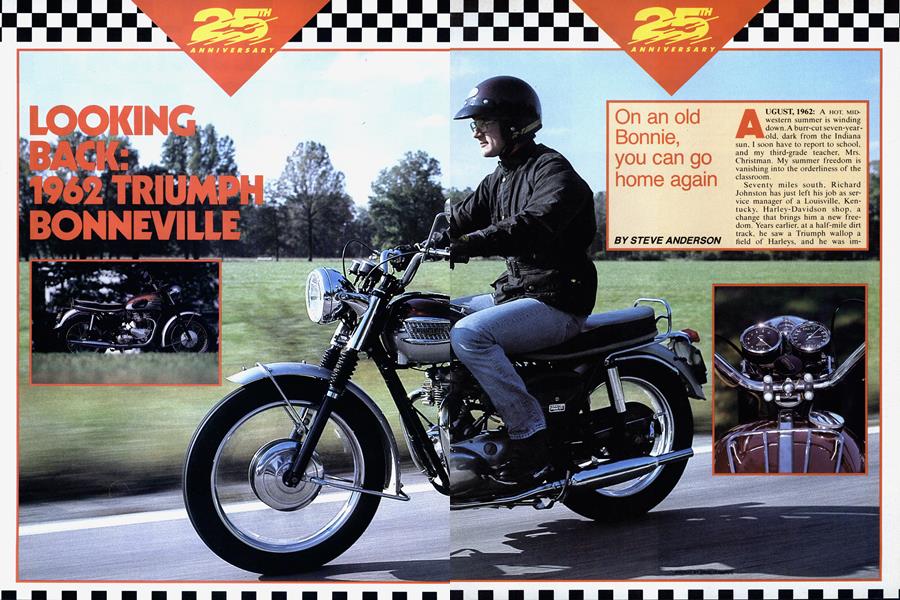
So does his Bonneville. It sits in the front of his shop, its seat draped with a slightly sun-faded Union Jack. Its orange paint is still shiny, its chrome still agleam. It’s not new, and it hasn’t been restored; a few wear spots on the cable housings, a drooping knob for the tripmeter, perhaps a slight fading here and there, give it a patina of age, of use. There are 20,597 miles showing on the odometer, but it’s hard to imagine finding a more original 1962 Bonneville. Johnston takes the flag off the seat, and begins to tell us about his bike.
“It has a little more mileage than it shows—the instruments were rebuilt.
I had the cylinder head off once, for the valves, but it still has the original bore. The big ends have never been touched. The paint isn’t original—I crashed and scratched it in 1969, and I sent the tank and fenders to Triumph in England to have them repainted. Took me nine months to get them back. I'd almost given up, and then they came back packed so badly they might as well have dropped them from an airplane. The original pinstriping was gold; when they repainted they pinstriped it with white.
“There are a few other things that a purist might notice. The lifting handles, the prop stand, the fender stays the and headlight mounts were all black originally, and I've had them chromed. I always figured that I could take the chrome off and paint them black again if it were ever important. The air cleaners were an accessory; they didn’t come standard back then. The tires are the second set that’ve ever been on the bike; the rear is a K.70, the front a Dunlop rib, about as original as you can get.”
While Johnston is explaining, we’re looking at his Bonneville. It has a classic appeal. Even young whippersnappers like 31-year-old Edwards, or my 32-year-old self, can see that it possesses a type of quality and simplicity very different from modern machinery.
Only two switches can be found on the handlebar: a left-side horn button, flanked by a dimmer switch. A kill switch is centrally placed between the handlebar mounts. There are no turn signals, and no bundles of wires snaking here and about. The light switch hides on the right, below the seat, and there is no ignition lock or key. Johnston quips that “They just assumed everyone was honest in those days.”
The Bonneville’s individual parts are often beautiful, reflecting manufacturing processes closer to what might be found in a small machine shop than in a modern plant. I look at the T-shaped adjuster that screws onto the rear brake rod, and I can picture English machinists bringing it to life. They started with bar stock, drilling and tapping it, and turned it on a lathe into a hat shape. Then they knurled its brim, and milled two flats into it, all to make it easier to use. Finally they chromed it. The coldformed equivalent part on a modern machine might be as functional, and much cheaper to make, but it’s not as pretty.
After all the talk and staring, we’re eager for a ride. Johnston is rightly concerned that I’ll confuse the Bonneville’s right-side gearshift for its very important lefthand brake pedal in the heavy traffic near his shop, so he leads the way on the Bonneville while I follow on a Moto Guzzi that is his regular transportation. Edwards trails behind in the rental car, with the cameras. We head east, toward the country. The fall air is crisp, and the leaves on the trees just starting to find their autumn colors. Ten miles from Johnston’s shop, we reach a country lane, and he pulls over, ready to trade machines.
I have never ridden any Triumph Twin before; I’m a member of the generation that just missed British motorcycling. But once I’m sitting on the Triumph, it feels like a familiar motorcycle, a roomy bike that feels light and carries its weight low. If the engine were cold, it would have been necessary to use the ticklers on the carburetors (there are no chokes) to start it; but warm as it is, it only requires a healthy kick, less bother than with most current 600 Singles. The engine falls into a very even, 1000rpm idle, and I have my first experience of the famous Smiths Chronometrie instruments.
Inside the tachometer, positive mechanical gearwork translates engine speed into jerkish needle movement. The needle jumps in 100-rpm increments, a half-step behind the engine. With a quick blip of the throttle, it’s possible to catch the needle still rising while engine speed falls. It’s a little like growing up with digital watches and encountering your first analog watch: They both tell the time, but differently.
The clutch feels different, as well. It has a fairly stiff pull and an imprecise engagement; I can’t imagine it surviving the type of high-rpm slippage that I routinely subject modern bikes to at the drag strip. And I botch my first shift down into first by failing to use the deliberateness required, and grind the gear dogs for an embarrassing moment. But only for a moment; I catch first, and start down the road.
I’m soon in the fourth (and highest) gear. The Bonneville’s exhaust is suprisingly quiet; I’ve heard so many Trj~jj~.phs
aftermarket mufflers through the years that the civilized, if distinct, tone of a stock machine is unexepected, as is the smooth lowspeed power. As mentioned in the 1962 test, the Bonneville pulls well from 2000 rpm in top gear, and if the exhaust is relatively quiet, the intake moan emerging from the air filters is a delight.
Our original test of the Bonneville (performed and written by Gordon Jennings, cw’s first technical editor) dwelt on the bike’s exceptional acceleration, even going so far as to describe the intense effort expended
“fighting to keep the front wheel down and the machine pointed" during a quarter-mile run. But that was then and this is now. And this Bonneville, an intimidatingly quick machine in its day, is a pussycat by today’s standards. It feels slow, with good power up through the midrange and flattening out somewhere above 5000 rpm. Almost any recent 400 Twin would outrun it.
The standards of 1962 apply in other places, as well; the original test said “there wasn’t much vibration to worry about,’’ but this Triumph shakes. Below 50 mph in top gear, a low-frequency quaking is felt in the pegs and handlebar. At 60, that shaking smooths almost completely, and the seat begins an electric, but not debilitating, buzzing. At higher speeds, the buzz is worse, numbing my buns with that same tingling, unpleasant sensation that occurs as a Novocaine injection wears off. I think I could adapt, but I’m glad new motorcycles don’t ask me to do so.
Neither do new motorcycles ask quite as much anticipation before stopping. The front brake of the Triumph is noticeably weak; so having been spoiled by 15 years of disc brakes, I stay well behind any cars on the road. The rear drum is much more powerful, capable of locking up the rear wheel with very little foot pressure, but it’s my right foot that seeks it out. I have to keep telling myself; The brake is on the left.
But none of this is really a surprise; 25 years of progress dictate that this Bonneville accelerate less hard, vibrate more, and take farther to stop than a machine designed last year. Instead, the surprise is how pleasant the Bonneville is at 50 to 60 mph on these winding, country roads. There is no driveline backlash at all (and try to find a modern machine you can say that of), and the engine is smooth and torquey, a complacent top-gear cruiser. It rumbles and makes soothing motorcycle sounds. I do no “earholing," but the Bonneville is agile, and handles well. As we cruise past fall foliage, crisp air lightly stinging, I find myself relaxed and happy; this is as good as motorcycling can be. I can’t help marveling at the circumstances that have brought me back to this familiar country, and together with Johnston and his Bonneville.
All too soon we’re back at the shop, with the Triumph safely back inside. Johnston is telling us more about why he bought, and has kept, his Bonneville. Even though 1962 vas 650 with separate engines and gearboxes (1963 brought a new generation, with unit-construction engines), Johnston has never regretted buying his bike. “For me, this has always been the traditional Triumph, the one with the right lines. I never cared as much for the styling of the later bikes.
“I never bought the Triumph because it was the best bike—other bikes did some some things better. The Harleys were better two-up, Nortons shifted better. But the Triumph was a good bike, and it was fun to ride. That was the important thing—it was a fun motorcycle whether you rode it one mile or 400.” And he’s right.