The Most Significant Motorcycles In Cycle World's History
THE MOST SIGNIFICANT MOTORCYCLES IN CYCLE WORLD'S HISTORY
25TH ANNIVERSARY
Lots of motorcycles have come and gone in the last 25 years. Some made a difference in their time. These 25 kept on making a difference long after their time.
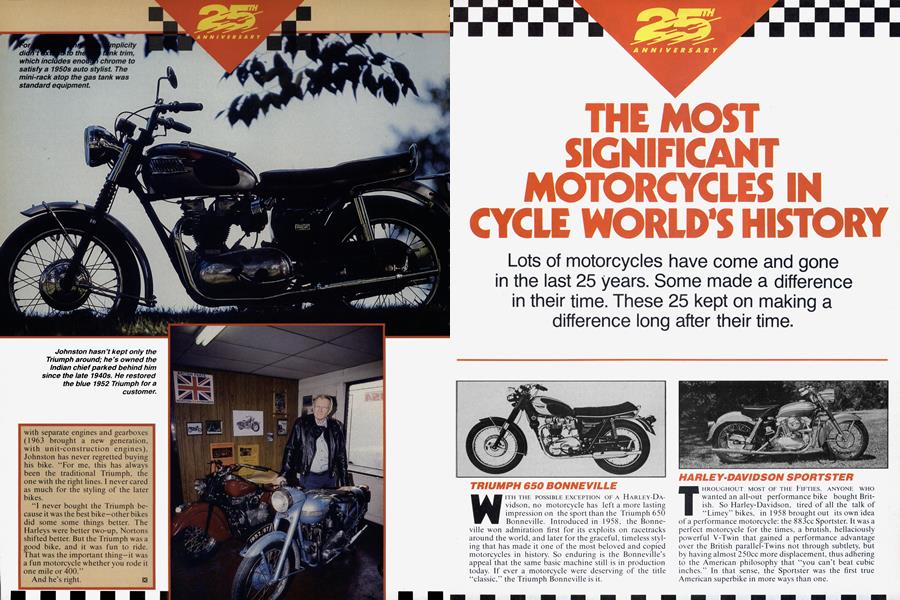
TRIUMPH 650 BONNEVILLE
WITH THE POSSIBLE EXCEPTION OF A HARLEY-DAvidson, no motorcycle has left a more lasting impression on the sport than the Triumph 650 Bonneville. Introduced in 1958, the Bonneville won admiration first for its exploits on racetracks around the world, and later for the graceful, timeless styling that has made it one of the most beloved and copied motorcycles in history. So enduring is the Bonneville’s appeal that the same basic machine still is in production today. If ever a motorcycle were deserving of the title “classic,” the Triumph Bonneville is it.
HARLEY-DAVIDSON SPORTSTER
THROUGHOUT MOST OF THE FIFTIES, ANYONE WHO wanted an all-out performance bike bought British. So Harley-Davidson, tired of all the talk of “Limey” bikes, in 1958 brought out its own idea of a performance motorcycle: the 883cc Sportster. It was a perfect motorcycle for the times, a brutish, hellaciously powerful V-Twin that gained a performance advantage over the British parallel-Twins not through subtlety, but by having almost 250cc more displacement, thus adhering to the American philosophy that “you can’t beat cubic inches.” In that sense, the Sportster was the first true American superbike in more ways than one.
HARLEY-DAVIDSON LOW RIDER
HARLEY-DAVIDSON DISCOVERED-OR PERHAPS, MORE accurately, rediscovered—its true market in 1977 when it introduced the Low Rider. This lowslung Big Twin took its styling cues from H-D’s own customers, looking like something one of them might have created by customizing a more ordinary Harley. Other Harley models since have been better all-around motorcycles than the Low Rider; but by and large, they all have followed the retro-fashion and custom-styling trends set by the Low Rider.
HONDA GL1000 GOLD WING
IT'S NOT VERY OFTEN THAT ONE BIKE BEGINS A WHOLE NEW class of motorcycles, and it’s even rarer when that bike creates an entirely new class of riders, as well. Yet, that’s what Honda’s Gold Wing did after its introduction in 1975: It virtually created “American-style” touring. Half of the reason for the ’Wing’s 10-year success is that Honda had the foresight to design such a bike in the first place; the other half is that Honda has been smart enough to refine the bike over the years as the result of input gathered from the people who were buying it. No wonder it’s the world’s best over-the-road tourer.
HONDA VF750F INTERCEPTOR
IN 1983, THE 750 INTERCEPTOR SET THE MOTORCYCLING world on fire for a year. Not simply because of its performance; other 750s were close. It did so because of its fine balance of power, handling and comfort, and its new-wave, high-tech appearance. The VF750F proved that sportbikes didn’t have to fit a visual mold, and would perhaps sell better if they didn’t.
MAICO 250 GP
IN EVERY REVOLUTION, SOMEONE HAS TO FIRE THE FIRST shot. In the suspension revolution of the 1970s, the credit for that shot has to go to Maico. Several manufacturers introduced “long-travel” suspension on 1975-model production bikes, but it was Maico’s works motocrossers of 1973 that started the suspension-travel wars. So because the concept originated at Maico, we feel that the honor of being the first long-travel production bike rightfully belongs to that company’s 1975 250 GP.
YAMAHA RD350
THE RD350 WAS THE TWO-STROKE THAT WON THE PERformance wars. This reed-valved, six-speed street racer was peaky, and fouled plugs if you didn’t keep the throttle turned up, but when ridden properly would keep up with the 750s of its day. Its basic engine design has lived on as one of the mainstays in Yamaha’s lineup (amazing, considering it started life as the 1970 R5), and only the EPA and the American preference for four-strokes keeps its progeny from being sold in the U.S.
HONDA 305 SUPER HAWK
A SIDE FROM BEING HONDA'S BEST-SELLING MODEL IN 1967, the 305 Super Hawk of the mid-Sixties was a pivotal machine. Until it came along, few "enthusiasts" took the Japanese seriously as motorcycle manufacturers. But the Super Hawk, which was Japan’s first adult-sized four-stroke sportbike, was good enough to make most of those enthusiasts at least consider that the Japanese might—just might—become a force to be reckoned with in the motorcycle industry.
HONDA CB750
THAT FIRST CB750 BACK IN 1969 USHERED IN A NEW AGE of motorcycling. The 750 was the first of a long progression of inline-Four production motorcycles that would become the mainstay of the industry even to this day. There’s no question that the CB750 caught the public’s fancy because it was different; but it held the public’s attention year after simply because it was a good motorcycle, one that gave its rider everything he could get on most other competitive machines—and more.
HODAKA ACE 90
TRAILBIKES EXISTED LONG BEFORE THE HODAKA came along. But the Ace 90 transformed trail riding from a sport strictly for tough mountain-men to something an entire family could enjoy. The rugged, capable little Hodaka opened up a whole new world of off-road exploration to a whole new world of riders. And on top of that, it was still a bike that tough mountain-men could love.
KAWASAKI GPz550
UNTIL 1981. ANY SPORTBIKE WITH ANY SORT OF A FAIRing on it was called a “café racer” —and as such, was doomed to failure on the showroom floor. But that’s before the GPz550, a sport machine designed to have the look and the flair and the performance of a café racer but the feel and the comfort of a realworld streetbike. The GPz550 changed America’s mind about faired sportbikes, opening the door to the current wave of racer-replica sport machines that are so popular today.
YAMAHA VIRAGO
AS FAR AS GOODNESS OR BADNESS IS CONCERNED. THE first Yamaha Virago, the XV750 of 1981, was more or less just another motorcycle, no better or no worse than any other. But in terms of significance, it was a landmark motorcycle. That’s because it was the bike that no one thought Japan would ever build: a VTwin cruiser aimed at the hallowed Harley-Davidson market. Considering the direction motorcycling has taken since, the Virago’s impact on the sport ranks it right up there as one of the most heralded machines ever.
HONDA CX500 TURBO
THE 500 TURBO WAS A PROBE INTO THE OUTER LIMITS of motorcycle complexity; it’s still the most advanced machine ever offered by Honda, or by any manufacturer, for that matter. It was also a probe too far, because motorcyclists apparently weren’t ready for a 500 that weighed more than some 1000cc bikes and went only like the average 750. But for two years, the three other Japanese manufacturers followed Honda into the unexplored world of turbo technology, whether they liked it or not.
HONDA CR250M ELSINORE
IN THE EARLY SEVENTIES. THE SPORT OF MOTOCROSS TOOK America by storm. A few years later, the Honda Elsinores took motocross by storm. The 1973 CR250, followed by the CR125, was the first Japanese MX bike built from the ground-up for the express purpose of winning motocross races. It marked the beginning of a new era in the sport, an era of Japanese domination—an era that still hasn’t ended.
HUSQVARNA 360 CROSS
EVERY TYPE OF RACING HAS ITS “YARDSTICK” MOTORcycle, a class-standard by which every other machine is measured. In motocross and off-road racing, that standard for years was the Husqvarna 360. The Husky was introduced in to the U.S. as a 360 in 1967, and became a 400 in 1969. It was a factor not only in the desert and on the track, but—in different forms—it dominated enduros, as well. And the 360/400 Husqvarna made the entire motorcycle industry think again about how a competitive dirt bike ought to perform.
SUZUKI X-6 HUSTLER
AN ENTIRE CHAPTER IN THE BOOK OF AMERICAN Motorcycling opened and closed between the midSixties and the early Eighties, a chapter called “High-performance two-stroke streetbikes.” And the first two-stroke roadster built with a distinct performance-above-all philosophy was the 1966 Suzuki X-6 Hustler. If not for this landmark two-stroke, six-speed Twin, that chapter might not ever have been written.
HONDA CB350
IF EVER A MOTORCYCLE DESERVED TO BE CALLED ubiquitious, the CB350 is it. Sold between 1968 and 1973, the CB350s (along with CL350/SL350 stablemates) seemed to be everywhere. Many, in fact, are still in use today. But it’s easy to understand why these bikes were so popular: They offered big-bike performance in a small-bike package, all for a small-bike price. So it’s not surprising that the Honda 350 may well be the bestselling full-sized motorcycle of all time.
YAMAHA DT-1 ENDURO
DUAL-PURPOSE BIKES WERE POSSIBLY THE MOST IMPORtant type of motorcycle in the late 1960s and early 1970s. Not because they were highly sophisticated or particularly good, but because they put a large part of an entire generation on two wheels. And no dual-purpose bike was more significant than the Yamaha DT-1 Enduro, introduced in l968. It was the right bike at the right time, and proved to be the forerunner of dual-purpose machines as we know them today.
KAWASAKI 903cc Z-1
GIVEN AMERICAS PREDILECTION FOR CUBIC INCHES and raw horsepower, a motorcycle like the Kawasaki Z-1 was inevitable. That Kawasaki saw fit to build it first is to that company’s credit. And, indeed, although the Z-1 was marketed worldwide, it was designed first and foremost to satisfy the cravings of power-mad motorcyclists in America. From its introduction in 1973 until 1978, the Z-1, or one of its offspring, was the meanest thing on the streets, the standard of twowheel performance on planet Earth.
HONDA C100
IN THE EARLY SIXTIES, HONDA BEGAN ITS EXEMPLARY AND extraordinarily successful “You meet the nicest people on a Honda” advertising campaign, building it around the innocuous little C100 step-through 50. The C100 was the first model offered for sale by Honda in this country, and it, perhaps more than any other machine, is what began the Japanese takeover of the motorcycle market.
KAWASAKI H1 MACH III
NO MACHINE EVER EMBODIED THE BEST AND THE worst of Japanese motorcycles more graphically than the Kawasaki H-1 Mach III, the 500cc twostroke Triple that was introduced in 1969 and became a legend almost immediately thereafter. Thanks to its wild performance claims—some of which it couldn’t live up to but most of which it could, and did—the H1 firmly established Kawasaki as the purveyor of lightningquick motorcycles. The bike also clearly demonstrated an all-important fact: that in America, engine performance sells, even if it comes in a less-than-spectacular chassis.
BIMOTA KB2
BIMOTA IS A SMALL COMPANY, EMPLOYING ONLY about 30 employees and producing just a few hundred bikes a year. But this outfit’s hand-built, beautifully crafted machines have had an impact far beyond their meager numbers, for they have affected the design and styling of many of today’s most sophisticated sportbikes. The best example is the KB2, a tiny, perimeter frame wrapped around a Kawasaki GPz550 engine and carried by 16-inch wheels at both ends; it’s no coincidence that one of the most successful sportbikes ever, the Ninja 600, followed the pattern set by the KB2.
BULTACO 125 SHERPA S
IN THE SIXTIES, ONE BRAND OF MOTORCYCLE REVOLUTION ized most types of off-road competition almost singlehandedly: Bultaco. And the most significant model in that revolution was the first Bultaco sold here, the
1962 Sherpa S 125, also available in 200cc and 175cc versions shortly thereafter. Employing the then-new concept of mating an ultra-high-output two-stroke engine with an ultra-lightweight chassis, Sherpas dominated their classes in TT scrambles, European scrambles and shorttrack. And ultimately, they proved to be the prototypes for the modern generation of two-stroke dirt racebikes.
HONDA MINI-TRAIL
IF YOU ASK 30-YEAR-OLD-OR-UNDER MOTORCYCLISTS WHAT two-wheeler they first rode, many of them will have the same answer: the Honda Mini-Trail. Introduced in 1968, this little 50cc kidbike was an immediate sales success, with Honda dealers having difficulty keeping them in stock during the pre-Christmas months. Basically a sophisticated version of the classic Briggs-andStratton-powered mini-bike, the Mini-Trail has likely introduced more people to motorcycling than any other single model before or since.
KAWASAKI KZ900 LTD
NO ONE, NOT EVEN KAWASAKI, QUITE UNDERSTOOD the importance of what had happened. It was December of 1975, and Kawasaki had just introduced the 900 LTD, a new idea in production motorcycles. Starting with a stock KZ900, the factory installed, among other things, a smaller gas tank, a stepped seat, a fat, 16-inch rear tire, shorter fenders and custom paint, along with shocks and an exhaust system plucked from the aftermarket. The result was the first factory-customized “custom,” and the forerunner of today’s supersuccessful genre of custom/cruiser motorcycles.