The Bikes We'll Miss Most
THE BIKES WE'LL MISS MOST
25TH ANNIVERSARY
The staff looks back on the good times, the good rides, and the bikes that made them so good
Paul Dean: 1966 BSA 650 Lightning
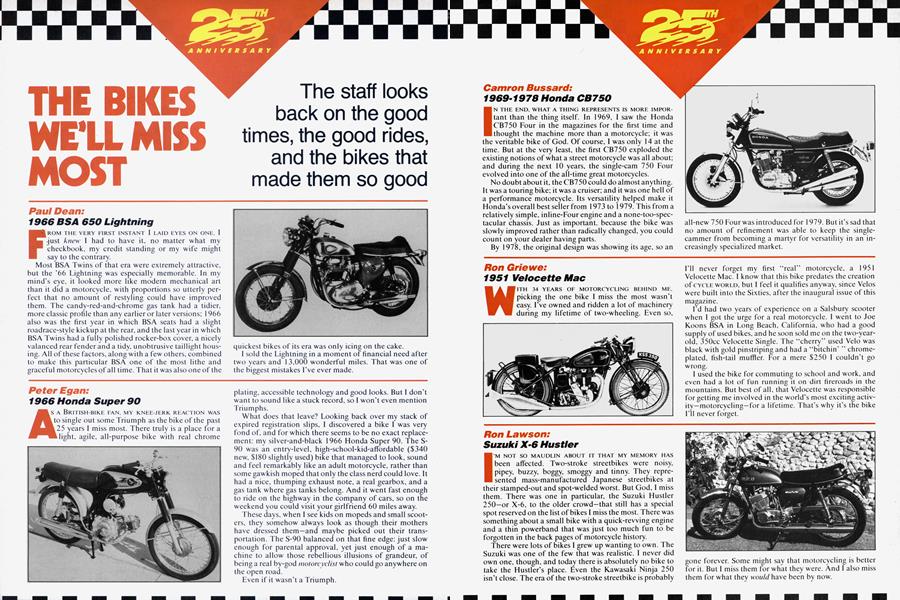
FROM THE VERY FIRST INSTANT I LAID EYES ON ONE, I just knew I had to have it, no matter what my checkbook, my credit standing or my wife might say to the contrary. Most BSA Twins of that era were extremely attractive, but the ’66 Lightning was especially memorable. In my mind’s eye, it looked more like modern mechanical art than it did a motorcycle, with proportions so utterly perfect that no amount of restyling could have improved them. The candy-red-and-chrome gas tank had a tidier, more classic profile than any earlier or later versions; 1966 also was the first year in which BSA seats had a slight roadrace-style kickup at the rear, and the last year in which BSA Twins had a fully polished rocker-box cover, a nicely valanced rear fender and a tidy, unobtrusive taillight housing. All of these factors, along with a few others, combined to make this particular BSA one of the most lithe and graceful motorcycles of all time. That it was also one of the quickest bikes of its era was only icing on the cake. I sold the Lightning in a moment of financial need after two years and 13,000 wonderful miles. That was one of the biggest mistakes I’ve ever made.
Peter Egan: 1966 Honda Super 90
A BRITISH-BIKE FAN, MY KNEE-JERK REACTION WAS to single out some Triumph as the bike of the past 25 years I miss most. There truly is a place for a light, agile, all-purpose bike with real chrome plating, accessible technology and good looks. But I don’t want to sound like a stuck record, so I won’t even mention Triumphs.
What does that leave? Looking back over my stack of expired registration slips, I discovered a bike I was very fond of, and for which there seems to be no exact replacement: my silver-and-black 1966 Honda Super 90. The S-90 was an entry-level, high-school-kid-affordable ($340 new, $180 slightly used) bike that managed to look, sound and feel remarkably like an adult motorcycle, rather than some gawkish moped that only the class nerd could love. It had a nice, thumping exhaust note, a real gearbox, and a gas tank where gas tanks belong. And it went fast enough to ride on the highway in the company of cars, so on the weekend you could visit your girlfriend 60 miles away.
These days, when I see kids on mopeds and small scooters, they somehow always look as though their mothers have dressed them—and maybe picked out their trans-portation. The S-90 balanced on that fine edge: just slow enough for parental approval, yet just enough of a machine to allow those rebellious illusions of grandeur, of being a real by-god motorcyclist who could go anywhere on the open road.
Even if it wasn’t a Triumph.
Camron Bussard: 1969-1978 Honda CB750
IN THE END, WHAT A THING REPRESENTS IS MORE IMPORtant than the thing itself. In 1969, I saw the Honda CB750 Four in the magazines for the first time and thought the machine more than a motorcycle; it was the veritable bike of God. Of course, I was only 14 at the time. But at the very least, the first CB750 exploded the existing notions of what a street motorcycle was all about; and during the next 10 years, the single-cam 750 Four evolved into one of the all-time great motorcycles.
No doubt about it, the CB750 could do almost anything. It was a touring bike; it was a cruiser; and it was one hell of a performance motorcycle. Its versatility helped make it Honda’s overall best seller from 1973 to 1979. This from a relatively simple, inline-Four engine and a none-too-spectacular chassis. Just as important, because the bike was slowly improved rather than radically changed, you could count on your dealer having parts.
By 1978, the original design was showing its age, so an all-new 750 Four was introduced for 1979. But it’s sad that no amount of refinement was able to keep the singlecammer from becoming a martyr for versatility in an increasingly specialized market.
Ron Griewe: 1951 Velocette Mac
WITH 34 YEARS OF MOTORCYCLING BEHIND ME, picking the one bike I miss the most wasn’t easy. I’ve owned and ridden a lot of machinery during my lifetime of two-wheeling. Even so, I’ll never forget my first “real” motorcycle, a 1951 Velocette Mac. I know that this bike predates the creation of CYCLE WORLD, but I feel it qualifies anyway, since Velos were built into the Sixties, after the inaugural issue of this magazine.
I’d had two years of experience on a Salsbury scooter when I got the urge for a real motorcycle. I went to Joe Koons BSA in Long Beach, California, who had a good supply of used bikes, and he soon sold me on the two-year-old, 350cc Velocette Single. The “cherry” used Velo was black with gold pinstriping and had a “bitchin’ ” chrome-plated, fish-tail muffler. For a mere $250 I couldn't go wrong.
I used the bike for commuting to school and work, and even had a lot of fun running it on dirt fireroads in the mountains. But best of all, that Velocette was responsible for getting me involved in the world’s most exciting activity—motorcycling—for a lifetime. That’s why it’s the bike I’ll never forget.
Ron Lawson: SuzukiX-6 Hustler
I’M NOT SO MAUDLIN ABOUT IT THAT MY MEMORY HAS been affected. Two-stroke streetbikes were noisy, pipey, buzzy, boggy, smoggy and tinny. They represented mass-manufactured Japanese streetbikes at their stamped-out and spot-welded worst. But God, I miss them. There was one in particular, the Suzuki Hustler 250—or X-6, to the older crowd—that still has a special spot reserved on the list of bikes I miss the most. There was something about a small bike with a quick-revving engine and a thin powerband that was just too much fun to be forgotten in the back pages of motorcycle history.
There were lots of bikes I grew up wanting to own. The Suzuki was one of the few that was realistic. I never did own one, though, and today there is absolutely no bike to take the Hustler’s place. Even the Kawasaki Ninja 250 isn’t close. The era of the two-stroke streetbike is probably gone forever. Some might say that motorcycling is better for it. But I miss them for what they were. And I also miss them for what they would have been by now.
Charles Everitt: 1983 Honda CX650 Turbo
ANY STAR WARS FAN WILL KNOW WHY I MOURNED THE passing of Honda’s CX650 Turbo. Because if you got even the slightest thrill out of watching the Millenium Falcon blast into hyperspace, then you intuitively know what’s it like to pull the trigger on Honda’s 1983-model high-tech wonder, the 650 Turbo.
After you hit the throttle, it took a second for things to begin to happen. (“Got to make the time/distance calculations, kid.”) Then, as the boost built, a shuddering started deep down inside the motorcycle, continuing outward until the mirrors themselves were almost fluttering, and then K-Pow! (“Punch it, Chewie!”) The bike would fling itself forward, turbocharger whistling, and you could easily mistake the blur of passing scenery for the blur of a Doppler shift as you reached terminal velocity. It was high drama every time you twisted the throttle, a kinesthetic delight punctuated by the V-Twin’s staccato exhaust beat.
There have been faster motorcycles since then, but to my mind, not one of them has made speed so entertaining, so sensuous. And we’re all the poorer for it. Especially me.
Steve Anderson: 1982-1983 Suzuki GS1100E
IT’S SUCH A SHAME. FOR TWO YEARS. 1982 AND 1983, SUZUki made the best motorcycle ever. Then, in 1984, its replacement was such a step backward that you could only wonder if Suzuki’s designers even understood what they'd had.
The one that was right was the GS1100E. It may have been a UJM, a Universal Japanese Motorcycle, but if so, it was the ultimate refinement of that concept. Dressed in a stylish set of Hans Muth clothes, it looked good. But its bodywork wasn’t what made the GS1100 great; balance did. Its engine, reliable as a hammer, combined great peak power with record-setting mid-range and tractability. Handling, at both low speeds and high, was excellent. Its riding position was right for going anywhere, doing anything, and its seat comfortable enough to sit on all day.
That riding position, especially with the 1100E’s fairly high and wide handlebar, drew some complaints in road tests, but I loved it. It felt like a big (really big) dirt bike, and it responded best if you rode it like one. With the leverage provided by the wide bar, you could just pitch the 1100 into corners, and if the rear tire got a little loose when accelerating out, well, no big deal.
I miss the 1100E; so much so that I find it hard to look at the GSX-R1100 without seeing an E-model lurking within. If Suzuki would just trim that fairing, and lower the pegs, and fit a different handlebar . . ..
Jim Hansen: 1980 Maico 450
MAICO-BREAKO.” MY RIDING BUDDIES USED TO SAY every time I unloaded my favorite mount, a 1980 Maico 450. It was a motocrosser, but I modified it exclusively for trail use and cross-country riding.
The “Breako” nickname was well-deserved, since Maicos had a habit of shedding parts with regularity. But one of the great things about these bikes was that, to be able to trust one out on the trail, its owner had to make a real commitment to preventive maintenance. You and the bike had to become partners of sorts. My 450s (I owned three through the years) proved very reliable if I looked after them and performed major tinkering between rides, and they would reward my tender loving care by being the most confidence-inspiring dirt bikes I’ve ever owned.
Maicos of the late Seventies and early Eighties invented something that mainstream dirt bikes just recently began to get serious about: Handling. When dialed-in, the big, red 450 could make any rider feel like he could do no wrong.
But although the 450 was, unlike today’s bullet-proof bikes, in constant need of attention, it was kind of like a good dog: All I had to do was feed it and pet it, and it would provide faithful service and fond memories long beyond its lifetime. I still miss Old Red.
David Edwards: 1963 BSA Gold Star
SHAKESPEARE SAID IT A LONG TIME AGO: "THAT ISland of England breeds very valiant creatures." The same, I think, can be said about that country’s mechanical creations. Oh, there’s none of
the stylish elegance that the Italians are famous for, and so too is the Germans’ cool technical prowess missing; and anyone who’s cursed in the dark of night at Lucas electrics knows that the British can't hold a candle to the Japanese in terms of efficiency. But every once in a while, England just plain gets it right. I’m thinking of the Supermarine Spitfire, to my eyes the most beautiful airplane ever built, and the Jaguar E-type, the most sensual sports car ever to turn a spoked wheel. I'm also thinking of the BSA Gold Star.
The last Gold Star rolled off the Birmingham assembly line in 1963, one year after CYCLE WORLD first hit the newsstands. I was 8 years old at the time. Even now, 23 years and hundreds of motorcycles later. I've never actually ridden one of those big Singles. I have one, though, a $100 basket case that I bought nine years ago. I'd seen Gold Stars in the magazines and at rallies, and to me they were what a motorcycle was supposed to look like. They were simple, direct and honest, centered around a massive, multi-faceted slab of an engine with cooling fins that went on forever.
I’m in the process of restoring my Gold Star, and when it’s done I’m sure I'll take it out for the occasional Sunday afternoon stroll. More often, though, I see myself going out to the garage, pulling up a lawn chair, popping the tab on a wet-and-cold one and just letting my eyes wander over the Goldie for a half-hour.
You see, someone once said that there will always be an England. That may be true, but there will never be another Gold Star.
Steven L. Thompson: Once and future Britbikes
THE BIKE I MISS THE MOST ISN'T A BIKE, IT'S A WHOLE nation of bikes: Britbikes. I miss some of the Britbikes that were, and all of those that should have been—but never were.
Some that were built after 1962 were just no good. The BSA 441 Victor, for instance, vibrated so badly that we in the motorcycle press decided in 1973 that it defined the extreme limits of human endurance, and so christened our unofficial standard of measurement for vibration in test bikes “the Victor Vibro Scale.”
But the Victor was England's worst, not her best. She had the means to make brilliant motorcycles. What she lacked was key men with the will. And so the Japanese inherited the earth.
For this legacy of motorcycle genius to turn to dust because of the foolishness, incapacity, laziness and greed of a few captains of British industry is the signal tragedy of our community over the last 25 years. That’s why I lament not the passing of any bike I ever rode, but those I never got to ride—and, sadly, never will.