Four For One
FOUR FOR ONE
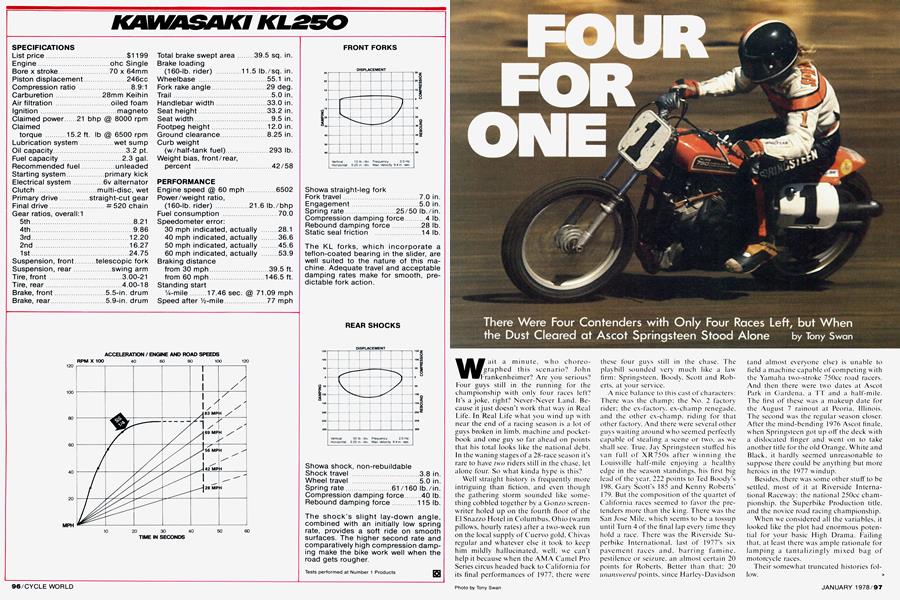
There Were Four Contenders with Only Four Races Left, but When the Dust Cleared at Ascot Springsteen Stood Alone
Tony Swan
Wait a minute, who choreographed this scenario? John Frankenheimer? Are you serious? Four guys still in the running for the championship with only four races left? It’s a joke, right? Never-Never Land. Because it just doesn't work that way in Real Life. In Real Life what you wind up with near the end of a racing season is a lot of guys broken in limb, machine and pocketbook and one guy so far ahead on points that his total looks like the national debt. In the waning stages of a 28-race season it's rare to have two riders still in the chase, let alone four. So what kinda hype is this?
Well straight history is frequently more intriguing than fiction, and even though the gathering storm sounded like something cobbled together by a Gonzo screenwriter holed up on the fourth floor of the El Snazzo Hotel in Columbus, Ohio (warm pillows, hourly rates) after a two-week run on the local supply of Cuervo gold. Chivas regular and whatever else it took to keep him mildly hallucinated, well, we can’t help it because when the AMA Camel Pro Series circus headed back to California for its final performances of 1977, there were
these four guys still in the chase. The playbill sounded very much like a lawfirm: Springsteen, Boody, Scott and Roberts, at your service.
A nice balance to this cast of characters: There was the champ; the No. 2 factory rider; the ex-factory, ex-champ renegade, and the other ex-champ, riding for that other factory. And there were several other guys waiting around who seemed perfectly capable of stealing a scene or two, as we shall see. True. Jay Springsteen stuffed his van full of XR750s after winning the Louisville half-mile enjoying a healthy edge in the season standings, his first big lead of the year. 222 points to Ted Boody’s 198, Gary Scott’s 185 and Kenny Roberts’ 179. But the composition of the quartet of California races seemed to favor the pretenders more than the king. There was the San Jose Mile, which seems to be a tossup until Turn 4 of the final lap every time they hold a race. There was the Riverside Superbike International, last of 1977’s six pavement races and. barring famine, pestilence or seizure, an almost certain 20 points for Roberts. Better than that; 20 unanswered points, since Harley-Davidson
(and almost everyone else) is unable to field a machine capable of competing w ith the Yamaha two-stroke 750cc road racers. And then there were two dates at Ascot Park in Gardena, a TT and a half-mile. The first of these was a makeup date for the August 7 rainout at Peoria, Illinois. The second was the regular season closer. After the mind-bending 1976 Ascot finale, w hen Springsteen got up off the deck with a dislocated finger and went on to take another title for the old Orange, White and Black, it hardly seemed unreasonable to suppose there could be anything but more heroics in the 1977 windup.
Besides, there was some other stuff to be settled, most of it at Riverside International Raceway: the national 250cc championship, the Superbike Production title, and the novice road racing championship.
When we considered all the variables, it looked like the plot had enormous potential for your basic High Drama. Failing that, at least there was ample rationale for lamping a tantalizingly mixed bag of motorcycle races.
Their somewhat truncated histories follow.
THE LAST MILE
OK, having reviewed the foursome that’s supposed to make all these finishes photo, try this name on for size: Skip Aksland. Of course, if you’d dialed in at some earlier point in the season’s second San Jose Mile it could have been any one of six or eight other names. The scorekeepers counted 39 lead changes in 25 laps, making the show look more like a cavalry charge than a race.
It looked as if the cavalry had been doing something other than racing when the grounds crew arrived at mid-week to begin preparations for the coming event. The weekend before the Mile, the Santa Clara County Fairgrounds played host to a rodeo, with the infield serving as a cowand-horse park. On the Monday following the rodeo, the skies over San Jose opened for the first time in recent memory, creating a small but persistent lake in the infield. Wheee-ew! Maintenance men muttered unhappy comments about the odors wafting off the lake and AMA officials wondered whether the clay surface of the track could possibly bake dry in time for the race, but sure enough, everything dried out (talk about your California adobe!) and when Sunday dawned there were all the AMA campaigners along with a sellout crowd (this means something between 15,000 and 17,000, depending on who you talk to) to watch some of the best by-God racing you’re likely to see anywhere.
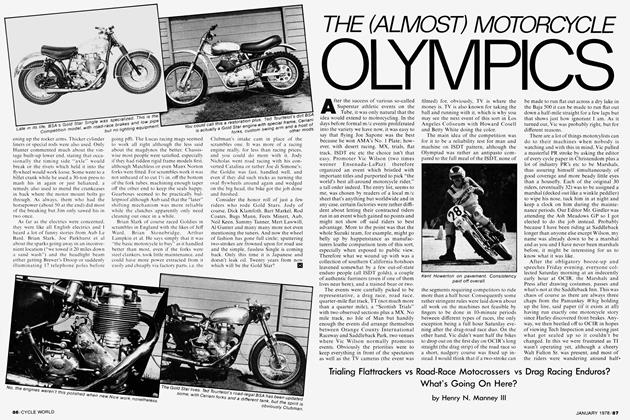
If motorcycle racers ever vote on an alltime Top Ten Tests of Manhood, you better believe the first turn at San Jose will be well up there. Amazing things happen to one’s anatomy in this one little stretch of unpaved roadway; everything that can possibly contract does so, with the exception of the eyeballs, which get very big. You can tell who’s going fast just by watching his entry into this turn (although you can tell who’s likely to win by how he sets up for Turn 3), and it quickly became plain that Aksland was moving quickly amid some of the AMA’s fastest flattrack company. Riding a superbly tuned Harley owned (and endlessly tweaked) by one Stormy Winters of Eureka, California, Aksland was unofficially one of the quickest in practice, and officially 2nd-fastest in qualifying, turning a lap of 37.91 sec., compared to 37.73 for Springer. No one else managed to get around in less than 38, but Steve Eklund, Rex Beauchamp, Mike Kidd, Chuck Palmgren, Hank Scott, Alex Jorgensen (on the only Norton in the field), Boody, Sonny Burres and Gene Romero all came in under 39. Roberts, who hadn’t made it into a dirt track main event for several weeks, blew an engine in qualifying—the head gasket was thought to be the culprit—causing Ken Clark, Babe DeMay, Nick Deligianis and the rest of the Yamaha crew to spring on the monoshocker with low animal cries as they yanked the offending motor out and substituted a fresh one, all in plenty of time for the heat races.
While this was going on, things seemed calm in the Gary Scott camp, even though Gary had qualified a tad slower than Roberts, doing the mile in a not-so-impressive 39.64.
The heats came and went, and Roberts, clearly down on power against the Harleys, found himself getting close to missing yet another show. KR couldn’t hold either Kidd or Springsteen in his heat, but looked to make the transfer with a 3rd-place finish when rookie Garth Brow suddenly sailed past on the outside of Turn 2, pulled the Yamaha down the straight and hung on to ace Roberts at the flag. Aksland won the next one without excessive heroics, followed by Bill Eves and Vince Mead; Hank Scott held off Eklund and Romero in heat three; Corky Keener, Rex Beauchamp and Gary Scott emerged from the fourth.
There remained four starting positions for the main event field, two each from the two semi-final dashes. The first of these wound up being one of the best races of the day as Boody and KR dueled for 2nd place behind Dave Aldana. Roberts’ lesson from the first heat was that the only way he could run with the top Harleys was to ride the high line through the turns, where he was able to do his passing. Boody played right into this strategy on the final lap of the semi, diving deep into Turn 1 before scrubbing off his speed, which gave him an excellent view of the yellow and black Yamaha sailing by on its hot outside line. Boody was able to reel Roberts in again on the back straight, but KR got into Turn 3 just the way he wanted to and took his high line again, getting a better exit from Turn 4 as a result. Boody wound the throttle on with all the leverage of his long right arm, but came up something like two inches short at the flag. (The same thing happened to him in the consolation, where Terry Poovey and Steve Morehead cleverly drafted past the factory Harley in the last third of the circuit.)
The second semi provided something of an emotional respite once Bill Schaeffer’s shift linkage broke oft', leaving the race to Jorgensen on the Norton, followed by David Rush.
Then the Mile was underway with about 16 guys trying to get into Turn 1 simultaneously. Keener, Romero and Gary Scott emerged as most successful at this hairy enterprise, followed by a clot that included Kidd, Hank Scott, Beauchamp, Brow, Jorgensen, Aksland and Roberts. Springer got an awful start, and was looking at this knot from behind.
It’s no exaggeration to say that all of this
changed by the time the pack had made one circuit, but generally speaking the battle at the front through the early laps was between Gary Scott and Eklund with Kidd. Aksland and Roberts—who was laying down a memorable riding lesson that day—working their way up. Kidd fought his way to the front of the parade, with Roberts moving into 2nd at about middistance. KR pressed Kidd for the lead while simultaneously holding off his friend Aksland in a handlebar-rattling contest that cost Aksland his clutch lever, several positions and maybe a year’s growth.
Then KR pressed a trifle too hard going through Turn 3—an overheated monoshock and consequent evil handling was the official diagnosis—and came perilously close to a haybale lunch, losing the draft of the front-running pack in the process. Dodgy handling or no, the Yamaha wasn’t making enough horsepower to catch up and Roberts saw his hopes for a third AMA title dwindling steadily away from him down the San Jose straights.
Aksland. meanwhile, soldiered back to-
ward the front and with five laps to go slid past Kidd to lead—briefly. Hank Scott had entered the picture by that time, and the three of them pecked away at each other until the final lap. when Scott and Aksland both began their sprint to the flag. Aksland managed to draft past Scott going into Turn 3. which isn’t regarded as the cagey way to do it. But Winters had screwed so many horsepower into that Harley that Aksland was able to make it stick in another photo finish. Kidd, meanwhile, got a bit sideways exiting Turn 4 and was thus picked off by the ever-present Springsteen—remember Springsteen?—in the last 100 yards. Tough luck after a mostly brilliant ride. Gary Scott came home 5th ahead of Eklund, Keener, Beauchamp, Brow, Jorgensen and, finally, Roberts.
It was national win number one for Aksland, who looks like an almost certain bet to be wearing that number on his bike one of these seasons. Although he’s know n primarily for his road racing achievements, Aksland proved he’s likely to become a force on dirt tracks as well, particularly the miles.
Aksland or no Aksland, Springsteen wound up the winner insofar as the championship chase was concerned, collecting 13 points to Gary Scott’s 10 and Roberts' 4. C’mon. Springer, you’re messin’ up the drama.
CAMEL PRO SERIES San Jose Mile 25-Lap National
KING OF THE ROAD
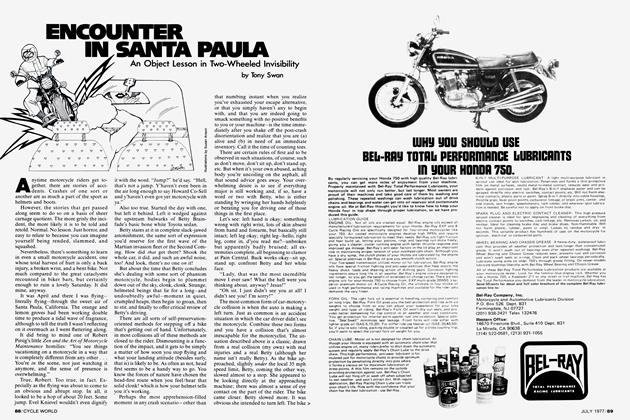
If there was any real mystery to the Riverside Superbike International, it was just how fast Aksland would force KR to go to win it, and that issue went up in a puff of smoke. While everyone else was either packing up or beginning all-night patchup sessions, Aksland and Roberts were staging a little cinema race for the benefit of a movie production company, Roberts on his Sunday bike, Aksland on the Team Yamaha backup. Although Aksland recalled later that he “wasn’t even going all that fast,” he nevertheless got into some sort of trouble in Turn 9, a carousel righthand sw'eeper, and came off the high side, winding up among the haybales. The Yamaha came down with sufficient force to separate it from its fuel tank, which sprayed gas all over the track and promptly burst into flames. Aksland, who was out cold, luckily avoided being the pièce de résistance of this impromptu cookout but did wind up with a cracked collarbone and his right arm broken just above the wrist.
Aksland was back at the track the next day with his right arm all trussed up, looking a little pallid but otherwise sound and surprisingly cheerful. He used the phrase, “I just don’t know w hat happened” 4297 times during the course of the afternoon and wasn’t kidding even once.
About the only other item that lent some intrigue to this meeting was the possible appearance of Springsteen on a road racing Harley-Davidson. Springer allowed as how he was game, and H-D went so far as to schedule some testing at Riverside the Thursday preceding the race. The pre-race pronouncements of Dick O’Brien, a veteran of two decades at the helm of Harley racing, were a study in the semantics of gamesmanship:
“Riverside is a go situation for us,” he said immediately after San Jose. “I’d hate like hell to lose it by one or two points.”
But as Riverside got closer, it was, “Y’know, there’s really no point in having him go out there and risk losing the whole works. No sense in it. It’s not sewed up, but there’s no point in taking unnecessary risks.”
The foregoing made sense, of course, but it didn’t really add much to the promotability of the event. Neither did the fact that a couple of relatively obscure national championships were about to be settled, which led to Sunday’s starting grid crowd being somewhat larger than the little flock of paying customers just across the way in the grandstands.
The first title to be decided was the 250cc Expert class, w here David Emde and Randy Mamola were separated by a single point. For Emde, 1977 had been an endless vista of hard knocks, including one perilous moment in Europe when he came off so hard his heart actually stopped. Obviously, he wasn’t left for dead, and went on to lesser but perhaps more painful lessons, including regular reminders about> when to drag knees and when not to. This last apparently has yet to take, because during practice at Riverside Emde once again whacked his knee on one of those devilish curbings that keep people from short-coursing the corners, and was hobbling around looking rather glum. Mamola had some worries too. Yamaha had flown in a brand new' frame for his final race, and even though it cured the wheelspin that had plagued Mamola in some earlier outings, the front end was showing a tendency to get a trifle light in certain situations.
The everlasting Gary Nixon was on hand, of course, and quickly established himself as the man to beat, which surprised no one. What was surprising was Emde’s charge from 3rd to 2nd on the second lap and thence to the lead five laps later, passing Nixon with amazing ease to do so. Mamola, meanwhile, was having difficulty with his new bike, getting out of shape and dropping to 7th on lap three, and later getting off' entirely while negotiating Turn 3, a rather fast part of the course for testing the abrasion resistance of one's leathers. Exeunt Mamola, unhurt, congrats to Emde. who has a great career of curb testing ahead of him if his knees hold out, not to mention his obvious skills with a motorcycle.
A great horde of novice riders was on hand, marshalled up like locusts waiting for the spring wheat, and when they'd finished flying their 16 circuits of the 2.5mile layout a great army of them had been cast down in varying stages of disrepair. Notable amid this latter group was Mark Jones, who came off'just short of mid-race whilst enjoying a substantial lead. This gave the 1977 novice title to Bruce Sass, who finished 4th behind John Gidney, Gennady Liubinsky and Don Bailey.
As happened so often during 1977, the Superbike Production race was the highlight of the meeting. This began as a showdown between Mike Baldwin’s Moto Guzzi and Reg Pridmore on the Racecrafters Kawasaki, the two of them separated by one point for the best Superbike season, but it was Cook Neilson w ho saved the show when the other two failed to finish. Neilson. who has probably done more for this popular class than anyone around, had the bottom end of his Ducati go away as he pursued Steve McLaughlin and the musclebound Yoshimura Suzuki during one of the Saturday heat races. Neilson and henchman Phil Schilling then spent the night in an engine swap, scavenging the Daytona-winning motor from Cook's street bike.
The chances of anyone catching McLaughlin seemed slim indeed —until Steve’s clutch stopped clutching on the second lap. giving the lead to Wes Cooley on the Yoshimura Kawasaki. Cooley was all by himself by that time, but no one went to sleep because it soon became obvious that Neilson’s street engine was good enough to make a run at the Kawasaki. By lap 12, Neilson had sneaked within a few feet of the leader, and one lap later he managed to slip past. Neilson was a study in smooth as he accomplished this, and it was certainly no reflection on Cooley, who was putting on a very hairy-chested ride. The Kawasaki was clearly pumping out plenty of power, but going through the fast turns just past start/finish its aft portions had more wiggles than a box of rattlesnakes. Cooley ultimately managed to screw it on in traffic between Turns 7 and 8, overtaking a back marker and Neilson in one perilous swoop, and from there til the finish he was not to be denied, even though Cook rode near the ragged edge, giving himself one very bad moment toward the end in Turn 9. Neilson’s 2nd place, ahead of Paul Ritieron another Ducati, also gives him 2nd in the Superbike standings behind Pridmore, and thank you very much Mr. Neilson for some memorable moments.
RIVERSIDE SUPERBIKE INTERNATIONAL 30-Lap National
The main event was pretty anemic by contrast, even though Roberts made a show of pursuing David Aldana for several circuits—to study Aldana’s lines and braking points, he said later. Sure. That’s about as plausible as the entire staff of CYCLE WORLD being appointed Pope. At any rate, following the retirement of first lap leader Nixon (no clutch) Roberts shadowed Aldana through six circuits (of the scheduled 30), then found an extra quarter turn in his throttle and slipped past as they began lap 7. From that point on the other riders saw KR only when the Yellow and black Yamaha whooshed past to lap them. By the end he’d lapped up to 6th place, held by Warren Willing. Aldana, who wasn’t dawdling either, rode home all alone for 2nd, and McLaughlin held off the various assaults of Ron Pierce, Bruce Hammer and Willing to finish 3rd.
It was Roberts’ fifth AMA road racing victory in six starts, which is more than anyone’s ever managed before in a single season. Post-race press box conversation turned on Roberts’ plans for 1978 and they do not seem to include any more frustrating work with Yamaha’s flattrack Twin. Most likely KR will be pursuing international road racing titles in Europe.
Speaking of frustration, Gary Scott was up to his face shield with it after another dismal road race outing. He’d badly needed some sort of points-paying position at Riverside, but after an inauspicious start (he was 25th on the grid) and 25 laps trying to soldier his way up through the pack, (he got no higher than 19th, which is still five positions out of the points) he packed it in with his Yamaha shimmering through its own heat waves. But Ascot Park looked to be much more hospitable to Scott’s aspirations.
THE ASCOT/PEORIA TT
There is this unconfirmed rumor that Gary Scott was actually born a little northeast of Ascot’s third turn and reared under its dismal little stand of palm trees. Maybe so, maybe not, but Gary sure seems familiar with the place, particularly when they’re holding a TT there. In fact, it’s going to seem strange when someone other than Gary wins one. He’d taken four straight going in, and no one was betting against his eight-year-old Triumph, even though Roberts set fastest time in practice.
But then, that sort of thing had been going on all season with KR’s dirt track Yamahas—fast practice times followed by some sort of disaster to keep them out of the main event. And so it proved to be at the Ascot TT, as Roberts led his heat most of the way, only to miss a transfer to even the semi-final when his transmission went solid. The 1977 championship field was thereby cut to three.
For a brief moment before the third heat it looked as though Springsteen might join the TT spectators and thus bring the title chase down to the final night of the season for the second straight year. The magneto on Springer’s Harley went into one of its frequent sulks on the starting grid, leaving the bike completely without zap. However, the malfunction came with just enough time for Springer and head wrench Bill Werner to switch to a backup battery ignition system (a changeover that takes about two minutes total) and the champ was in the show.
About the only other unusual development in the preludes to the main event came in the final heat when Gene Romero had something lock up in Turn 1, sending him over the bars and into the haybales. Besides landing on a wrist, Romero apparently caught the end of one bar in the chest and there was concern for possible internal injury. After a long and worrisome interval of Romero lying rather still on the track, he was carted off to a local hospital where the gents in the white smocks confirmed what Romero already knew: He was sore as hell and wouldn’t be doing any more riding this season.
While Romero was being dusted and repaired, Corky Keener and wrench AÍ Stangler were making excellent use of the respite to do a hasty magneto swap. Keener’s zapper had quit just before Romero came to grief, and the replacement program was successful, keeping Keener alive in the TT. He eventually made the program through the semi-finals.
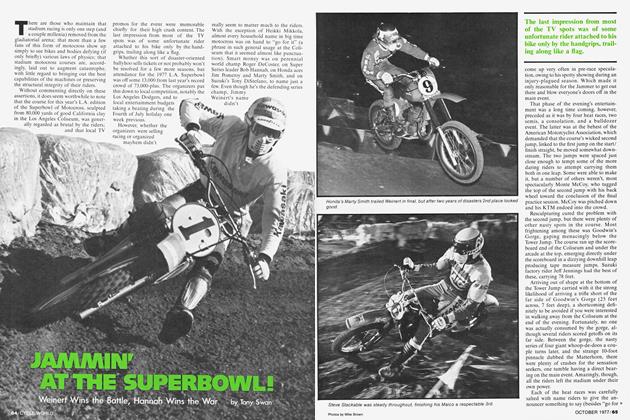
From the point of view of anyone other than Gary Scott, the main event was hardly what you’d call a Thrilling Spectacle. Although Scott hadn’t looked overpowering in practice or his heat race (where he was 2nd behind Alex Jorgensen’s 10-year-old BSA), he quickly re-established his complete mastery of this event in the main, pushing the Triumph quickly out of reach. The battle was all for lesser placings, with Steve Eklund bolting his Yamaha solidly into 2nd on lap five, Mike Kidd’s Harley regaining 3rd when Randy Goss’ Harley stopped with a broken fuel line and Ted Boody stalking Kidd.
Springsteen, who is more at home in flattrack events, rode carefully after an indifferent start, eventually working his way up to 6th (at the expense of Keener, among others) about two inches behind Rick Hocking’s Yamaha. Although 6th place isn’t always an occasion for frenzy on the Harley-Davidson racing team, it was this time because the resultant nine points were more than enough to lock up the championship. Scott, meanwhile, had displaced Boody for 2nd place in the standings and while sponsor Evel Knievel made a few self-serving remarks on the general subject of racing and snickered over some tasteless humor concerning baseball bats, the riders began getting their half-mile machines organized for the season’s finale.
ASCOT TT 25-Lap National
ASCOT HALF-MILE
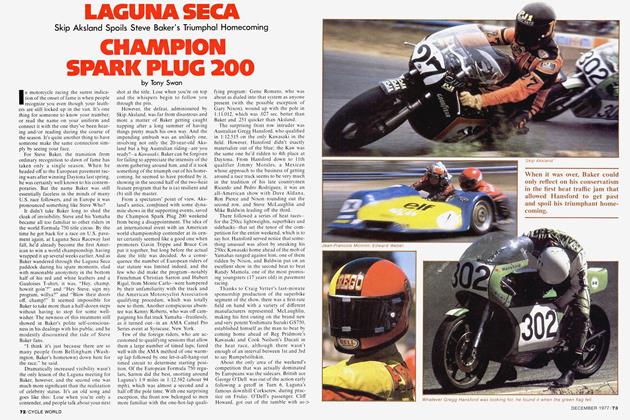
There may have been a strong element of anti-climax in 1977’s last race. But it was far from being dull; we view it more as a taste of things to come this year, as 1977’s Rookie of the Year Garth Brow blew everybody's doors off, breaking Springsteen’s 1976 track records in the process. Brow was nursing a burned hand suffered in Friday’s TT after a tangle with Hank Scott that took both riders out of the hunt. But the injury didn’t seem to have any deterrent effect, psychological or physical, as Brow completely dominated both his heat race and the final.
Springsteen, who wasn’t exactly taking it easy himself despite having the championship sewed up, came home a distant 2nd following retirement by Keener (magneto again) and Hank Scott (blown engine) and was still shaking his head over Brow's performance a few days later. Where Jim Gurnow is finding all that horsepower remains a dark secret, but Brow certainly knows how' to get it down to the ground.
For all the record-setting by Brow (he established new marks in his 10-lap heat race as well as the final), the evening’s greatest struggle occurred in the first semifinal, as Roberts, Scott and Boody all lined up to go for the single transfer position with 2nd place in the season standing the likely prize for making the main event. Roberts was again the fastest qualifier, Scott was 2nd, but whaddaya know, Boody grabbed the lead in the first lap and then benefited for several laps from the furious battle that was going on just behind him. Roberts finally got a trifle high in Turn 1, giving Scott his shot at Boody, but it was too late and the factory Harley got across the line about a length-and-spoke-width ahead of the privateer.
Boody went on to finish 6th in the main, which gave him enough points to boost him back into 2nd place in the season standings.
David Aldana, riding the Ron Wood Norton, was fast and steady throughout the race and eventually finished 3rd, ahead of Rick Hocking and Don Goss. This was good enough to elevate Hocking into the season's top 15, and it seems realistic to expect even more of him in the coming campaign.
Then everyone was standing around Lynn Griffis—who has surely seen more champagne sprayed into the air during her two years as Miss Camel than almost anyone in the world; do you suppose any of these guys know what champagne is really for?—and 1977 was officially consigned to AMA history. It may not have been quite the cliff-hanger of the ’76 edition, but it offered plenty of variety nevertheless. Besides having four riders in contention with four events left, rare enough in itself, the 1977 AMA Camel Pro Series had 11 different winners in 28 dates—six each to Springer and Gary Scott, five (all pavement) to Roberts, three to Mike Kidd, two to Boody, and one each to Steve Baker. John Hateley, Eklund, Randy Skiver, Aksland and Brow.
It certainly makes us look forward to the 1978 wars. See you in Houston.
ASCOT HALF-MILE 20-Lap National
FINAL STANDINGS (Top Ten) For 28-Race Season