Bsa Gold Star Review
BSA GOLD STAR REVIEW
Yamaha’s New 500 Single Has a Tough Act To Follow
Henry N. Manney III
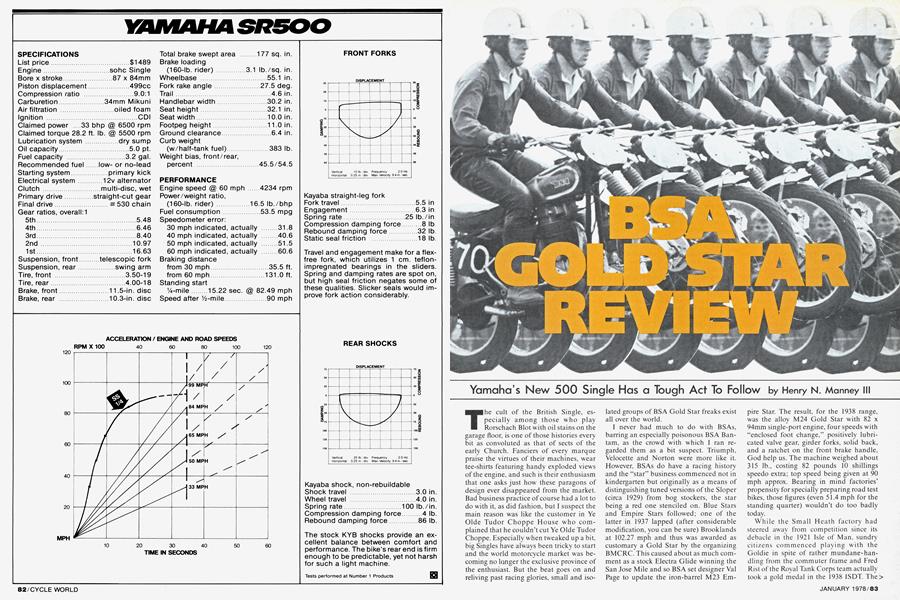
The cult of the British Single, especially among those who play Rorschach Blot with oil stains on the garage floor, is one of those histories every bit as convoluted as that of sects of the early Church. Fanciers of every marque praise the virtues of their machines, wear tee-shirts featuring handy exploded views of the engine, and such is their enthusiasm that one asks just how these paragons of design ever disappeared from the market. Bad business practice of course had a lot to do with it, as did fashion, but I suspect the main reason was like the customer in Ye Olde Tudor Choppe House who complained that he couldn’t cut Ye Olde Tudor Choppe. Especially when tweaked up a bit, big Singles have always been tricky to start and the world motorcycle market was becoming no longer the exclusive province of the enthusiast. But the beat goes on and reliving past racing glories, small and isolated groups of BSA Gold Star freaks exist all over the world.
I never had much to do with BSAs, barring an especially poisonous BSA Bantam, as the crowd with which I ran regarded them as a bit suspect. Triumph, Velocette and Norton were more iike it. However, BSAs do have a racing history and the “star” business commenced not in kindergarten but originally as a means of distinguishing tuned versions of the Sloper (circa 1929) from bog Stockers, the star being a red one stenciled on. Blue Stars and Empire Stars followed; one of the latter in 1937 lapped (after considerable modification, you can be sure) Brooklands at 102.27 mph and thus was awarded as customary a Gold Star by the organizing BMCRC. This caused about as much comment as a stock Electra Glide winning the San Jose Mile and so BSA set designer Val Page to update the iron-barrel M23 Empire Star. The result, for the 1938 range, was the alloy M24 Gold Star with 82 x 94mm single-port engine, four speeds with “enclosed foot change,” positively lubricated valve gear, girder forks, solid back, and a ratchet on the front brake handle, God help us. The machine weighed about 315 lb., costing 82 pounds 10 shillings speedo extra; top speed being given at 90 mph approx☺. Bearing in mind factories’ propensity for specially preparing road test bikes, those figures (even 51.4 mph for the standing quarter) wouldn’t do too badly today.
While the Small Heath factory had steered away from competition since its debacle in the 1921 Isle of Man. sundry citizens commenced playing with the Goldie in spite of rather mundane-handling from the commuter frame and Fred Rist of the Royal Tank Corps team actually took a gold medal in the 1938 1SDT. The war then put a damper on things but afterward BSA fitted telescopic forks first to the iron B32 350 and then in 1948 to the 85 x 88mm B34 500 derived from it. Many people don’t realize that Beezers probably sold more 350s than 500s and in fact the 350 got an alloy barrel and head in 1948. With the advent of plunger rear springing in the late Forties, these ZB Gold Stars were still not to be mistaken for International Nortons but began to give a very good account of themselves in the hands of private owners, especially in “trials” (for which read enduros) and production or Clubman’s racing. Such successes were largely because of BSA’s good sense in offering a wide range of high-performance equipment at reasonable prices while ensuring that the basic Goldie was strong enough to stand the gaff. For example. Clubman mods included a new head with 1 '/i6-in. inlet port, ditto TT 10 Amal. a high-eompression 7.5:1 piston (pool petrol!). trick cams, closer gearbox ratios. folding kick starter etc. etc; pretty heady stuff for a simple pushrod Single. Brian Slark says that you could buv one over the counter all done up and I think that Triumph offered much the same sort of arrangements with its Tiger 100. a setup that suited the thousands of impecunious amateur tuners and racers very well.
Inevitably an alloy Gold Star 500 was produced in 1949. noted by a concerted sigh of relief from customers tired of stuck pistons, and whereas it picked up about 10 golds in the ISDT. w:as nowhere near as great a success in Clubman racing as the 350 had been. However the design office, reputedly living out of one engineer’s pockets, persevered and for 1951 swing arm rear suspension became available as well as a slightly redesigned engine with die-cast cylinders and heads, the rocker boxes now being detachable instead of cast-in. By 1952 the BB series short(er) stroke engine was introduced, the object being greater piston and valve area, coupled with a new^er swing arm duplex frame that immediately paid dividends in that year’s ISDT and the Scottish Trial, among others. The IOM Clubman’s races were still a 350 Goldie benefit but as a result of a promising showing by ISDT rider Eddie Dow in the Senior, BSA decided to lean heavily on the 500BB and retained Roland Pike of Rudge fame to breathe upon it. The result was the “wine jug” CB model with much larger finning, yet shorter stroke so that the flywheels were oval to miss the piston skirt, eccentric rocker spindles for valve adjustment and a GP Amal. The rev limit now went up 400 rpm to 6600 and a massive 37 hp wras produced for the 500 (30 for the 350). enough to produce a double clean sweep in both classes for the Clubman’s in 1954. La. Not satisfied, Small Heath then produced the neated-up DB with bigger carb and valves, with the result that 7000 could be pulled in top. Next steps were a full-w idth front brake, 1 '/2-in. Amal, a craftv megaphone-cum-silencer to beat the regs, plus the usual detail modifications until the Clubman’s races (according to Bruce Main-Smith’s informative Gold Star book) died a natural death because they had become a BSA benefit.
Parallel with the road racing development went the Triumphs (oops, successes) of the scrambling or dirt versions, more of interest to customers in the USA. but eventually time caught up w ith the Goldie and production was halted in 1964. The parent B31 and B33 roadsters on which the Gold Star w;as based had been discontinued, mostly because the obsolete design just wasn’t selling and at this point BSA didn’t think it economical to continue a limited production run of semi-competition machinery. Emphasis shifted to the 441 “Victim” plus the Twins. Time has shown that they signed their own death warrant.
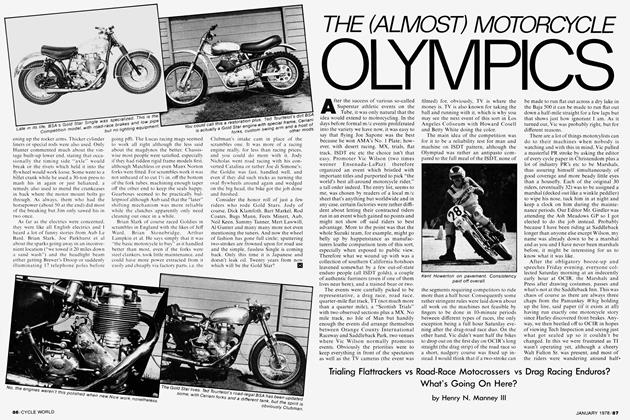
All in all it was a pretty remarkable performance of getting such results out of a basically early Thirties design, one that inspired fanatical loyalty, and we talked to a lot of people trying to find out why. Gold Star specialist Jim Hunter, who supplies parts and information all over the country, was very informative and has certainly had the experience, winning the No. 1 plate (Dist. 37 1 think) at the advanced age of 41 on one. Jim states that they “were the most popular thing there was at that time” although Matchless and AJS freaks might disagree. Generally frames were run stock as there were very few special ones in those days and were reinforced where they broke, usually at first in back under the oil tank. If run too long, they became a mass of gussets. In spite of the Matchless being better in the desert because it was lighter and the forks more supple, the Goldie could be made to produce more power and had a more lively response because the flywheels were lighter. Matter of riding style as much as anything else I suppose.
As time passed the Catalina scrambler became available, the U.S. and particularly California market being valuable in keeping BSA above water, and it was a good starting point with its l3/i6-in. Amal, small ports and two exhaust cams for torque. The usual hop-up business was flourishing as Harman and Collins made cams with press-on gears for altering timing, several specialists including AÍ Gunter fabricated roller tappets, and the market was thriving for special pistons of course. The engine w as fundamentally reliable if a bit of a shaker (although one famous tuner said it was “no damn good”): lots of lock washers, removal of the head steady and safety wiring were called for. Engine work basically was careful assembly although if one w'ere serious about speed there were head mods like fitting a 1 'Vi6-in. inlet valve which “was optimum.” S& W valve springs were the trick setup even in England. U-in. dia. alloy pushrods were popular, while if time and money were available hard chrome w'as put on valve stems, cam spindles. idler gear spindles etc. besides lightening up the rocker arms. Thicker cylinder liners or special rods were also used. Only Hunter commented much about the vintage built-up lower end. stating that occasionally the timing side “axle” would break or the rivets which held it into the flywheel would work loose. Some went to a billet crank while he used a 30-ton press to mash his in again or just heliarced. a remedy also used to mend the crankcases in back where the motor mount bolts go through. As always, them who had the horsepower (about 50 at the end) did most of the breaking but Jim only saw'ed his in two once.
As far as the electrics w'ere concerned, they were like all English electrics and 1 heard a lot of funnv stories from Aub Le Bard, Brian Slark, Joe Parkhurst et al about the sparks going away in an inconvenient location (“we towed it 20 miles down a sand wash") and the headlight beam either getting Brewer’s Droop or suddenly illuminating 17 telephone poles before
going pfft. The Lucas racing mags seemed to work all right although the less said about the magdynos the better. Chassiswise most people were satisfied, especially if they had ridden rigid frame models first, although Matchless or even Manx Norton forks were fitted. Lor scrambles work it was not unheard of to cut 1 Vi in. off the bottom of the fork tubes, machining enough taper off the other end to keep the seals happy. Gearboxes seemed to be practically bulletproof although Aub said that the “later” shifting mechanism was more reliable while the clutches apparently only need cleaning out once in a while.
Brian Slark of course raced Goldies in scrambles in England with the likes of Jeff Ward. Brian Stonebridge. Arthur Lampkin et al. He says simply that it was “the basic motorcycle to buy” as it handled better than most, even if the forks w'ere steel clankers. took little maintenance, and could have more power extracted from it easily and cheaply via factory parts, i.e. the
Clubman's intake cam in place of the scrambles one. It was more of a racing engine really, for less than racing prices, and you could do more with it. Jody Nicholas w'ent road racing with his converted Catalina or rather Joe di Simone’s; the Goldie was fast, handled well, and even if they did such tricks as turning the oval flvwheels around again and wedged on the big head, the bike got the job done and finished.
Consider the honor roll of just a few riders who rode Gold Stars. Jody of course, Dick Klamfoth, Bart Markel, Rod Coates, Bugs Mann, Leets Minert, Aub, Neil Keen, Sammy Tanner, Mert Lawwill, AÍ Gunter and many many more not even mentioning the tufters. And now the w heel of fashion has gone full circle; sputtering two-strokes are frowned upon for road use and the simple, fussless Single is coming back. Only this time it is Japanese and doesn’t leak oil. Twenty years from now which will be the Gold Star?