Roundup
ROUNDUP
WHY COPYING DOESN'T COME EASILY
One of the more reliable staples in the tester's notebook is a remark or two in re the various new ideas displayed by one factory and not the others. Either we praise a nifty new gadget and hint that rival firms will have the same thing shortly, or we complain because the first outfit had theirs last season and the others haven’t gotten around to it yet.
One of the ranking men in one of the U.S. distributorships for a Japanese manufacturer—no names, because that doesn't matter—was visiting the office recently and he gave a new look at what gets copied and why it can take such a long time.
It’s a matter of patent laws. The Japanese have them and they are quite different from the U.S. patent laws.
In the U.S. an inventor can patent a device, and onlv a device. A concept cannot be patented. If. say. you come up with custom bodies which fit right atop a VW chassis, why. everybody and his brother can offer kits just like yours and you will go broke, which is what happened to the man who dreamed up the dune buggy, by the way.
And our laws limit the time for which a patent is good.
In Japan, a concept can be patented. The first man to come up with, oh, a helmet hook that uses the seat base as the lid owns that idea. Doesn't matter if the bright guys in the other firms can devise umpty-12 other ways of using the seat base for the helmet holder, first man there owns the concept.
Nor do the Japanese patents run out. You do it first, you got it for keeps.
This isn't to say the Japanese system is better. There were and are good arguments to be made for both principles.
What matters to motorcycle buyers is that there's no sense in Honda or Yamaha or whomever trying to beat each other’s patents. Can’t be done. Nor is there any point in waiting the inventor out. If the other guys decide they, too. must have a self-canceling turn signal or some such, they must pav royalties on it and that means they’re liable to wait until the market truly justifies it or they can put it on a new model or something.
So. That’s why the improvements take longer than we expect and we hereby resolve to be a little more patient in demanding better games of catch-up from the factories.
EARL’S COURT EXPOSED
If you started riding motorcycles in the 1950s or early Sixties your heart beats just a little faster when you hear Earl's Court mentioned. It was, after all. the motorcycle show of the year and all of the major manufacturers would show their new models.
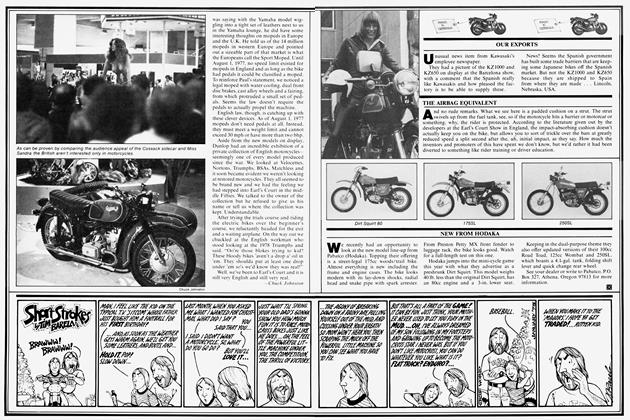
While we know the hub of the motorcycle world has moved elsewhere. Earl's Court remains one of the industry’s major show's. So it was with some excitement that I stepped out of the London subway station and looked across the street at the Earl’s Court exhibition hall. Because it was press day and a day before opening, we were prepared to step over extension cords, saw's, hammers and partially completed booths but what we were not prepared for was what the English quaintly call a “photo call.” At least once an hour the public address system would say something like “In 15 minutes Miss Sandra will show all at the Samaguchi booth.” Workmen stopped hammering, conversations stopped between journalists and manufacturers and everyone walked briskly toward the Samaguchi booth where if you were 6'4" you could watch a topless model climb onto a motorcycle. I don’t consider mvself a prude and living in a southern California beach town has shown me my share of female bodies in bikinis but my oh my. Miss Sandra!
Semi-oblivious to the hourly spectacles, Stirling Moss and Mike Hailwood sat on displayed motorcycles and Hailwood confided he was serious about looking for a ride in next year’s Isle of Man TT. Barry Sheene had a much photographed chat with the Minister of Transportation and was much at ease when posing with pretty girls. Like CYCLE WORLD says, experience makes the difference.
We were surprised at the number of motorcycles on display that aren’t sold in the U.S. because of marketing predictions or DOT requirements on lighting and emission controls. The Russian Cossacks are just one example of this and after looking carefully at the bikes, we can’t believe they would be anything but popular in the U.S. Imagine a nearly identical copy of a Werhmacht-style BMW complete with military-style sidecar for £ 749 ($1300). The engine is a 650cc opposed Twin and John Garfield, vice president of Cossacks Motorcycles in England, frankly admits the Russians found an abandoned BMW sidecar rig when the Germans left Stalingrad rather hurriedly and have been producing them for the Eastern Bloc countries ever since. The bikes have been selling well in the U.K. and we saw several on the road.
The complete line seemed to be a bit on the rustic side but the finish was certainly pleasing and workmanship, while not up to current BMW standards, was evident. Cossack executives related that they are ready to start on the U.S. market as soon as the Russians will pay for a U.S. testing program with the DOT.
Paul Butler of Yamaha in Amsterdam talked to us about the Yamaha line and as hard as it w^as to concentrate on what Paub was saying with the Yamaha model wiggling into a tight set of leathers next to us in the Yamaha lounge, he did have some interesting thoughts on mopeds in Europe and the U.K. He told us of the 14 million mopeds in western Europe and pointed out a sizeable part of that market is what the Europeans call the Sport Moped. Until August 1, 1977, no speed limit existed for mopeds in England and as long as the bike had pedals it could be classified a moped. To reinforce Paul’s statement, we noticed a legal moped with water cooling, dual front disc brakes, cast alloy w'heels and a fairing, from which protruded a small set of pedals. Seems the law doesn’t require the pedals to actually propel the machine.
English law, though, is catching up with these clever devices. As of August 1, 1977 mopeds don’t need pedals at all. Instead, they must meet a weight limit and cannot exceed 30 mph or have more than two bhp.
Aside from the new models on display, Dunlop had an incredible exhibition of a private collection of English motorcycles— seemingly one of every model produced since the war. We looked at Velocettes, Nortons, Triumphs, BSAs. Matchless and it soon became evident we weren't looking at restored motorcycles. They all seemed to be brand new and we had the feeling we had stepped into Earl’s Court in the middle Fifties. We talked to the owner of the collection but he refused to give us his name or tell us where the collection was kept. Understandable.
After trying the trials course and riding the electric bikes over the beginner’s course, we reluctantly headed for the exit and a waiting airplane. On the way out we chuckled at the English workman who stood looking at the 1978 Triumphs and said, “Oo're those blokes trying to kid? These bloody bikes ’aven’t a drop a' oil in 'em. They shoulda put at least one drop under 'em so's we'd know they was real!”
Well, we’ve been to Earl’s Court and it is still very English and still very real.
— Chuck Johnston
OUR EXPORTS
Unusual news item from Kawasaki’s employee newspaper.
They had a picture of the KZ1000 and KZ650 on display at the Barcelona show, with a comment that the Spanish really like Kawasakis and how pleased the factory is to be able to supply these.
News? Seems the Spanish government has built some trade barriers that are keeping some Japanese bikes off the Spanish market. But not the KZ1000 and KZ650 because they are shipped to Spain from where they are made . . . Lincoln, Nebraska, USA.
THE AIRBAG EQUIVALENT
And no rude remarks. What we see here is a padded cushion on a strut. The strut swivels up from the fuel tank, see, so if the motorcycle hits a barrier or motorcar or something, why, the rider is protected. According to the literature given out by the developers at the Earl’s Court Show in England, the impact-absorbing cushion doesn’t actually keep you on the bike, but allows you to sort of trickle over the bars at greatly reduced speed a split second after the, uh, initial impact, as they say. How much the inventors and promoters of this have spent we don’t know, but we'd rather it had been diverted to something like rider training or driver education.
NEW FROM HODAKA
We recently had an opportunity to look at the new model line-up from Pabatco (Hodaka). Topping their offering is a street-legal 175cc woods/trail bike. Almost everything is new including the frame and engine cases. The bike looks modern with its lay-down shocks, radial head and snake pipe with spark arrester.
From Preston Petty MX front fender to luggage rack, the bike looks good. Watch for a full-length test on this one.
Hodaka jumps into the mini-cycle game this year with what they advertise as a preshrunk Dirt Squirt. This model weighs 40 lb. less than the original Dirt Squirt, has an 80cc engine and a 3-in. lower seat.
Keeping in the dual-purpose theme tney also offer updated versions of their lOOcc Road Toad, I25cc Wombat and 250SL, which boasts a 4.1-gal. tank, folding shift lever and quick change rear wheel.
See your dealer or write to Pabatco, P.O. Box 327, Athena, Oregon 97813 for more information.