Bultaco 125 Pursang Six-Speed
BULTACO 125 PURSANG SIX-SPEED
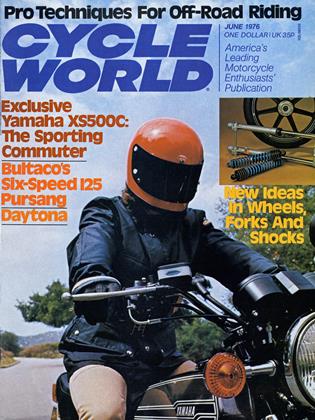
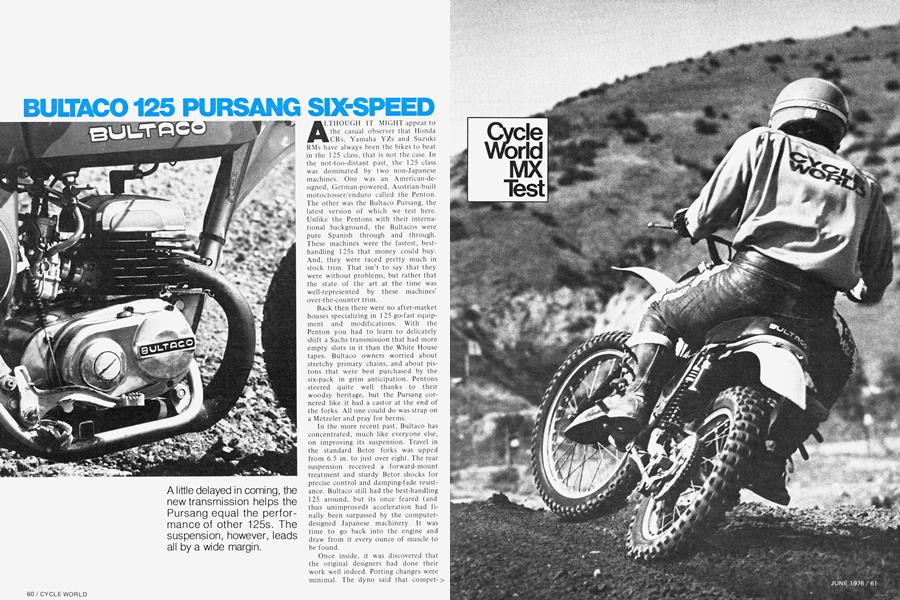
A little delayed in coming, the new transmission helps the Pursang equal the perfor-mance of other 125s. The suspension, however, leads all by a wide margin.
ALTHOUGH IT MIGHT appear to the casual observer that Honda CRs, Yamaha YZs and Suzuki RMs have always been the bikes to beat in the 125 class, that is not the case. In the not-too-distant past, the 125 class was dominated by two non-Japanese machines. One was an American-designed, German-powered, Austrian-built motocrosser/enduro called the Penton. The other was the Bultaco Pursang, the latest version of which we test here. Unlike the Pentons with their interna-
tional background, the Bultacos were pure Spanish through and through. These machines were the fastest, besthandling 125s that money could buy. And, they were raced pretty much in stock trim. That isn’t to say that they were without problems, but rather that the state of the art at the time was well-represented by these machines’ over-the-counter trim.
Back then there were no after-market houses specializing in 125 go-fast equipment and modifications. With the Penton you had to learn to delicately shift a Sachs transmission that had more empty slots in it than the White House tapes. Bultaco owners worried about stretchy primary chains, and about pistons that were best purchased by the six-pack in grim anticipation. Pentons steered quite well thanks to their woodsy heritage, but the Pursang cornered like it had a castor at the end of the forks. All one could do was strap on a Metzeier and pray for berms.
In the more recent past, Bultaco has concentrated, much like everyone else, on improving its suspension. Travel in the standard Betor forks was upped from 6.5 in. to just over eight. The rear suspension received a forward-mount treatment and sturdy Betor shocks for precise control and damping-fade resistance. Bultaco still had the best-handling 125 around, but its once feared (and thus unimproved) acceleration had finally been surpassed by the computerdesigned Japanese machinery. It was time to go back into the engine and draw from it every ounce of muscle to be found.
Once inside, it was discovered that the original designers had done their work well indeed. Porting changes were minimal. The dyno said that compet-> itive power was present, so something was obviously awry between the engine and the rear wheel. The five-speed transmission was circular-filed and the redesigning began.
Cycle World MX Test
BUEF~O 125
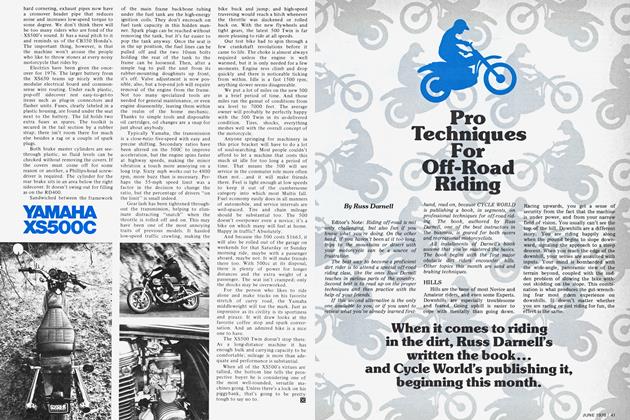
In this day and age, a five-speed gearbox on a 125 motocrosser is positively archaic, from both technical and marketing standpoints. Yamaha found that out on its first YZs and now Suzuki has discovered it with its RMs. Six speeds are a must to keep these peaky mills buzzing contentedly.
The change from a fiveto a sixspeeder is not drastic from an engineering perspective. Since each shift fork operates a maximum of two gears, a five-speed transmission already has three shift forks in it. Bultaco redesigned the shift drum, selected new ratios and then put the whole thing back into the cases. Not an easy job, but far simpler than trying to go from a fourto a five-speed as Maico and CZ have recently done on their bigger machinery. On the 125 Bui, the extra cog in the trans turned the trick. The Pursang is back in the thick of things.
The new transmission receives the engine’s power through a double-row primary chain. The standard chain is still not one of extreme quality, but the vastly superior replacement chain manufactured by Diamond will give many additional hours of life before requiring replacement.
With the help of a few porting changes and a new pipe and carburetor, peak engine power has been relocated from 10,000 rpm to nearly 12,000. Since the bore and stroke of the engine remain unchanged at 51.5 and 60, respectively, the increased rpm means that the piston will be traveling at better than 4150 feet per minute at the top of each gear. This certainly won’t do anything to extend piston life, despite a higher quality piston. Even though pistons will have to be changed regularly on the new Bui in order to maintain an efficient engine, we doubt that it will be more often than the twice-a-month ritual necessary to keep some of the more highly-strung Japanese small-bores going.
Most of the chrome-moly chassis remains unchanged. And it should, because it is one of the sturdiest ever encountered on a machine of this size. There is a minor change in the location of the lower shock mounts. Whereas last year’s Pursangs all sported radically forward-mounted shocks bolted almost halfway up the swinging arm in a near-vertical position, the new ‘Sang reverts back to a position with a more conventional shock angle, though still sufficiently forward of a conventional position.
To obtain the range of axle movement necessary to keep its machine competitive, Bultaco has gone to long Betor gas shocks. The dampers are nearly 15 inches long, possessing almost five inches of movement themselves, which translates to more than six inches at the axle.
Like all the new Pursangs, the 125 carries Sherpa T hubs. While we didn’t think at first that hubs and brakes taken from Bultaco’s trials bike would be either strong or efficient enough for motocross work, we were wrong. Both ends of the Bul have fine stoppers. The rear unit has been updated to cableoperated, full-floating status. Up front, the binder has a very confidenceinspiring progressive feel. Spokes on both ends loosened up as we rode, but this was attributable to the stretching of the spokes and settling in of the nipples on the ridgeless Akront rims rather than to any weakness in the hubs themselves.
There has been a cosmetic change in the front forks. Both lower sliders have lost their polished look and received instead a coat of black paint. At the base of each fork leg are cast-in cooling fins to keep the fork oil from overheating. Our experiences with Betor forks tell us that these are more for looks than practicality, since the silky smooth action provided doesn’t create enough heat to cause any noticeable damping fade. Still, it looks trick.
Styling is outstanding. The Spanish produce some of the most gorgeous motorcycles in the world. The silver-onred layout of the 125 is yet another example of their artistry. White fenders are found front and rear. The forward mung blocker is plastic (at last) but the rear one is still fiberglass, as are the fuel tank and side panels.
The powerplant housed amid all the chrome-moly tubing and fiberglass is quite responsive. The engine runs crisply, metered cleanly by the 30mm Bing carburetor. We found the gearing to be on the tall side for most of the tracks on which we tested, but the Bultaco pulled it without any complaints. We simply couldn’t use all the gears in the transmission. Most Pursang riders we talked to said they like to use anywhere from a 54to a 60-tooth rear sprocket, depending on the track. With such gearing, they can take advantage of all the gears in the tranny and not be forced to wring each gear to its absolute maximum in order to ensure engaging the succeeding gear with the engine “on the pipe.”
Steering geometry is right on the money. Even with the sketchy Pirelli front tire, the ‘Sang sticks to its chosen line very well. The new 4.10-18 rear knobby doesn’t look particularly mean just setting there, but it sure hooks up to the ground when you gas it. And there’s a good supply of sidewall knobs for traction when laying the baby Bui over, sliding it into a turn to the exact point you want it.
Jumps are a breeze. Not once in the time we had it did the 125 try to pull something funny on us. It launches perfectly and lands with directional authority. Nothing fancy here, just crisp, clean and fast.
As for keeping up with the competition, the Bultaco is faster than most 125s thanks to its generous gearing. But this gearing is also what makes it marginally slower to accelerate than the Japanese 125s. Regearing cures this. But there’s one thing that the Bui has over every other 125 we’ve ever tested. Its handling is so smooth, so precise and so pure that you are deceived into thinking you’re going slower than you really are. You don’t drive the Pursang around a track, you ride it. It knows how to corner, it knows how to slide, it jumps with the no-nonsense attitude of a bullet in flight, and it brakes perfectly. It demands less of the rider, yet delivers more per ounce of rider effort. It is immediately intimate and infinitely forgiving. Riders develop an instant rapport with the machine. You guide it and it does the work for you.
It is for these reasons that we liked the 125 Bultaco Pursang. We know that it is a machine that just about anyone could enjoy. But it’s the way you look at the sport and how you feel about yourself as a person and a racer that will determine whether these reasons are enough to make you turn over the extra $300 your Bultaco dealer is going to ask for this silver and red beauty. [0
BULTACO 125 PURSANG SIX-SPEED
$1385
SUSPENSION DYNO TEST
Description: Bultaco/Betor fork with HD-31 5 oil Fork travel, in.: 8.0 Engagement, in.:. 2.68 Spring rate, lb./in.: 18 Compression damping force, lb.: 7 Rebound damping force, lb.: 19 Static seal friction, lb.: 30 (see remarks)
Remarks: A couple of years back, Betor forks were infamous for leaking oil. Unfortunately, when Bultaco demanded correction of this problem, another was created: excessive static seal friction. The new seal to prevent oil leakage has three lips. The uppermost lip is designed to keep oil that gets by the scraper from entering the rest of the seal. This lip is responsible for most of the 30 lb. of seal friction present. With this portion of the seal in place, it was impossible to plot the viscous damping curve, so it was removed. The viscous compression damping rate of 7 lb. and the rebound rate of 19 lb. are both too light for the 18-lb. spring. Heavier oil is the cure, since the viscous damping ratio is correct With the oil change it will be necessary to replace the stock fork seals because the combination of high seal friction and increased viscous compression damping would be too much. We recommend these changes, even though the forks work well
in stock configuration, because less friction and total reliance on viscous damping for control is a better way to go. Engagement is less than the 3~in. minimum most manufacturers consider adequate for strength. To prevent breakage with only 2.68 in. of engagement, Bultaco has cast front and rear strengthening ribs into its slider. Do not extend the travel in these forks.
Description: Gas/oil Betor shock Shock travel, iii.: 3.75 Wheel travel, in.: 6~25 Spring rate, lb./in.: 98 Compression damping force, lb.; 40 Rebound damping force, lb.: 84
Remarks: For the mechanical advantage of 1 .6: 1, 40 lb. of compression damping is good. Rebound damping force should be 20 lb. higher for optimum control of the 98-lb. spring rate. The dual spring combination should provide a progressive rate but doesn't in this application. The reason is this: the soft spring does not coil bind until approximately 3.5 in. of shock travel is used up. Bottoming occurs before the stiff spring is compressed enough to influence the rate.
Tests performed at Number One Products