Honda Cr125m2
HONDA CR125M2
Cycle World MX Test
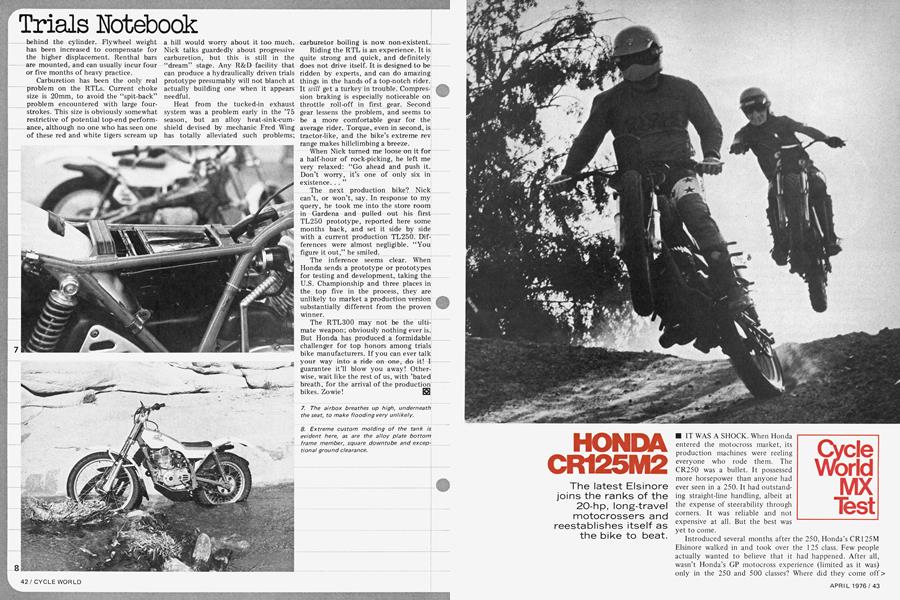
The latest Elsinore joins the ranks of the 20-hp, long-travel motocrossers and reestablishes itself as the bike to beat.
■ IT WAS A SHOCK. When Honda entered the motocross market, its production machines were reeling everyone who rode them. The CR250 was a bullet. It possessed more horsepower than anyone had ever seen in a 250. It had outstanding straight-line handling, albeit at the expense of steerability through corners. It was reliable and not expensive at all. But the best was yet to come.
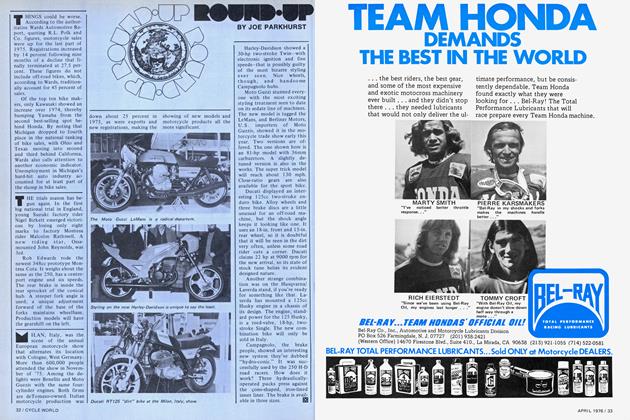
Introduced several months after the 250, Honda’s CR125M Elsinore walked in and took over the 125 class. Few people actually wanted to believe that it had happened. After all, wasn’t Honda’s GP motocross experience (limited as it was) only in the 250 and 500 classes? Where did they come off > making a 125 as good as the Elsinore? Are the megabuck computers that much help in designing motocrossers, machines whose purpose is so lacking in constants as to make the average engineer or physicist slip his slide rule? Apparently so. And while the rest of the world sat around for a while, trying to recover from the shock, Honda sold literal boatloads of the little buzzers.
But not everyone reeled for very long. Soon after, TM Suzukis and YZ Yamahas were in the hunt. Kawasaki introduced the KX125, which had a stock motor superior to the Honda’s, but there was insufficient aftermarket racing equipment to keep the Kaws competitive. Yamaha updated its five-speed YZ with a six-speed monoshocker. Suzuki followed with its RM125. In the meantime, Honda’s 1975 Elsinore came with a different cylinder that had more horsepower, a new exhaust pipe, sturdier shock absorber shafts (although the shocks remained in their conventional position) and a new paint job. The gap between the Elsinore and the rest of the 125 world was shortened, and in some cases, eliminated entirely.
This year, however, Honda returns with more than just a few new doodads to dazzle the buyers. This year they’ve got a completely new machine, and from what we discovered during the weeks we thrashed it, they’ve done their homework well.
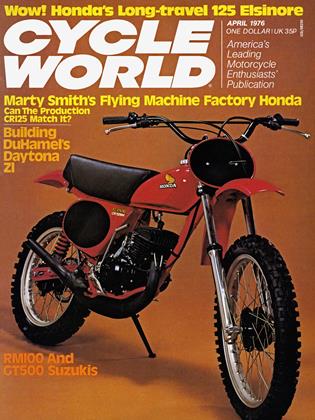
The CR125M2 is, undoubtedly, the most attractive motocrosser of any size on the market. Done in Honda racing red with black accents, the machine’s paint scheme is as starkly simple as the Elsinore’s purpose. . .motocross. Wherever we went with the test bike, everyone spotted it immediately. Those who had'their ‘74 and ‘75 CRs painted red in an effort> to make them look as much like the factory race bikes as possible, still spotted the machine as “something special.”
Powering the Honda is the trusty two-cycle Elsinore power plant. Cylinder finning is heavier this year—as is the finning on the head—for greater heat dissipation, a problem that plagued earlier Hondas. Internally, most of the porting appears to be identical to that in the ‘75 cylinders, with the exception of a much larger and slightly reshaped exhaust port. The increased volume of the exhaust port is partially responsible for the incredibly high rpm that the engine will turn. A peek at the dyno chart in the following sidebar will show you that maximum horsepower was achieved at a shrill 11,000 rpm. Feeding the cylinder all the way through the rpm range is a 30mm Keihin carburetor that replaces the standard 28mm jug of years past.
The cylinder head has a totally new design. The squish area has been tightened up, to improve combustion, but the compression ratio has dropped slightly from 7.6:1 to 7.5:1. By retaining the moderate compression ratio, Honda has insured that the engine will have no problems reaching its high rpm power peak.
The rest of the drive train is pretty much untouched. A wet multi-plate clutch transmits the power from the straight-cut primary gears to the six-speed transmission. Ratios are the same as they’ve always been. Countershaft and rear wheel sprockets are 14 and 53 teeth, respectively.
Spark is delivered by a CDI internal rotor unit. Kickstarting the bike was not really a problem, but could be if care isn’t taken. With the larger carburetor and the more radical port timing, it is easy to load up the engine. We found that the easiest way to start a cold engine was to use the enrichening lever on the carburetor and leave the throttle alone. After a
few prods, the engine jumped to life. After a few seconds, blipping the throttle smoothly ensured that the crankcase would not become an instant gas depository. It was best to begin riding the bike after only 20 seconds of warm up and to disengage the enrichening lever once underway. Trying to take off with the lever in the off position required a lot of rpm, not good for a cold engine. After a lap of putting around, the bike was warm enough to stretch its wings and take off.
Once you start riding the new Elsinore hard, you begin to realize that while previous Elsinores were fine-handling motocrossers, the new bike is really outstanding! The all-red frame is made from chrome-moly and holds everything in place regardless of the pounding delivered. The stanchion tube diameter of the front forks has been increased from 31mm to 35mm. This will eliminate some of the tube-bending problems that the faster riders have been experiencing. The lower fork legs still have the offset front axle, but the offset is more severe now, reducing the trail from 5.5 in. to 5.4. Although this may appear to be a minute alteration, there was no doubt in our minds that the ‘76 model steered better than any other Elsinore we’ve ever ridden.
Another contributing factor to the steering is the 3.00-21 front tire that replaces the old 2.75 knobby. Damping control up front felt just fine. There was a little too much compression damping, but the only time we felt it was when we stepped off an older Elsinore onto the new one.
The forks are, of course, much stronger. They are also heavier, as are the new frame and swinging arm. All of these contribute to a 16-lb. increase in the overall weight of the machine, bringing it in at 198 lb. without any gas. While the weight increase is not welcome, the added strength in the frame and forks certainly is. The ‘76 CR was slightly more tiring to ride than other Elsinores, but that can be attributed to the above-mentioned compression damping, as well as to the increased weight.
The frame is stronger, thanks to liberal gusseting of known stress points. Also, one of the main problems with previous> Elsinores, that of the constant breakage of upper rear motor mount bolts, has been remedied by a redesigned mount. We flogged our test bike constantly and experienced no problems with the new mount.
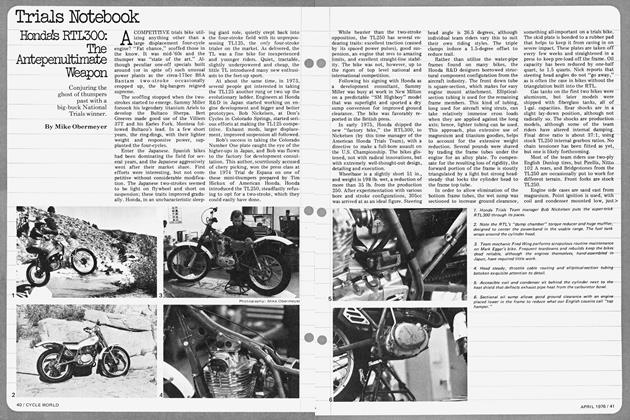
The swinging arm is new in construction. It is a one-piece stamped-metal item. There are new lower shock mounts that work in conjunction with the newly positioned upper shock mounts and gas Showa shock absorbers to give almost six inches of rear wheel travel. The new gas shocks can have their internal pressure adjusted to suit track conditions. We found the performance to be surprisingly good when the shocks were cool. Spring rate was good for our various weights, which means that the lighter riders who fill the ranks of the 125 class will probably want lighter springs than the standard 131-lb. units.
We said that the shocks worked well when cold, but they are radically inconsistent after about 20-25 minutes of constant use. We would go over a particular pothole on one lap as though it wasn’t even there. On the next lap the back end would react as though there were no oil in it at all. A few laps later and everything was back to normal. Again a few more laps and the shocks refused to work. We suggest that rather than purchase lighter springs to cure the harsh ride that lighter riders will encounter, you simply discard the shocks and put on a set of Girling gas emulsion shocks with their 106-lb. (read 90) springs.
And while we’re on the subject of things that should be discarded, remove the handlebars and donate them to the local BMX freak. During cover photography, the CR fell over in the photo studio. When we picked it up, the handlebars were rather heavily tweaked. So we turned the wheel to full-lock and one person straightened them by applying pressure with just one arm! If the bars bend this easily at zero mph, we imagine that if you unloaded at 30 mph you could take the bars, salt them and go into the pretzel business.
The quality of the handlebars and the inconsistent performance of the rear shocks are our only major complaints about the new Elsinore. Everything else is first rate. The grips are good (not great, just good), while the new, more heavily padded seat transmits a lot less pounding to the rider. The fenders are made of highly flexible red plastic that blends perfectly with the rest of the styling scheme.
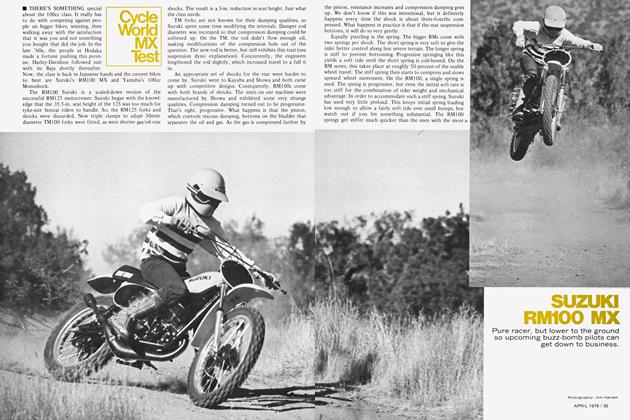
The front tire, which we’ve already mentioned as being, at 3.00 cross-section measurement, much more useful, is complemented by an all-new Bridgestone 4.0-18 variable-pitch rear tire. The knobs on the tire vary from closely-spaced to widely-spaced, back and forth all the way around the tire. The theory behind the tire is that, depending on the particular terrain, if one set of knobs doesn’t get enough traction, the other set will. And with a 125, once traction is obtained, it is much easier to maintain than with a more powerful machine.
We rode the bike on a dry sand track, a wet sand track, a dry hard-packed track and a slick mud track. It performed poorest of all in the mud, but even still its manners were not deteriorated enough by the conditions to make us say it was a bad mud tire. It simply wasn’t as good in the mud as it was on any and everything else.
By now you’re no doubt wondering when we’re going to tell you how the bike feels on the race track, what it’s like to take the new red screamer and pretend you’re Marty Smith. Well we’re not going to do that here.
In the accompanying sidebar, we will discuss at length the merits of the new Honda’s engine, chassis and braking manners. Once you’ve read both articles, you’ll understand more clearly why Honda’s new CR125M2 is not only Honda’s best motocrosser, but, once again, king of the 125s. (§
HONDA
CR125M2