Suzuki Rm100 Mx
Cycle World MX Test
■ THERE’S SOMETHING special about the l00cc class. It really has to do with competing against people on bigger bikes, winning, then walking away with the satisfaction that it was you and not something you bought that did the job. In the late ’60s, the people at Hodaka made a fortune pushing this premise. Harley-Davidson followed suit with its Baja shortly thereafter. Now, the class is back in Japanese hands and the current bikes to beat are Suzuki’s RM 100 MX and Yamaha’s l00cc Monoshock.
The RM 100 Suzuki is a scaled-down version of the successful RM 125 motocrosser. Suzuki began with the knowledge that the 35.5-in. seat height of the 125 was too much for tyke-size bonzai riders to handle. So, the RM 125 forks and shocks were discarded. New triple clamps to adapt 30mmdiameter TM100 forks were fitted, as were shorter gas/oil rear
shocks. The result is a 3-in. reduction in seat height. Just what the class needs.
TM forks are not known for their damping qualities, so Suzuki spent some time modifying the internals. Damper rod diameter was increased so that compression damping could be softened up. On the TM, the rod didn’t flow enough oil, making modifications of the compression hole out of the question. The new rod is better, but still exhibits this trait (see suspension dyno explanation). Concurrently, the engineers lengthened the rod slightly, which increased travel to a full 6 in.
An appropriate set of shocks for the rear were harder to come by. Suzuki went to Kayaba and Showa and both came up with competitive designs. Consequently, RM 100s come with both brands of shocks. The units on our machine were manufactured by Showa and exhibited some very strange qualities. Compression damping turned out to be progressive. That’s right, progressive. What happens is that the piston, which controls viscous damping, bottoms on the bladder that separates the oil and gas. As the gas is compressed farther by
SUZUKI RM100 MX
the piston, resistance increases and compression damping goes up. We don’t know if this was intentional, but it definitely happens every time the shock is about three-fourths compressed. What happens in practice is that if the rear suspension bottoms, it will do so very gently.
Equally puzzling is the spring. The bigger RMs come with two springs per shock. The short spring is very soft to give the rider better control along less severe terrain. The longer spring is stiff to prevent bottoming. Progressive springing like this yields a soft ride until the short spring is coil-bound. On the RM series, this takes place at roughly 50 percent of the usable wheel travel. The stiff spring then starts to compress and slows upward wheel movement. On the RM 100, a single spring is used. The spring is progressive, but even the initial soft rate is too stiff for the combination of rider weight and mechanical advantage. In order to accommodate such a stiff spring, Suzuki has used very little preload. This keeps initial spring loading low enough to allow a fairly soft ride over small bumps, but watch out if you hit something substantial. The RM 100 springs get stiffer much quicker than the ones with the more> exotic spring rates on the big RMs. Consequently, the RM 100 cannot maintain the comfort level or the control the bigger Suzukis have in the rough.
The RM 100’s suspension isn’t the equal of the big MXer’s, but it is vastly superior to what was fitted onto its predecessor, the TM100. Since better suspension and more power go hand in hand, Suzuki’s engineers avoided installing the TM100 powerplant. Instead, they borrowed the crankshaft, connecting rod, transmission and clutch from the RM 125, and installed them into what are essentially TM100 cases.
To this proven bottom end, they added an all-new cylinder barrel with six transfer ports—the TM had four—and with good reason. The increase in transfer ports was to keep the engine’s cylinder full of fuel without having to go to radical intake or exhaust timing. When properly executed, this nets a broader powerband than might otherwise be possible. Considering the small size of the engine and that the borrowed RM transmission is only a five-speed, we feel this barrel change was mandatory.
In the interest of maximum horsepower, the new barrel is accompanied by a redesigned head, a 28mm carburetor and a new exhaust system. Suzuki claims these changes are good for 17 SAE net horsepower at 10,000 rpm. Torque is a creditable 8.97 lb./ft. at 9500 rpm. If you think this spells FAST when you’re talking lOOcc, you’re right.
Power is transmitted to the clutch and transmission by helical-cut gears on early production models, and by straight-
cut gears on the rest. Models with helical-cut gears will be quieter, but since this is a racer, we opt for the more efficient straight-cut gears.
A number 428 chain to the rear wheel completes the drive line. As on any bike with long-travel suspension, keeping the chain on the sprockets is difficult. Suzuki engineers realized this and equipped the RM 100 with two chain guides. One is located just before the rear sprocket and one is just after the countershaft sprocket. These guides also have small rubber runners to prevent the chain from rubbing against the swinging arm.
Even with the guides, however, chain adjustment is critical. The countershaft sprocket is far enough forward of the swinging arm pivot to allow chain tension to vary quite a bit. If you race in the desert or are lax about chain adjustment, we suggest a spring-loaded tensioner. It’s a lot cheaper than engine case repairs caused by broken chains.
As on all of Suzuki’s dirt bikes, brakes are excellent. They are even relatively waterproof and recover quickly after they get wet. The brake hub up front is full width in the interest of strength. The rear is conical. TMlOOs had a lot of rear hub problems. The hub itself didn’t break, but a bushing in the hub wore out very quickly. On the TM, this bushing has been eliminated. Hubs are laced up to shoulderless Takasago alloy rims. Tires are Bridgestone and work well for motocross and desert events.
Another major redesign on the RM 100 is the airbox. Access is afforded by removal of the seat (two 10mm bolts). A single wing nut removes the foam element. The airbox itself is steel and is designed to draw air in from under the seat. When you realize what this system replaces, you can fully appreciate it. Ineffectual best describes the TM’s unit. Getting the filter out was practically impossible and too much dirt reached the filtering element.
The remainder of the machine is taken directly from other RM motocrossers. The aluminum gas tank is from the 125. The fenders and the seat are common to all RMs from 370 on down. Ditto the levers and corresponding grit covers.
What we’ve just described is a racing machine, pure and simple. If Suzuki has made any major concessions it is in the area of suspension. What they did was modify the suspension in order to reduce overall machine height so that a lot of fledgling racers could get down to business.
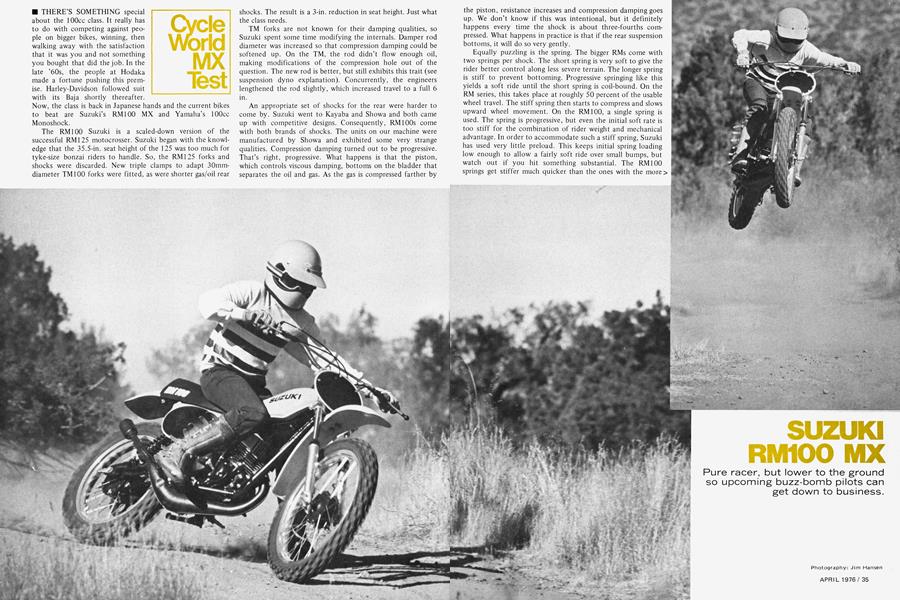
To judge just how successful Suzuki was in this endeavor, we loaned our RM to an 11-year-old desert racer named Don Griewe. Don is an Amateur with high hopes of becoming an Expert. He currently races a modified TM100. Don’s TM has had the ports cleaned up and is geared one tooth taller at the countershaft than the RM. He soon found that the RM is both quicker and has more top speed than the TM. Quicker, we expected, but the increased top end was a surprise, since the RM was geared shorter. The reason is that the RM has another 1000 rpm on top. Gear the RM up and the speed advantage would increase even more.
The RM 100’s forks work quite a bit better in the desert than do the TM’s. Compression damping on the RM is a bit high for motocross, but in the desert, where you don’t want anything to bottom, it’s perfect. Don weighs about 95 lb.; for him, spring rate was ideal.
He also liked the rear suspension. In fact, he said it had a smoother ride than the cantilever-modified set-up on his TM.
Don thought the bike was neat, so we asked him if he thought it was good enough to race. . .i.e., could he win on it. His answer was simple: put a bigger gas tank on it, raise the gearing, and I can win (he finishes 2nd and 3rd in his class on his TM).
In desert events then, there is little doubt that the RM 100 is competitive. But what about motocross? Here, we’d have to say that the bike is potentially a winner, but not a winner as delivered. Small-bore motocross is really competitive. The lOOcc class is particularly fierce on the East Coast. You will need a few modifications to keep you in front of your friends. To begin with, a port job is in order, and a reed-valve modification could possibly help.
The chassis works well, especially on tight tracks. The RM will hold an inside line, turns well in berms, and will even slide because of its lower stance.
A large diameter damper rod will increase the potential of the front forks, which are adequate as delivered. If you weigh more than 125 lb., though, bottoming will occur after big jumps. . .particularly at speed. The Showa shocks need more> rebound damping, especially considering the spring rate. On rough tracks or through rocks, the back end skates around enough to make the bike a handful. This is particularly true on straights when the RM is wound out in fifth.
SUSPENSION DYNO TEST FRONT FORKS
Description: Kayaba fork, 30mm dia. stanchion tube, H0315 oil Fork travel, in.: 6.5 Engagement, in.: 4.5 Spring rate, lb./in.: 1 9/28 progressive Compression damping force, lb.: 10 Rebound damping force, lb.: 15 Static seal friction, lb.: 12
Remarks: Spring rate is good for desert racing. For motocross, 100-lb riders should go to a marginally lighter spring. Adults should find the standard spring ideal for all high-speed riding. Because of the small diameter of the stanchion tubes, extending the forks to increase travel is not recommended. Damping is close, but not perfect. Considering the light weight of both machine and intended rider, compression damping is slightly harsh. C.D. hole size cannot be enlarged effectively because the inner diameter area of the damper rod is less than the area of the compression damping holes. So, increasing the diameter of the C.D. holes will have no effect, since the rod cannot flow as much oil as the stock holes. The solution is 5-wt. oil to bring compression damping down. Rebound holes must then be restricted to restore and slightly increase return damping. Weld up the rebound hole closest to the guide bushing and redrill to .050-.060. If you aren't a perfectionist, you'll like the forks as they are. And they're pretty good.
REAR SHOCKS
Description: Showa gas/oil shock Shock travel, in: 2.75 Wheel travel, in.: 5.0 Spring rate, lb./in.: 130/160 progressive Compression damping force, lb.: 38/58 progressive Rebound damping force, lb.: 48
Remarks: Without a doubt, this is the most unusual rear shock we've tested. Most shocks show a constant compression damping rate as long as velocity remains constant. Under constant velocity, however, the Showa gas/oil shock exhibits progressive compression damping. This is probably caused by the damping piston hitting the bladder after about three-quarters of the shock's travel is completed. As soon as the piston contacts the bladder, compression of the gas begins and that additional resistance increases compression damping. The reasoning behind the progressive compression damping escapes us, but in practice it works very well. On the RM100, Suzuki has opted for an inordinately stiff spring with 30 lb. of preload. Because of the minimal preload, riding comfort is acceptable. Rebound damping is too light for the spring. This lets the Suzuki pitch and dance around a bit, especially over rocky terrain.
Tests performed at Number One Products
SUZUKI
RM100 MX
The five-speed transmission is okay for motocross at present, but next year you’ll probably need another gear on fast tracks. The drawback now is a tendency to bog off the line, especially if the track is loamy. And when the engine starts to bog, the RM wheelies. Both make getting to the first turn first a sketchy proposition.
There are few tests that go without incident, and our encounter with the RM 100 was no exception. We had one failure. The footpeg pivot bolt on the left side broke. If that bolt breaks at the wrong instant, you’ll end up with a broken leg. It isn’t worth taking a chance. We therefore heartily recommend replacing the pivot bolts on both pegs with case hardened units of equivalent size.
There is another problem with the RM 100, and one that we are going to be made increasingly aware of. It is too loud. It is unacceptable for motocross and is illegal for cross-country racing in some states. Making power is nice, but not at the expense of noise.
The RM 100 is a fast, light bike. We liked the ease of control. It steers well, yet still has the ability to slide turns. We found the suspension to be a good compromise between wheel travel and the overall height of the machine. But perhaps most importantly, the RM 100 is competitive. It is competitive as is in the Novice class, and with some engine and suspension work it could take Experts to the winners’ circle. We don’t think this bike will disappoint you either way. |Q