Ktm 250 Mc5
KTM 250 MC5
Cycle World MX Test
It’s expensive, but the Expert racer will find it’s money well-spent.
KTM. THE NAME either rings a bell or it doesn’t. If you know much about international motocross racing, then you know KTM is an Austrian firm that has earned a pretty solid reputation ... a reputation stemming from a number of prestigious motocross and ISDT victories around the world.
And if you want to talk championships, the KTM name can be brought up again. In 1974 Guennady Moiseev took the world title on one in 250 GP motocross, and in 1975 the overall winner at the ISDT was a West German mounted on a big-bore model sporting the increasingly familiar initials, KTM.
One is not apt to see many a KTM in dealer showrooms throughout the West (east of the Mississippi identical machinery carries the Penton nametag), but once one is spotted, it will commandeer the attention of any serious dirt rider. The reason is the look: tall, serious, mean and purposeful. The KTM tells you it is no namby-pamby playbike to be used for an occasional excursion across a neighbor’s field. No indeed.
Rather, the price scribbled on the tag attached to the handlebars will (or should) separate the serious from the occasional rider. And the novice, hopefully, will be scared off by the speed potential of an ultimate performance off-road motorcycle. The MC5, then, is a bike for experts that costs a great deal of money ($1800, plus) because nothing has been spared on the entire machine.
Starting with the frame, chrome-moly is used throughout, but there’s little similarity between the MC5 chassis and that of the enduro model. This is an entirely new frame design, built for the specifics of long-travel front and rear suspension. Lighter than last year’s frame by more than 10 pounds, the unit still features some of the old Penton/KTM drawbacks: poor access to the 36mm Bing carburetor and weak rear fender and seat support tubing. Welding quality could be more pleasing to the eye, but penetration is sufficient and welds are strong.
Drawing much attention is a very robust-looking swinging arm, nearly 20 inches long and featuring a contoured bend in the middle. Braced heavily with top-mounted support plates, the arm pivots on quality needle bearings and has proven to be more than strong in the toughest of events. Unlike last year’s model, which included a number of choices for mounting the rear shocks, the latest has but one position for the Marzocchi gas units. The radical mounting position becomes even more radical when the rear suspension is totally compressed, transferring most of the shock load toward the steering head in a rather interesting fashion. The swinging arm, like the frame, is finished in a tough, silver enamel.
Our test KTM was loaned to us by Steve Platt, just after he purchased it from AAA Cycle in Santa Ana. It had the latest Number 3 Marzocchi shocks, a big inprovement over earlier units, and what we feel to be among the finest OEM rear suspension components we’ve ever run across (see shock dyno for details). No amount of hard-going seemed to affect their damping or ride characteristics, which tests on the dyno later bore out. Lighter riders might opt for softer springs, but most hard-charging throttle-twisters should be happy with what the machine comes with. And that goes for what’s up front as well.
We have yet to find better fork units than the Marzocchi forward-axle models, and the ones that come standard on the KTM/Penton MC5 are of the magnesium variety. We question the value of this, because the same forks in aluminum weigh only about eight ounces more each, but the mag units add nearly $100 to the cost of the bike. Triple crowns are of the more conventional aluminum, with only the slider castings fashioned from magnesium. As far as performance goes, the Marzocchi PA forks take second to none, though our units would have benefitted from less fork seal drag. We found that the units worked quite well under enduro-like riding conditions, but when seriously flogged on a motocross course, they bottomed enough to cause the rider grief. Heavier fork springs or insertion of a 1-in. preload spacer on top of the stock springs should cure the problem.
It’s kind of interesting to note that, although this machine is designed for motocross, it would be equally at home in a fast, open-country enduro. A larger fuel tank would be the only necessary addition. And it goes without saying that the bike is a natural born desert racer, more than ready to handle a wide-open charge across the terrain we find in the Southwest. Presently, in fact, KTM 400s are the bikes to beat in Southern California Open desert competition. A goodly portion of that success is owing to a high reliability factor.
And some of that can be attributed to the huge aluminum cylinder featuring a pressed-in steel liner and one of the largest fin surface areas of any motocrosser we can think of. Those fins keep things running cool, and coolness means extra performance for a longer period of time, as well as a longer-lasting engine.
Port work is extensive, consisting of 11 holes in all to duct the fuel/air mixture to the proper areas at the right time. The engine unit remains basically the same as the 1975 version, which goes to say that KTM engineers must have been happy with what they had and didn’t want to change a good thing.
That “good thing” continues with main engine cases and outer case covers made from magnesium alloy that is strong and super light. The engine itself, with its angular sidecases and giant finned cylinder barrel, is quite attractive to the eye.
The six-speed gearbox offers fairly smooth and always precise shifts; first gear is so low that it is rarely used. We modified the left-side-mounted shift lever because the stocker is a little short for feet of average size. While we were at it we used the Hi Point accessory version that features a spring-loaded toe piece to keep the lever from bending or breaking in the event of a spill or prang.
Actually, ground clearance is very good, but since the mag cases are expensive to replace, our test bike also carried a Fun ’N Fast skidplate as insurance against breakage. Certainly this isn’t mandatory for a bike that will see strictly motocross duty, but cross-country riders may find the extra money well spent. Footpegs also have sufficient ground clearance, but they aren’t spring-loaded, so sometimes get smacked by the rider’s boot and stay-in the “up” position. Not good.
In terms of power the KTM is an Expert’s motorcycle. A rider with limited experience will have a great deal of difficulty coping with the tremendous throttle response and what some would describe as a moderately narrow powerband. While it is true that the pulling power of the 250cc engine has been spread into wider rpm ranges than on older models, the MC5 still explodes when the engine gets on the pipe. Not a toggle switch, for sure, but a delivery that will earn respect from a rider the instant he grabs a handful of throttle.
Off the pipe, the engine still responds quickly and doesn’t trip over itself, but a rider getting the most out of the bike will be rowing the shift lever at a respectable rate. Clutchless shifts, by the way, are the way to go with this one, for the clutch not only requires some muscle to operate, but won’t tolerate much in the way of slipping without starting to drag. If KTM has any future ideas concerning clutch improvement, we won’t be the ones to stand in its way.
Among all machines in its class, the KTM will stand up heartily in a drag race.
It produces enough power to get the lead and hold it in that all-important charge to the first turn. The Metzelers (front and rear) provide superb traction on a variety of surfaces, and shine brightly when the track gets hard and slick. Rims come from the U.S. and are made by Sun. They’re tough devils and are popular the world over in both cross-country and motocross. The tire is prevented from spinning on the rim by bead spikes rather than the heavier and more-miserable-to-install bead lock clamps. We’ve run the Sun rims on flat tires and the spikes, surprisingly enough, keep the tire in position. Of course, they work best when there’s air in the tires. Spokes are steel, and magnesium once again finds its way onto the machine in the form of wheel hubs.
The hubs are really tough, lightweight, and good looking. Another plus is the brakes; you’ll search a long time to find> better as-delivered brakes on a dirt machine. They have the power to haul bike and rider down from 70-80 mph speeds with lots of control, yet respond just as well in low-speed situations. Water resistance is high, and recovery time is minimal. Keep them clean and they’ll last quite a while. There is a noticeable degree of wheel hop during braking, however, especially when charging downhill.
We never ceased to be impressed by the KTM’s ease of starting, virtually a onekick operation every time. Here’s the drill: Turn on both click-action petcocks, tickle the Bing until it dribbles, make sure the bike is in neutral (there is no primary kickstarting), and take a stab at the lever. If the engine is really cold, then the enrichening lever on the handlebars might need a bit of a pull. Most of the time, however, it can be ignored. In fact, it’s a good idea to use a rubber band made from an old inner tube to ensure that the lever stays in the “off” position until needed.
It’s fascinating to study the way the KTM’s exh aust pipe snakes its way through the frame tubes, ending up on the right side of the machine after starting out on the left. The pipe barks enough to let people know it’s around, okay for motocross tracks and the like, but nothing to promote goodwill around a neighborhood. The new pipe obviously has much to do with the KTM’s flashy performance, but the fly in the ointment is that it interferes with the rider’s right leg when he’s in a standing position. Compared to the competition, the KTM is wide enough through its middle, wide enough, that is, to be uncomfortable for the majority of riders who sampled our test bike. Some people will be able to get used to the girth, but we put it on the list of major (and unchangeable) flaws. Sitting on the seat (narrow but ample), solves the problem, but most of the time a rider has to do business standing up.
The air intake for the Bing carburetor is high and well-protected. A giant-sized foam filter lets the engine inhale without coughing, and dirt will have hell to pay trying to work its way past the element. The airbox housing is made from aluminum. Access to the Twin Air element is via sidecover/number plates. Enduro models have a different chassis and therefore use a completely different air intake system.
As we mentioned before, the MC5 will do double duty as an enduro machine . . . if the right kind of terrain exists. We wouldn’t want to run a tight woods event on this model, since it offers just a little too much in the way of suspension and power, but given the right set of circumstances, it can do business just fine. High-speed stability is excellent, yet low-speed steerability leaves nothing to be desired. We found the MC5 to be equally happy with inside jogs around tight turns and bouncing off berms at higher speed. Only a few machines perform well in both areas.
Gearing is on the tall side, but the KTM motor has the power to pull it. Hence, the KTM is able to outrun other stock-geared machines in its class when it comes to top speed. Wide-open running will consume fuel at an alarming rate, though, so if distance is your game, plan on something bigger than the stock fiberglass 2.5-gal. tank. Our test bike ran happily and mightily on Pennzoil two-stroke oil mixed at a ratio of 32:1. The plug stayed clean, there was little in the way of visible exhaust smoke, and the engine ran strong.
The new era KTM is really tall, so shorter riders will have trouble getting their feet on the ground unless a curb or mound of dirt is handy. The KTM is just the opposite of some motorcycles that you seem to sit in, not on. It’s like the difference between sitting on a Clydesdale rather than a Shetland pony. Underway, some of> that feeling disappears, but not all of it. Because of the tall seating position, the MC5 responds well to body English, so much so that it’s important to lean forward when accelerating hard. Otherwise, you can go over backward before you know it. This doesn’t apply only to lower gears; the bike will easily stand on its rear wheel in fifth if one so desires. If the bike didn’t balance well on the rear wheel, this would be a problem. As is, it is beautiful for the Expert because he can lift the front end at will.
KTM 250
$1850
Changing the countershaft sprocket is quick and simple thanks to easy access, but allow lots of time if you want to do some carb tinkering. Fenders are flexible plastic, but frontal mud protection is limited with the stock unit. One of the accessory brands would be a wise choice if the tracks or terrain you frequent are usually on the muddy side.
Aside from niggling incidentals like a leaky gas cap, hard Magura grips, too short a sidestand, and seat foam that packs down, the KTM comes through with few major flaws. We’d like to see a narrower frame unit and a tougher, easier-to-operate clutch, but that’s about it. Those are the things that keep the MC5 from being perfect. In stock form there’s enough power for Experts. That means the KTM/ Penton is capable of getting anyone to the first turn in front of the pack. Once in front, the rider will be the limiting factor, because the MC5 is also a handler.
In short, KTM/Penton has come up with a machine that is everything you’d expect an Expert’s motocrosser to be. If you are á successful rider, and if price doesn’t scare you, check one out. The MC5 is capable of winning if you are. |o]
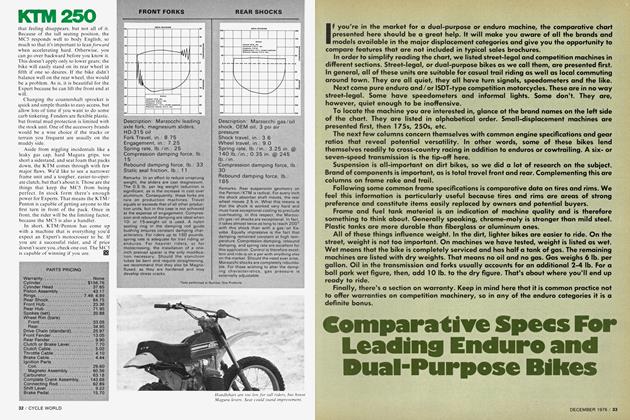
FRONT FORKS
Description: Marzocchi leading axle fork, magnesium sliders, HD-315 oil Fork Travel, in.: 8.75 Engagement, in.: 7.25 Spring rate, lb./in.: 25 Compression damping force, lb.: 15 Rebound damping force, lb.: 33 Static seal friction, lb.: 1 1 Remarks: In an effort to reduce unsprung weight, the sliders are cast magnesium. The 0.5 lb. per leg weight reduction is significant, as is the increase in cost over aluminum. Consequently, these forks are rare on production machines. Travel equals or exceeds that of all other production units, but in this case is not achieved at the expense of engagement. Compression and rebound damping are ideal when 10or 15-weight oil is used. A nylon sealing ring in the damping rod guide bushing ensures constant damping characteristics. For riders up to 1 50 pounds, spring rate is adequate for trail riding or enduros. For heavier riders, or for motocrossing, the installation of a oneinch preload spacer is the only modification necessary. Should the stanchion tubes be bent and require straightening, we recommend that they also be Magnafluxed, as they are hardened and may develop stress cracks.
REAR SHOCKS
Description: Marzocchi gas/oil shock, OEM oil, 3 psi air pressure Shock travel, in.: 3.6 Wheel travel, in.: 9.0 Spring rate, lb./in.: 3.25 in. @ 140 lb./in.; 0.35 in. @ 245 lb./in. Compression damping force, lb.: 30 Rebound damping force, lb.: 185 Remarks. Rear suspension geometry on the Penton/KTM is radical. For every inch the shock absorber shaft moves, the rear wheel moves 2.5 in. What this means is that the shock is worked very hard and must have exceptional cooling to preclude overheating. In this respect, the Marzocchi gas/oil shocks are exceptional. In fact, it takes almost twice as long to reach 200° with this shock than with a gas/oil Kayaba. Equally impressive is the fact that damping remained constant at high temperature. Compression damping, rebound damping, and spring rate are excellent for this application. Control is therefore excellent and ride is on a par with anything else on the market. Should the need ever arise, Marzocchi shocks are completely rebuildabie. For those wishing to alter the damping characteristics, gas pressure is externally adjustable.
Tests performed at Number One Products