Cotton Trials
COTTON TRIALS
CYCLE WORLD TRIALS TEST
A Trim Anglo-Italian Middleweight
ONE OF THE LATEST rages in Europe is the introduction and frequent success of under 125-cc machines for observed trials. Once dominated by 350 and 500 English Singles, trials shifted to 250-cc two-stroke Singles in the past ten years, as British four-stroke makers appeared to lose interest in this very exciting form of motorcycle competition.
Now the “Minis,” as they are termed in Europe, are threatening the reign of 250s, which now are referred to as “big bikes.” If that is the case, our 175-cc Cotton must fall into the “Midi” category and should, we expect, display the virtues of both worlds. And, in some respects, that is the case.
The overall motorcycle is almost identical to the Villierspowered model tested by CYCLE WORLD two years ago. So great was that little gem that the editor, who is fruity for trials anyway, promised to buy it after trying two sections. The little Viiliers unit is a willing worker that continually refuses to give up, regardless how it’s treated. But, faced with the loss of Viiliers engines for their machines, British manufacturers had to turn to suppliers outside of the country—thus the introduction of Minis and Midis.
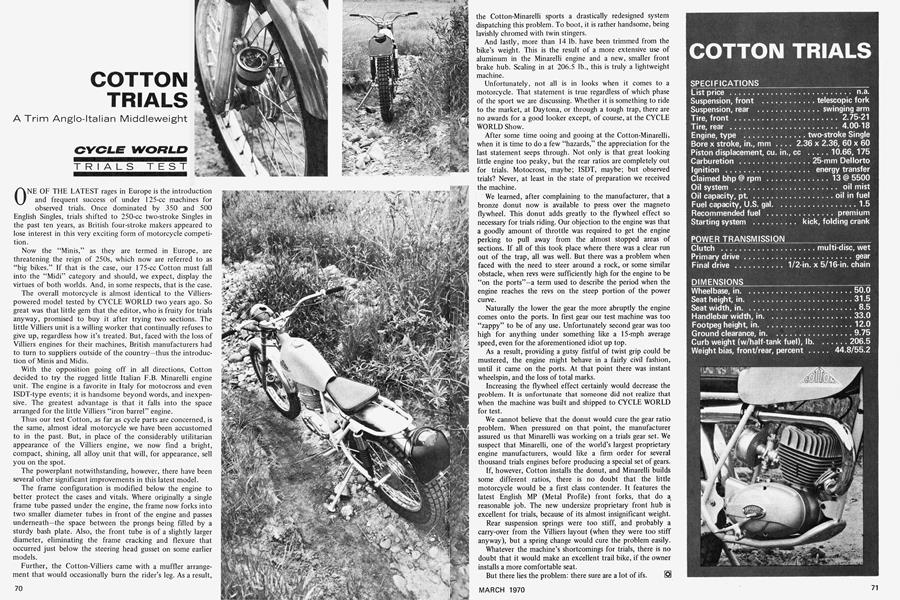
With the opposition going off in all directions, Cotton decided to try the rugged little Italian F.B. Minarelli engine unit. The engine is a favorite in Italy for motocross and even ISDT-type events; it is handsome beyond words, and inexpensive. The greatest advantage is that it falls into the space arranged for the little Viiliers “iron barrel” engine.
Thus our test Cotton, as far as cycle parts are concerned, is the same, almost ideal motorcycle we have been accustomed to in the past. But, in place of the considerably utilitarian appearance of the Viiliers engine, we now find a bright, compact, shining, all alloy unit that will, for appearance, sell you on the spot.
The powerplant notwithstanding, however, there have been several other significant improvements in this latest model.
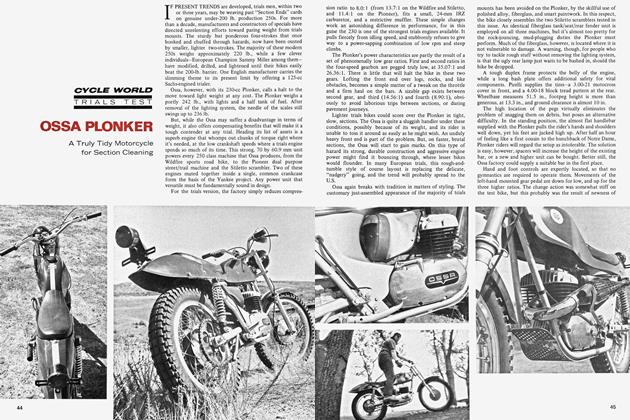
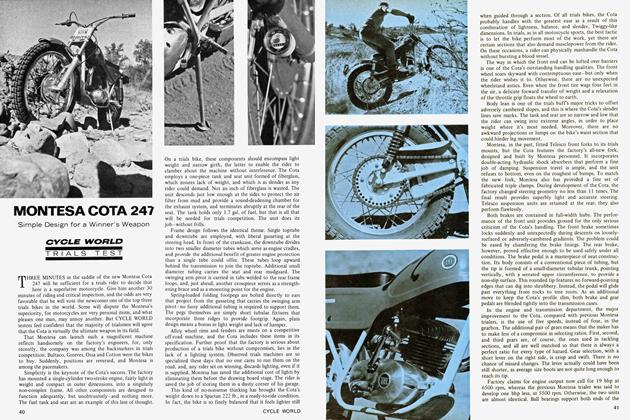
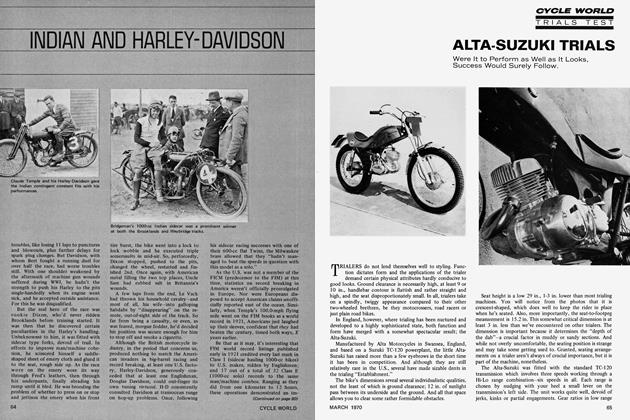
The frame configuration is modified below the engine to better protect the cases and vitals. Where originally a single frame tube passed under the engine, the frame now forks into two smaller diameter tubes in front of the engine and passes underneath—the space between the prongs being filled by a sturdy bash plate. Also, the front tube is of a slightly larger diameter, eliminating the frame cracking and flexure that occurred just below the steering head gusset on some earlier models.
Further, the Cotton-Villiers came with a muffler arrangement that would occasionally burn the rider’s leg. As a result, the Cotton-Minarelli sports a drastically redesigned system dispatching this problem. To boot, it is rather handsome, being lavishly chromed with twin stingers.
And lastly, more than 14 lb. have been trimmed from the bike’s weight. This is the result of a more extensive use of aluminum in the Minarelli engine and a new, smaller front brake hub. Scaling in at 206.5 lb., this is truly a lightweight machine.
Unfortunately, not all is in looks when it comes to a motorcycle. That statement is true regardless of which phase of the sport we are discussing. Whether it is something to ride to the market, at Daytona, or through a tough trap, there are no awards for a good looker except, of course, at the CYCLE WORLD Show.
After some time ooing and gooing at the Cotton-Minarelli, when it is time to do a few “hazards,” the appreciation for the last statement seeps through. Not only is that great looking little engine too peaky, but the rear ratios are completely out for trials. Motocross, maybe; ISDT, maybe; but observed trials? Never, at least in the state of preparation we received the machine.
We learned, after complaining to the manufacturer, that a bronze donut now is available to press over the magneto flywheel. This donut adds greatly to the flywheel effect so necessary for trials riding. Our objection to the engine was that a goodly amount of throttle was required to get the engine perking to pull away from the almost stopped areas of sections. If all of this took place where there was a clear run out of the trap, all was well. But there was a problem when faced with the need to steer around a rock, or some similar obstacle, when revs were sufficiently high for the engine to be “on the ports”—a term used to describe the period when the engine reaches the revs on the steep portion of the power curve.
Naturally the lower the gear the more abruptly the engine comes onto the ports. In first gear our test machine was too “zappy” to be of any use. Unfortunately second gear was too high for anything under something like a 15-mph average speed, even for the aforementioned idiot up top.
As a result, providing a gutsy fistful of twist grip could be mustered, the engine might behave in a fairly civil fashion, until it came on the ports. At that point there was instant wheelspin, and the loss of total marks.
Increasing the flywheel effect certainly would decrease the problem. It is unfortunate that someone did not realize that when the machine was built and shipped to CYCLE WORLD for test.
We cannot believe that the donut would cure the gear ratio problem. When pressured on that point, the manufacturer assured us that Minarelli was working on a trials gear set. We suspect that Minarelli, one of the world’s largest proprietary engine manufacturers, would like a firm order for several thousand trials engines before producing a special set of gears.
If, however, Cotton installs the donut, and Minarelli builds some different ratios, there is no doubt that the little motorcycle would be a first class contender. It features the latest English MP (Metal Profile) front forks, that do a reasonable job. The new undersize proprietary front hub is excellent for trials, because of its almost insignificant weight.
Rear suspension springs were too stiff, and probably a carry-over from the Villiers layout (when they were too stiff anyway), but a spring change would cure the problem easily.
Whatever the machine’s shortcomings for trials, there is no doubt that it would make an excellent trail bike, if the owner installs a more comfortable seat.
But there lies the problem: there sure are a lot of ifs.
COTTON TRIALS