Alta-Suzuki Trials
ALTA-SUZUKI TRIALS
CYCLE WORLD TRIALS TEST
Were It to Perform as Well as It Looks, Success Would Surely Follow.
TRIALERS do not lend themselves well to styling. Function dictates form and the applications of the trialer demand certain physical attributes hardly conducive to
good looks. Ground clearance is necessarily high, at least 9 or 10 in., handlebar contour is flattish and rather straight and high, and the seat disproportionately small. In all, trialers take on a spindly, twiggy appearance compared to their other two-wheeled brethren, be they motocrossers, road racers or just plain road bikes.
In England, however, where trialing has been nurtured and developed to a highly sophisticated state, both function and form have merged with a somewhat spectacular result; the Alta-Suzuki.
Manufactured by Alta Motorcycles in Swansea, England, and based on a Suzuki TC-120 powerplant, the little AltaSuzuki has raised more than a few eyebrows in the short time it has been in competition. And although they are still relatively rare in the U.S., several have made sizable dents in the trialing “Establishment.”
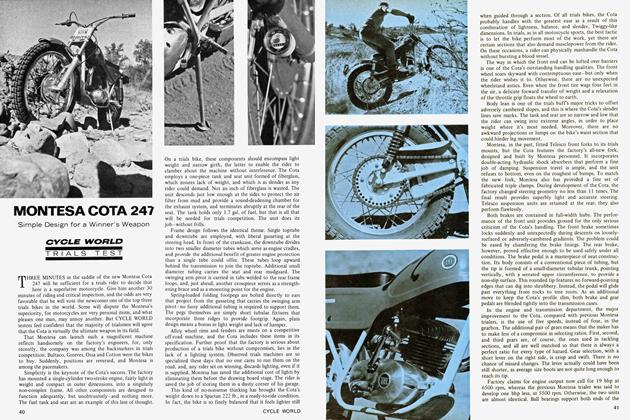
The bike’s dimensions reveal several individualistic qualities, not the least of which is ground clearance; 12 in. of sunlight pass between its underside and the ground. And all that space allows you to clear some rather formidable obstacles.
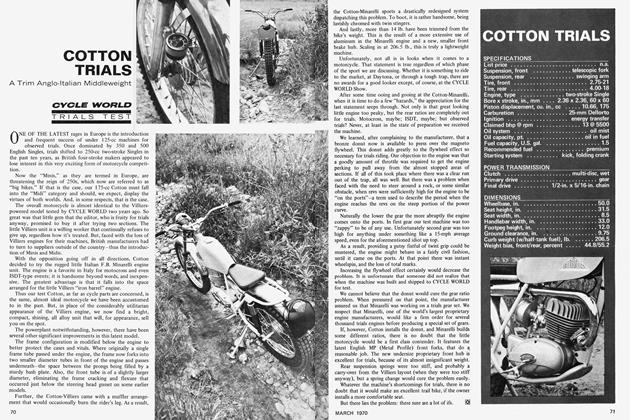
Seat height is a low 29 in., 1-3 in. lower than most trialing machines. You will notice from the photos that it is crescent-shaped, which does well to keep the rider in place when he’s seated. Also, more importantly, the seat-to-footpeg measurement is 15.2 in. This somewhat critical dimension is at least 3 in. less than we’ve encountered on other trialers. The dimension is important because it determines the “depth of the dab”—a crucial factor in muddy or sandy sections. And while not overly uncomfortable, the seating position is strange and may take some getting used to. Granted, seating arrangements on a trialer aren’t always of crucial importance, but it is part of the machine, nonetheless.
The Alta-Suzuki was fitted with the standard TC-120 transmission which involves three speeds working through a Hi-Lo range combination—six speeds in all. Each range is chosen by nudging with your heel a small lever on the transmission’s left side. The unit works quite well, devoid of jerks, kinks or partial engagements. Gear ratios in low range are nice and close with plenty of torque multiplication. In high range the bike will really squirt along—a feature of particular benefit between sections as the engine doesn’t have to strain at high rpm to maintain a reasonable rate—cruising at 50-55 mph is in order.
Another valuable point, often overlooked, is the starter mechanism which is geared through the primary drive. Hunting around for neutral with a stalled engine can be an extravagant time waster. But if you happen to stall the Alta-Suzuki while on the go, you can just pull in the clutch and kick it through, often without wasting a precious dab. On machines lacking this feature you’d have to stir through the gearbox first to find neutral, and then kick the starter. Try doing this without putting your foot down and you’ll know what we mean.
On the negative side, we must take to task the cushion drive in the rear hub. Its power delivery to the rear wheel is too soft and imprecise, causing some rather unpredictable reactions on rock surfaces. It acts like a rubber band between the engine and wheel—as power is applied the band winds up, and suddenly...sproing! The power is released to the wheel with a jolt. On the other hand, this trait is hardly noticeable in mud or sand where traction is poor.
We discovered another odd phenomenon: as the fork is turned from side to side, the Alta’s chassis rises and falls. In other words, ground clearance is lowest at each extreme of fork lock and highest when the wheel is pointed straight ahead. This characteristic is somewhat disadvantageous, as it makes it harder to hold a precise straight line. Neutral steering characteristics from lock to lock—the prevailing practice on most trials bikes—would be preferable.
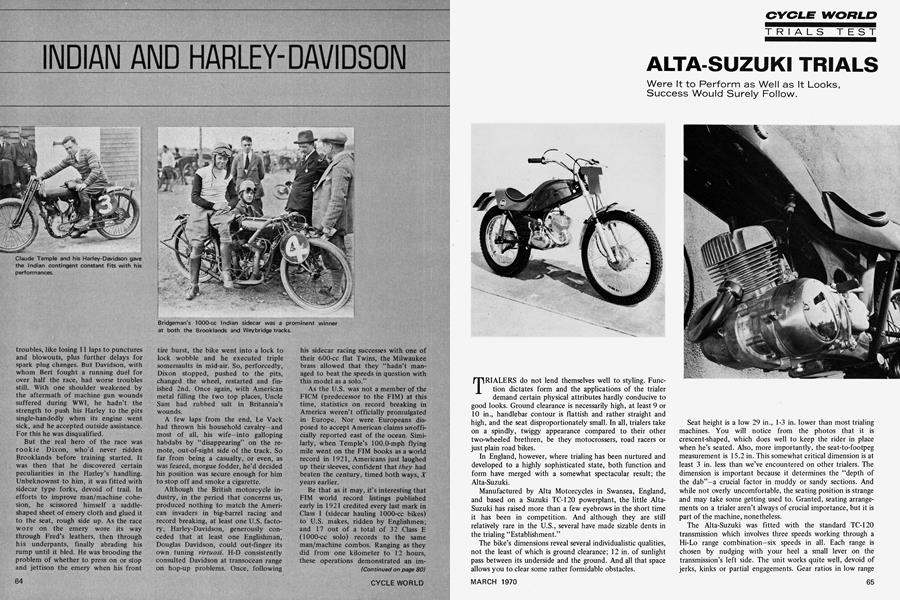
It was necessary to make substantial modifications to the air filtration system before the engine would even run. Above mid-rpm the filter just wouldn’t pass enough air. After a little filing and cutting, a Filtron unit was installed, eliminating the problem.
In summation, we have mixed feelings about the AltaSuzuki. We know the potential is there because of its past trialing performances. But our own experiences with it have proven somewhat disappointing. The little Suzuki engine is a very willing powerplant, although hindered by excess weight: 194 lb. isn’t too much for a 250, but remember, this has only 128 cc. A bit of paring down would be in order.
ALTA-SUZUKI TRIALS
$566