Billy Wells
Race Watch
BILLY WELLS -> INDIAN MOTOCYLE -> ISLE OF MAN TT -> MICHAEL DUNLOP
THE VIEW FROM INSIDE THE PADDOCK
BILLY WELLS
ISLE OF MAN
The life and times of a pioneering American motorcyclist
Steven L. Thompson
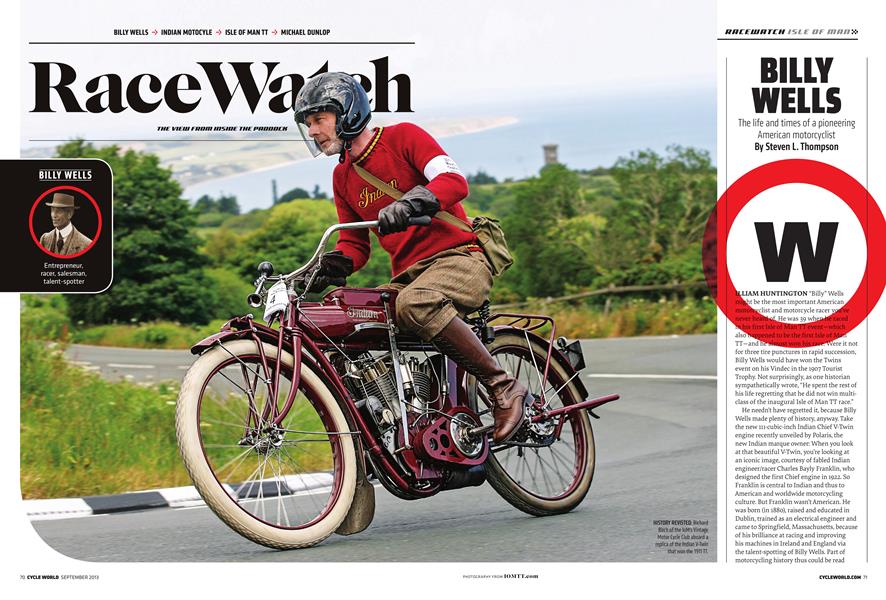
WILLIAM HUNTINGTON “Billy” Wells might be the most important American motorcyclist and motorcycle racer you’ve never heard of. He was 39 when he raced never heard of. He was 39 when he raced in his first Isle of Man TT event—which also happened to be the first Isle of Man TT—and he almost won his race. Were it not
for three tire punctures in rapid succession, Billy Wells would have won the Twins event on his Vindec in the 1907 Tourist Trophy. Not surprisingly, as one historian sympathetically wrote, “He spent the rest of his life regretting that he did not win multiclass of the inaugural Isle of Man TT race.” He needn’t have regretted it, because Billy Wells made plenty of history, anyway. Take the new 111-cubic-inch Indian Chief V-Twin engine recently unveiled by Polaris, the new Indian marque owner: When you look at that beautiful V-Twin, you’re looking at an iconic image, courtesy of fabled Indian engineer/racer Charles Bayly Franklin, who designed the first Chief engine in 1922. So Franklin is central to Indian and thus to American and worldwide motorcycling culture. But Franklin wasn’t American. He was born (in 1880), raised and educated in Dublin, trained as an electrical engineer and came to Springfield, Massachusetts, because of his brilliance at racing and improving his machines in Ireland and England via the talent-spotting of Billy Wells. Part of motorcycling history thus could be read this way: No Franklin means no Scout, no Chief and no modem, Polaris-owned Indian.
Look at motorcycling history in its second decade through its fourth and you find Billy Wells’ fingerprints all over it. That Indian 1-2-3 sweep of the first TT held on the Mountain Course in 1911? Billy Wells was behind that, as marketing man and team manager. Speedway in Britain 17 years later? Billy Wells, entrepreneur-cummissionary for the sport.
Sole link between the racing organization of the United States and Europe? Billy Wells.
Wells was born in Winthrop, Maine, in 1868. While living in Brooklyn, New York, in the mid-i88os, he attended and graduated from the New York Polytechnic Institute’s high school—a significant achievement in an era when fewer than seven percent of Americans held a high-school diploma. While still in school, at age 16, he was involved in the building of the then-new “safety” bicycles and was obviously already smitten with the racing bug. Soon, he was famous as an ace racer, as well as very active in club organization. Wells looked for work in the burgeoning industrial world and found a good gig working for the Prescott Steam Cars company.
In 1902, for reasons still not clear, Wells climbed aboard an ocean liner and sought his fortune in England. At the time, London was the center of the British Empire, the biggest empire ever known. British society was dominated by the class system, and that actually helped Billy Wells; as an American, he avoided being pigeonholed in this or that class. The English looked upon most Americans—by 1914, there were 11,000 expatriate Yanks in England—with a jaundiced but not entirely disdainful eye.
Soon after he set foot in London, Wells established a place for himself at the South British Trading Company, Ltd. Wells clearly found something that suited him about life and work in England, and the English likewise found they liked him. He had taken to “motor-bicycles” early on and was quickly winning races, hillclimbs and trials on Vindec Specials he imported through the SBTC. By the time he entered the 1907 TT, he was a famous rider and contributed frequent letters to the British motorcycle magazines. But in 1908, he decided to call it quits selling Vindec Specials, as well as with the SBTC, and went back to the U.S. seeking new cards to play in the commercial game of thrones.
He visited his old bicycle-racing buddy, George Hendee, at the Hendee Manufacturing Company in Springfield, who persuaded him to take on the challenge of becoming the first overseas agent for Indian by setting up shop in London to sell throughout the British Empire. Because Indians had already made a splash in England in the hands of American Teddy Hastings, for example, in reliability trials,
Wells grabbed the brass ring of opportunity and went right back to Britain. He set up the Indian MotoCycle agency on Great Portland Street in London as a factory-salaried manager and immediately set to work on schemes to sell Indians throughout the vast empire through the already-clichéd means of “win on Sunday, sell on Monday.”
And win the Indians did, in his hands and in the hands of fellow Yank Guy Lee Evans. They electrified the British with their showings at Brooklands and in the 1909 Isle of Man TT—the first TT to be run without regs restricting fuel consumption.
Wells and Evans were expected to be fast and they were, but Wells tried to start his bike with his usual high-jump-style leap into the saddle and misjudged it, slamming his chest on the top rail and suffering internal injuries. He was a DNF and would never again race solos. Evans finished second to Englishman Charlie Collier on his Matchless, and this, according to the authors of “Franklin’s Indians,” “was a wake-up call to the British riders and manufacturers.”
It’s difficult today to grasp the significance of a “foreign” challenge to Britain’s supremacy in anything for Britons of the day. Their empire was at its peak, their confidence in themselves and their national champions unassailed, and here was not only a challenge from an American marque but also a pair of American riders!
It got worse for the Brits in 1911. By then, Indian’s chief engineer Oscar Hedstrom had refined the chaindriven, two-speed V-Twin racers to be both fast and reliable, and Indian had even retained famed French-Canadian racer Jake de Rosier, by now a factorysupported pro. He’d set records on American tracks and his fame spread to Britain. So, when Wells put together the official Indian team for the 1911 TT, it included de Rosier, Oliver Godfrey, Arthur Moorhouse and Charles Franklin. Godfrey won, and though de Rosier crashed out of contention after second-place Charles Collier was disqualified for taking on fuel at an unauthorized spot, the thirdand fourth-placed Indian riders, Franklin and Moorhouse, moved up a spot, resulting in a 1-2-3 sweep by Indian.
Billy Wells and Indian capitalized on this victory, and after Wells wed his secretary, Edith Clara Wilson, it looked like a rosy future for the family and the business. But the lights began going out in Europe in August, 1914, when what should have been a purely Austrian-Serbian fracas exploded into the Great War. Too old to enlist, Wells served as a Special Constable in London, and when the war was over in 1918, the world had changed. In response to protectionist demands from domestic firms, America and Britain both raised tariffs on imported goods—among them, motorcycles. When Britain ratcheted up its own tariffs far enough, Wells was forced to close the London Indian depot’s doors in 1925.
His fortunes changed again in 1928. While running a small motor accessory business, Wells was approached by entrepreneur Claude Langdon to investigate the possibilities of introducing the Australian sport of dirt-track racing to England. The Aussies had developed the technique of broadsliding on dirt tracks to new heights. As the authors of “Franklin’s Indians” put it, “The final ingredient needed to bust this new sport right out into the big-time was to provide track venues at the heart of population centers in built-up urban neighbourhoods, and run the events on weeknights under electric floodlights. It was with this last ingredient that Billy Wells had the greatest impact on the budding new sport of Speedway. For it was at Stamford Bridge that the first such floodlit event in Britain was run, as an experiment, on 5th May 1928. As Secretary of Meetings and Clerk of the Course at Stamford, the person who dreamt-up and organized the new race-meet formula was none other than Billy Wells.”
ISLE OF MAN: JEWEL IN THE IRISH SEA
Wells finally retired from business just before World War II, which created a problem for future historians who would seek to understand his significance. On April 17,1941, a Fuftwaffe bomb demolished the Wells home and workshop in Harrow, England, destroying a vast storehouse of Wells and Indian memorabilia and records.
Nevertheless, through the efforts of historians like pre-eminent Wells scholar Tim Pickering, Wells’ fascinating life and influence on motorcycle history has been brought to light. As Pickering writes, “A key point is that Wells was a delegate to the FICM... Wells therefore embodied the sole official link between US national motorcycle sport administration (FAM) with the global administration of FICM, thereby making it possible for records such as Gene Walker’s (Indian) 1920 Daytona record to be ratified as an outright Fand Speed Record for motorcycles.”
The FICM—Fédération International e des Clubs Motocyclistes—was the ancestor organization of the modern FIM (Fédération Internationale de Motocyclisme), established first in France in 1904. It was the crucial supra-national organizing body of motorcycling, which the early American motorcycling organization FAM (Federation of American Motorcyclists) pre-dated. The FAM was created by 93 enthusiasts in 1903 in New York and eventually became the American Motorcyclist Association.
It was from New York that Billy Wells crossed an ocean to find his destiny in England, and in so doing helped shaped ours. Wells died there in 1954 at age 86, his accomplishments and significance already fading from memory, along with Indian’s, since the company had shut down the year before, seemingly forever.
But Indian is back, maybe this time to stay. And Billy Wells? In spite of his importance, he’s not in the AMA’s Hall of Fame. Yet.