The Impressionable Mind
The Impressionable Mind
UP FRONT
Mark Hoyer
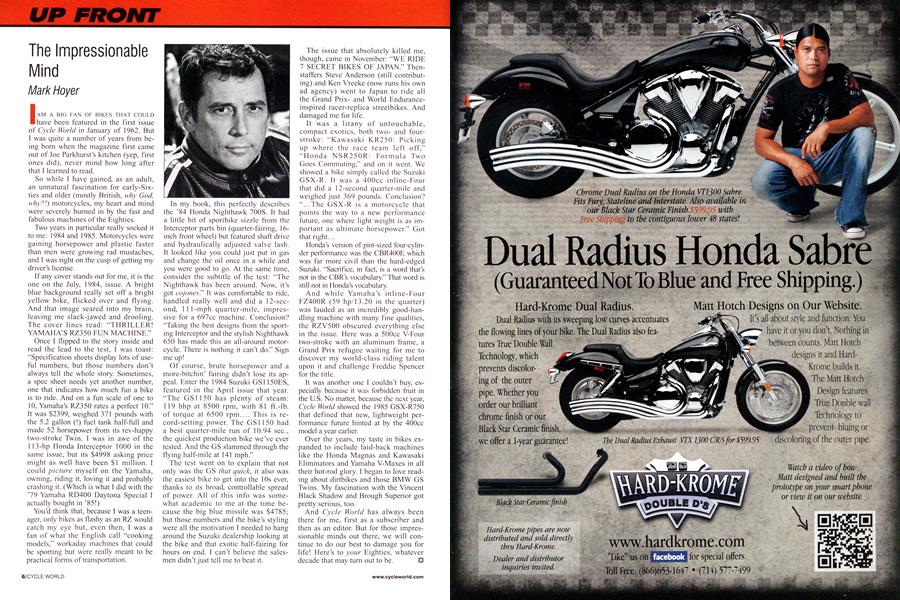
I AM A BIG FAN OF BIKES THAT COULD have been featured in the first issue of Cycle World in January of 1962. But I was quite a number of years from being born when the magazine first came out of Joe Parkhurst’s kitchen (yep, first ones did), never mind how long after that I learned to read.
So while I have gained, as an adult, an unnatural fascination for early-Sixties and older (mostly British, why God, why?!) motorcycles, my heart and mind were severely burned in by the fast and fabulous machines of the Eighties.
Two years in particular really socked it to me: 1984 and 1985. Motorcycles were gaining horsepower and plastic faster than men were growing rad mustaches, and 1 was right on the cusp of getting my driver’s license.
If any cover stands out for me, it is the one on the July, 1984, issue. A bright blue background really set off a bright yellow bike, flicked over and flying. And that image seared into my brain, leaving me slack-jawed and drooling. The cover lines read: “THRILLER! YAMAHA’S RZ350 FUN MACHINE.” Once I flipped to the story inside and read the lead to the test, 1 was toast: “Specification sheets display lots of useful numbers, but those numbers don’t always tell the whole story. Sometimes, a spec sheet needs yet another number, one that indicates how much fun a bike is to ride. And on a fun scale of one to 10, Yamaha’s RZ350 rates a perfect 10.” It was $2399, weighed 371 pounds with the 5.2 gallon (!) fuel tank half-full and made 52 horsepower from its rev-happy two-stroke Twin. I was in awe of the 113-hp Honda Interceptor 1000 in the same issue, but its $4998 asking price might as well have been $1 million. I could picture myself on the Yamaha, owning, riding it, loving it and probably crashing it. (Which is what I did with the ’79 Yamaha RD400 Daytona Special I actually bought in ’85!)
You’d think that, because I was a teenager, only bikes as flashy as an RZ would catch my eye but, even then, I was a fan of what the English call “cooking models,” workaday machines that could be sporting but were really meant to be practical forms of transportation.
In my book, this perfectly describes the ’84 Honda Nighthawk 700S. It had a little bit of sportbike sizzle from the Interceptor parts bin (quarter-fairing, 16inch front wheel) but featured shaft drive and hydraulically adjusted valve lash. It looked like you could just put in gas and change the oil once in a while and you were good to go. At the same time, consider the subtitle of the test: “The Nighthawk has been around. Now, it’s got cojones.” It was comfortable to ride, handled really well and did a 12-second, lll-mph quarter-mile, impressive for a 697cc machine. Conclusion? “Taking the best designs from the sporting Interceptor and the stylish Nighthawk 650 has made this an all-around motorcycle. There is nothing it can’t do.” Sign me up!
Of course, brute horsepower and a more-bitchin’ fairing didn’t lose its appeal. Enter the 1984 Suzuki GSI 150ES, featured in the April issue that year. “The GS1150 has plenty of steam:
1 19 bhp at 8500 rpm, with 81 ft.-lb. of torque at 6500 rpm.... This is record-setting power. The GS1 150 had a best quarter-mile run of 10.94 sec., the quickest production bike we’ve ever tested. And the GS slammed through the flying half-mile at 141 mph.”
The test went on to explain that not only was the GS that quick, it also was the easiest bike to get into the 10s ever, thanks to its broad, controllable spread of power. All of this info was somewhat academic to me at the time because the big blue missile was $4785; but those numbers and the bike’s styling were all the motivation I needed to hang around the Suzuki dealership looking at the bike and that exotic half-fairing for hours on end. I can't believe the salesmen didn’t just tell me to beat it.
The issue that absolutely killed me, though, came in November: “WE RIDE 7 SECRET BIKES OF JAPAN.” Thenstaffers Steve Anderson (still contributing) and Ken Vreeke (now runs his own ad agency) went to Japan to ride all the Grand Prixand World Enduranceinspired racer-replica streetbikes. And damaged me for life.
It was a litany of untouchable, compact exotics, both twoand fourstroke: “Kawasaki KR250: Picking up where the race team left off,” “Honda NSR250R: Formula Two Goes Commuting,” and on it went. We showed a bike simply called the Suzuki GSX-R. It was a 400cc inline-Four that did a 12-second quarter-mile and weighed just 369 pounds. Conclusion? “...The GSX-R is a motorcycle that points the way to a new performance future, one where light weight is as important as ultimate horsepower.” Got that right...
Honda’s version of pint-sized four-cylinder performance was the CBR400F, which was far more civil than the hard-edged Suzuki. “Sacrifice, in fact, is a word that’s not in the CBR’s vocabulary.” That word is still not in Honda’s vocabulary.
And while Yamaha’s inline-Four FZ400R (59 hp/13.20 in the quarter) was lauded as an incredibly good-handling machine with many fine qualities, the RZV500 obscured everything else in the issue. Here was a 5()0cc V-Four two-stroke with an aluminum frame, a Grand Prix refugee waiting for me to discover my world-class riding talent upon it and challenge Freddie Spencer for the title.
It was another one I couldn’t buy, especially because it was forbidden fruit in the U.S. No matter, because the next year, Cycle World showed the 1985 GSX-R750 that defined that new, lightweight performance future hinted at by the 400cc model a year earlier.
Over the years, my taste in bikes expanded to include laid-back machines like the Honda Magnas and Kawasaki Eliminators and Yamaha V-Maxes in all their hot-rod glory. I began to love reading about dirtbikes and those BMW GS Twins. My fascination with the Vincent Black Shadow and Brough Superior got pretty serious, too.
And Cycle World has always been there for me, first as a subscriber and then as an editor. But for those impressionable minds out there, we will continue to do our best to damage you for life! Flere’s to your Eighties, whatever decade that may turn out to be.