Kawasakizx-14r
KAWASAKIZX-14R
ROUNDUP
Is this the most-powerful and fastest-accelerating production motorcycle on Earth?
MATTHEW MILES
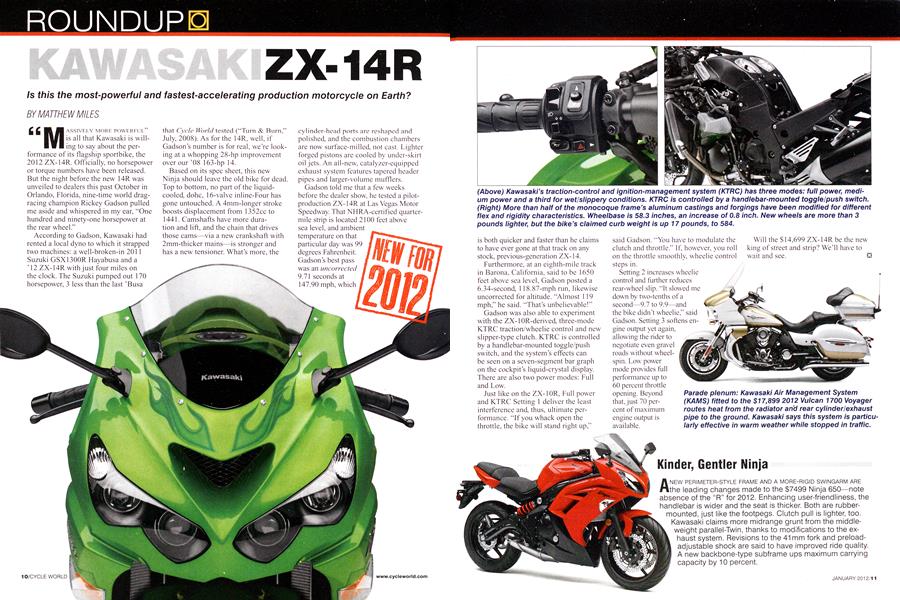
"MASSIVELY MORE POWERFUL” is all that Kawasaki is willing to say about the performance of its flagship sportbike, the 2012 ZX-14R. Officially, no horsepower or torque numbers have been released. But the night before the new 14R was unveiled to dealers this past October in Orlando, Florida, nine-time world dragracing champion Rickey Gadson pulled me aside and whispered in my ear, “One hundred and ninety-one horsepower at the rear wheel.”
According to Gadson, Kawasaki had rented a local dyno to which it strapped two machines: a well-broken-in 201 l Suzuki GSX1300R Flayabusa and a ’12 ZX-14R with just four miles on the clock. The Suzuki pumped out 170 horsepower, 3 less than the last ’Busa
that Cycle World tested (“Turn & Burn,” July, 2008). As for the 14R, well, if Gadson’s number is for real, we're looking at a whopping 28-hp improvement over our '08 163-hp 14.
Based on its spec sheet, this new Ninja should leave the old bike for dead. Top to bottom, no part of the liquidcooled, dohc, 16-valve inline-Four has gone untouched. A 4mm-longer stroke boosts displacement from I352cc to 1441. Camshafts have more duration and lift, and the chain that drives those cams—via a new crankshaft with 2mm-thicker mains—is stronger and has a new tensioner. What’s more, the
cylinder-head ports are reshaped and polished, and the combustion chambers are now surface-milled, not cast. Lighter forged pistons are cooled by under-skirt oil jets. An all-new, catalyzer-equipped exhaust system features tapered header pipes and larger-volume mufflers.
Gadson told me that a few weeks before the dealer show, he tested a pilotproduction ZX-14R at Las Vegas Motor Speedway. That NMRA-ccrtified quartermile strip is located 2100 feet above sea level, and ambient temperature on that particular day was 99 degrees Fahrenheit.
Gadson's best pass was an uncorrected 9.71 seconds at 147.90 mph, which is both quicker and faster than he claims to have ever gone at that track on any stock, previous-generation ZX-14.
Furthermore, at an eighth-mile track in Barona, California, said to be 1650 feet above sea level, Gadson posted a 6.34-second, 118.87-mph run, likewise uncorrected for altitude. “Almost 119 mph,” he said. “That's unbelievable!”
Gadson was also able to experiment with the ZX-1 OR-derived, three-mode KTRC traction/wheelie control and new slipper-type clutch. KTRC is controlled by a handlebar-mounted toggle/push switch, and the system’s effects can be seen on a seven-segment bar graph on the cockpit’s liquid-crystal display. There are also two power modes: Full and Low.
Just like on the ZX-IOR, Full power and KTRC Setting l deliver the least interference and, thus, ultimate performance. “If you whack open the throttle, the bike will stand right up,”
said Gadson. "You have to modulate the clutch and throttlc.'~ If, however, you roll on the throttle smoothly, vheelie control
steps in.
Setting 2 increases wheelie control and further reduces rear-wheel slip. “It slowed me down by two-tenths of a second—9.7 to 9.9—and the bike didn’t wheelie,” said Gadson. Setting 3 softens engine output yet again, allowing the rider to negotiate even gravel roads without wheelspin. Low power mode provides full performance up to 60 percent throttle opening. Beyond that, just 70 percent of maximum engine output is available.
Will the S 14,699 ZX-14R be the new king of street and strip? We'll have to wait and see.
Kinder, Gentler Ninja
ANEW PERIMETER-STYLE FRAME AND A MORE-RIGID SWINGARM ARE the leading changes made to the $7499 Ninja 650—note absence of the “FT for 2012. Enhancing user-friendliness, the handlebar is wider and the seat is thicker. Both are rubbermounted, just like the footpegs. Clutch pull is lighter, too. Kawasaki claims more midrange grunt from the middleweight paraliel-Twin, thanks to modifications to the exhaust system. Revisions to the 41mm fork and preloadadjustable shock are said to have improved ride quality. A new backbone-type subframe ups maximum carrying capacity by 10 percent.