Vincent Reborn
VINCENT REBORN
CW EXCLUSIVE
Bringing Vincent back, with a little help from Honda
STEVE ANDERSON
THE LAST DECADE OF THE 20TH CENTURY was the decade of revivals. No, we’re not talking about Elmer Gantry-we’re talking about resurrected motorcycle nameplates. Excelsior-Henderson, Indian, Matchless, Norton, Triumph-all of these ancient brands and others have been brought back from the graveyard, to try again to make their way in the commercial motorcycle world. Add another name to that list, and one of the most that : Vincent. Bernard Li, the American who created the Eagle One line of car-care products (and then sold his company for a large fortune to Valvoline) is busy bringing the famous English marque back to life. And this is no thin attempt to repackage a Harley-clone engine or a Rotax Single into a pale replica of a classic. Instead, Li aims to built his first Vincent around Honda's most advanced Superbike engine, and to house it in a sophisticated chassis that harks back to both the beauty and the real-world functionality of the original Black Shadow. Shadow
Two prototype Vincents tell where Li and where he hopes to go. The first built was a machine that uses an updated version of the original Vincent VTwin in a modem chassis. Developed by an Australian y, RTV (which had made its own efforts to revive Vincent), the new/old engine displaces 1200cc, has a redesigned clutch that works and represents a slight modernization of Phil Irving’s archetypal 50-degree V-Twin.
The bike looks great, but according to Li, it wasn’t capable of competing in today’s world.
“The engine was just too old a design to give the level of performance today’s rider expects. It’s like a ’57 Chevrolet BelAir. The BelAir looks cool, but when you go to drive one...they drive like crap by today’s standards,” he says. “There’s also production efficiencies and certifiability to take into account. By the time you’re done meeting current standards, it doesn’t look the same and you’ve ended up with a great old bike-while Vincents were about generationleading performance.”
After determining it wasn’t feasible to design and produce a new engine from the beginning for his startup motorcycle company, Li went looking for one currently in production. He found it in Honda’s RC51-a state-of-the-art V-Twin that had proven itself on the racetrack and could give all the performance desired. The only problem was convincing Honda to sell him engines.
“Honda is a proud company,” says Li, “and they wanted something worthy of their legacy with this motor application. They told me, ‘We’re interested in you building a Vincent with a Honda motor, not a Honda with a Vincent badge.’” It was only after Honda was convinced of Li’s seriousness that it agreed to make engines available to him-something that it hadn’t done even with Bimota.
To design the new Vincent, Li recruited some talented partners. First was James Parker, of RADD fame, designer of the single-sided-swingarm front suspension that he licensed to Yamaha for the GTS 1000. Acting as the back-up team was Roush Industries, the specialty engineering-support company that has assisted in everything from designing Detroit hot-rods to Harley’s VR1000 Superbike engine.
“Parker was perfect for this job,” says Li. “He comes from both an art and technical background, and he truly understands the heritage of Vincent.”
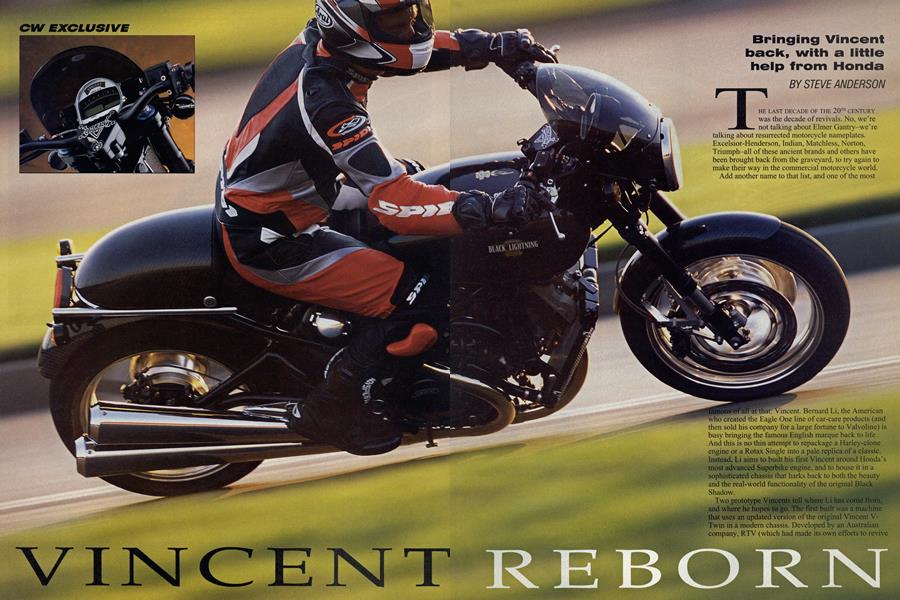
Parker designed a chassis that is reminiscent of past Vincents while being thoroughly modem. It carries 17-inch wheels on a long, 62.5-inch wheelbase, and the frame itself is aluminum, put together on this prototype with beautiful welds. A large backbone serves as the airbox, with the air filter and intake actually in front of the steering head. The triangulated swingarm and rear suspension are a straightforward translation of classic Vincent practice into the modem world. The fork is a high-end Showa unit, similar to that fitted to the RC51, as is the rear damper, while the latest Brembo calipers and discs provide braking.
The detailing, though, is what really sets this new Vincent apart. The classic cues are there, such as the big round headlight and instrument housing-but they have modem twists. The headlight doesn’t hold a single round bulb. Instead, mounted in its reflective surface are several modem projector bulbs that work independently. And those instruments are not Smith’s Chronométries; the speedometer and tach are their modem electronic equivalents, more current Formula One practice than English tradition. Similarly, the apparent gas tank isn’t-it’s just a beautifully crafted carbon-fiber shell that covers the frame/airbox and gives your knees something to grip. On this model, a perfect clearcoat shows the carbonfiber weave. Another model will have its composite bodywork painted black and run spoked rims. A power-cruiser and sport-tourer are also in the prototype stage.
In appearance, then, this Vincent harks back to the old while embracing the new. As for performance, Li had some definite ideas about what he wanted. Like many others, he grew up on Japanese motorcycles, stopped riding for years, and came back to motorcycles in middle age through the Harley-Davidson boom. He had several hot-rod Harleys built, but realized he didn't want all the image baggage that went with Harleys, and wanted more performance.
“A friend, Bill Babcock, said it best,” remembers Li. ‘“It’s not that we really want Harley-Davidsons, they’re just the closest thing. We really want Black Shadows with brakes.’ It had to be the bike your momma was always afraid of.”
So the RC51 engine has not been detuned in the least, and with its barely muffled howl provides a full Superbike soundtrack-production versions will have to make do with something less, but there will certainly be the usual “offroad” kit to recover the prototype’s bellow. The long wheelbase and conservative steering geometry-neither exceptionally steep nor raked out-are aimed at providing “solid, stable handling,” says Li, “not super-quick. That’s what I like, and this bike is a lot about what I like.”
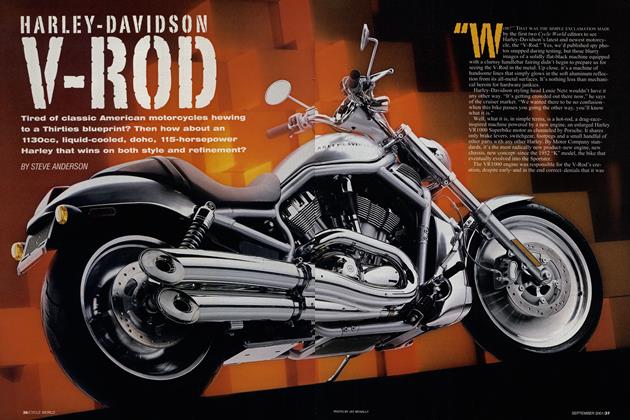
After our brief ride on this prototype, we’d have to say that Li has achieved his goal of creating a retro-influenced machine that still has a lot of modem sportbike in it. Powering a machine weighing somewhere in the low 400pound range, the big V-Twin provides a true thrill-seeker’s rush. The fuel-injected engine pulls well from low rpm, and then revs out with a top-end rush that even a Harley V-Rod doesn’t have. Quarter-mile times should be in the low-11, high-10-second range, depending on how much of the engine’s power makes it past sound and emissions tuning.
Steering is welcomely neutral, and the Vincent prototype feels long, light and very stable. Even at 125 mph, the Vincent broadcasts to its rider security and confidence, with not a hint of weave. The sportbike tires provide more traction than there is ground clearance, and this prototype will start dragging hard parts long before any true racer-replica. But then again, it will lean over farther than any sport-cruiser, with far more cornering clearance than a V-Rod, for instance. Li mentions that he likes the stability and heavier steering of BMW Boxers, and there’s a lot of that grown-up feel in this new Vincent.
Of course, there’s a lot more to selling motorcycles than building a prototype, but Li is gathering investment monies and moving toward production. The schedule calls for the first bikes to reach the public in the third or fourth quarter of 2004, which means realistically you might be able to buy and ride one by early 2005 if all goes well. Roush has been retained to shepherd the design through all the testing and certification required, and the Vincent factory will be like that of Aprilia and Buell-largely an assembly operation.
“You should never reinvent the wheel,” says Li. “We’re going to get the most competent guys around to supply parts-and that’s generally the guy who’s already been making the part for a profit for the last 40 years.” So while many of the components, from the frame and bodywork to the engine sidecovers to the forged aluminum wheels, will be unique to the Vincent, they will be made by established motorcycle and automotive suppliers.
But most importantly, Li has a burning passion to make Vincent live again. “Vincents were always mythical motorcycles that exceeded anything else,” he says. “Everyone knew about them and how fast they were. I want to extend that great and worthy legacy.” He’s on his way. □