Grand Prix Studies
GRAND PRIX STUDIES
GOING TO SCHOOL ON HONDA RS125s
KEVIN SMITH
IT SAID A LOT ABOUT THE DAY WHEN I DISCOVERED a whole new reason for hanging off. Shifting across the saddle in the right-left-right combination that ends a lap at the Streets of Willow Springs, I could take some time at the top, posting high on the pegs...and get a few brief shining moments of circulation back into my knees.
It was none too stylish, I imagine. And didn’t help my lap times. But as a way to keep my falling-asleep right leg in the game-and to keep me on the bike, on the track, cutting laps and having a blast-it was brilliantly creative, thank you very much.
Laugh if you want. But I was slashing apexes on a no-fooling, GP-pedigreed, “not-to-be-used-on-publicstreets” roadracing motorcycle. I wasn’t about to interrupt that for something that felt only a little worse than creeping gangrene.
As a rule, Americans don’t do tiddlers. At least not the devotees of pavement sport, who figure a twostroke, single-cylinder engine with all of a quarter-pint of swept volume belongs in a motocrosser. Or a shifter kart. Or a margarita blender. Europeans know better. But we Yanks are too insecure about the size of our pistons. Still, there was no ignoring that small headline in last April’s Street Bike magazine: “125cc GP Bike School,” it said.
“Whoa,” I said back. “So what if I outweigh them? I’m not marrying one, for heaven’s sake. I can go play for a day on somebody else’s cute little buzzbomb and not jeopardize my standing as a Real American Motorcyclist.”
And that’s how I came to be slouched in the sumptuous surroundings of a Willow Springs garage, listening to Keith Code describe the 125 experience. “It’s a little uncomfortable at first. After the first lap, you might decide you shouldn’t be here,” he said. “It does get better.”
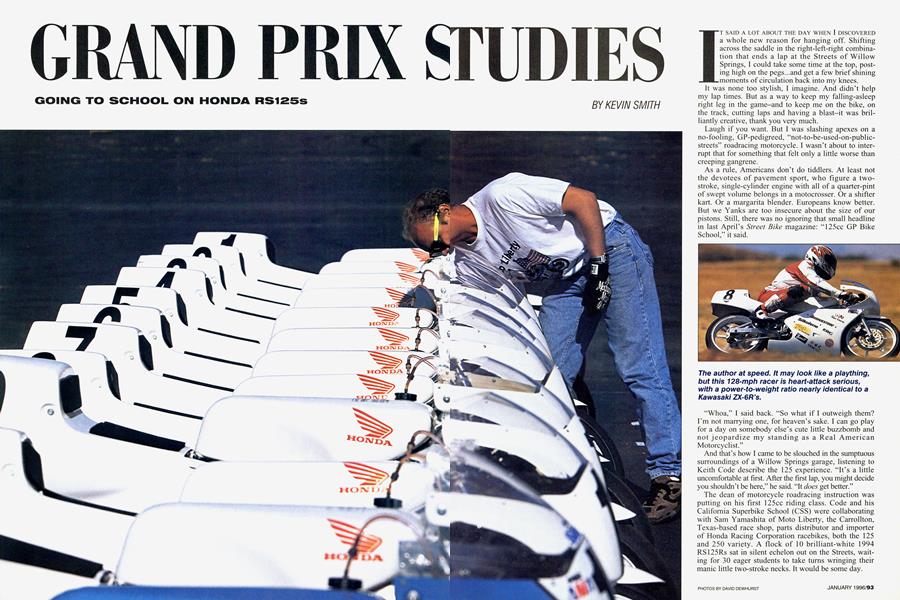
The dean of motorcycle roadracing instruction was putting on his first 125cc riding class. Code and his California Superbike School (CSS) were collaborating with Sam Yamashita of Moto Liberty, the Carrollton, Texas-based race shop, parts distributor and importer of Honda Racing Corporation racebikes, both the 125 and 250 variety. A flock of 10 brilliant-white 1994 RS125Rs sat in silent echelon out on the Streets, waiting for 30 eager students to take turns wringing their manic little two-stroke necks. It would be some day.
The 125 class has been quietly gaining momentum. It’s a mainstay of the worldwide GP scene, of course, but it has only recently begun to be appreciated Over Here. Starting fields at club events are growing, and, thanks to Yamashita’s sponsorship, many pro weekends have a 125 event on the card. So the eighth-liter mini-racers have been around a bit. And I, as a lapsed racer, street-going sportbike rider and aging family guy on a budget, had not failed to notice them.
The Code/Yamashita program jumped out at me. Here was the perfect way to answer questions that begged resolution. Can I fit on a 125? Should I want to? What’s a 125 like to ride? How fast is it, really? How is it similar to “regular” motorcycles? How is it different? Would a 125 make a realistic hobby racer for a normal-sized adult American male?
Eight hours after letting Code’s CSS folks take a Visa card imprint (my “damage deposit”-I’d already written a check for the $495 tuition), I had my answers.
The program followed the proven CSS curriculum. In three groups of 10, we alternated among chalk talk with Code, riding the track and letting it all sink in while catching our breath. And unkinking our legs. Each session emphasized a particular point: the Throttle Control/NoBrakes Drill, Rider Input, Quick Turning, Turn-In Points, the Two-Step Turn Entry.
But the stars of the proceedings were the bikes. That’s why most of us were there. The special characteristics and demands of 125 GP bikes dominated the discussion.
“These bikes are small,” Code began. “You can’t ride them like a 600 or 750. They’re real fussy. What you need to do as a rider is a lot less than you’re used to. You have to handle them gently.”
In addition to being small, they are genuine racers: “The bikes really are made to go around comers. They feel great doing that, and the faster you go, the better they feel.”
Throttle control, maybe the central tenet in riding a bike fast and well, came up continually. “The earlier in the turn you can get the gas on, the happier the bike is. It’ll stabilize instantly. If you’re not on the gas, the bike isn’t happy at all,” Code warned.
A dim light flickered in my head. Was that the nugget? Is that why 125s make great race trainers? They don’t overwhelm you with mass and power, yet they insist on being ridden at proper racing intensity? And they let you know when you aren’t managing it?
Yes to all the above.
Walking time, it top of up looked the to fairing “my” like bubble RSI25 a child’s for toy. was the barely first The crotch-high, the clip-ons put my hands about a foot apart, and the Moto Liberty technicians moved the bikes around by picking them up. But the RSs were gorgeous pieces: pure, simple, triple-distilled competition instruments, with no frills, no fat, no pretensions. And everything turned real serious when I bumped Number 8 to life and headed out onto the track with nine other eager souls. “Toy” never came to mind again.
But “little” sure did. With a dry weight of 152 pounds, a scant 49.4 inches between axles and no space to spare anywhere, a Honda RSI25 is indeed a tiny motorcycle. And although the first riding session was supposed to be a NoBrakes Drill, in which Code wanted us to focus on throttle management and turn entry, it was in fact an initial comingto-terms with the machines-a time to find out if we could operate a motorcycle, and keep doing it for 20 minutes, with each bun jammed down on a boot heel.
At least that’s how it felt to me. Okay, I’m a little on the meaty side of average in stature: a bit under 6 feet and about 180 pounds. I’m reasonably fit, but my middle-age joints lack their original flexibility, especially my right knee, the one with the surgeon tracks. Leg room would be my big challenge all day. I could get my feet on the RS’s pegs, but settling down into its saddle folded my legs enough to start a slow bum in both knees after six or eight minutes. I managed to find the shifter with my left foot, and got to where I could operate it with reasonable regularity; the rear brake, well, it was there, I assume.
Some exaggerated movements on the bike became a necessity to keep my legs alive. But other than that, riding the RS required no unnatural acts. The reach to the bars was easy, and there was nothing tricky in the manipulation of throttle, brake or clutch-though the wet clutch did have to be slipped for about a day and a half getting underway, the single-disc front brake was powerful beyond belief and the throttle response varied from nobody home (below 8000 rpm) to quite thrilling (nearing the 12,000-rpm power peak).
So, after just one riding session (of five), some answers were emerging. Yes, I could fit on a 125, with some effort.
And, oh boy yes, it was worth that effort. (It would also be worth investigating dropping the pegs an inch and maybe adding some seat foam, if it were my own.) Furthermore, an RSI25 was indeed a motorcycle; if you were familiar with how motorcycles worked, you could hustle a 125 around pretty much as you would anything else.
But it didn’t react like anything else. You know a 125 will be quick-turning and light to the touch, but it was still a revelation to discover how immediately it could be dropped into comers, redirected and moved around.
And that race-trainer character was evident. Turn 3 at the Streets is a long left through a gentle bowl; you enter downhill and exit going back uphill. After brakes and a backshift, the RS would lie into the turn happily, but if I waited to pick up the throttle where I might on a four-stroke, the little racer bobbled, pushed its front wheel wide and muttered to itself, “Jeez, where’d I pick up this wanker?” But cracking open the throttle as part of the comer-entry sequence promptly settled it. The front Bridgestone slick took a bite and the bike arced through the bend feeling stuck down. The magic worked!
Other impressions: Smoothness counts for a lot. There is no apparent limit to how quickly and how violently you can pitch around an RSI25, but the bike reacts to every command you issue, including the careless and inadvertent ones. Get sloppy with your body English, tense up or be too harsh with the controls, and the obedient RS mirrors back every stupid thing you do.
And if you were concerned a 125 would be too slow to be interesting, forget it. Running up the hill to Tum 1 in fifth (maybe sixth, for the fastest guys), slicing right for that apex, then cresting the rise into the braking zone for tight Turn 2, there was plenty of speed to manage. (Roadracing World reports Randy Renfrow’s RSI25 posted 128-mph trap speeds on the Brainerd front straight at last summer’s national.) As long as the tach needle is into the five-figure zone, rolling on throttle out of comers also generates attention-grabbing thrust. A rating of 37 horsepower sounds modest, but it meets little resistance, and no one fell asleep on the track, as far as I know.
“Getting to stick ’em in harder and quicker,” Code said after our second track session (subject: Rider Input), “would be agreeing with the way 125s are designed. You can go in deeper because there’s nothing to stop you from turning the bike faster. If you’re going to increase your turn speed, you do have to increase your turn rate.”
You also have to get the tum-in process right. Code drills a three-phase routine: turn, relax, throttle. That is, sight your trajectory and flick the bike in at your turning point, immediately relax when the lean and arc are established, and just as immediately crack on the gas to shift some weight off the nose and let the bike carve through under power. It’s a sound approach to turning most any motorcycle, but a 125 won’t let you do anything else.
Session Three was about Quick Turning, and although I felt a long way from really using the machine to attack the course, I did begin to feel some fragments of rhythm and flow. I was committing a little more seriously. I was also getting tired, riding tight, working too hard and not trusting the tires to grip at lean angles that were unfamiliar.
By the end of the fourth session (Tum-in Points), I felt better. I was-forgive me-beginning to think about passing more of my classmates, and fretting less over whether my knees would ever function again. And in the fifth and final session (the Two-Step Turn Entry: Sight your target and dive for it), I really began to focus on proceeding swiftly around the track, and not being distracted by a motorcycle that was two sizes too small. I was still not getting on the throttle soon enough unless specifically thinking about it, I was more tentative about tire grip than I had to be and I was only barely glimpsing the potential of these machines as true weapons of combat. But it was beginning to come together, and I was having a ball. And then, too soon, it was over.
For for prix anyone racing motorcycle, contemplating fans who want the Keith racing to sample Code/Sam the 125 a true class, grand Yamaor shita schools are ideal. There are five dates set around the country for 1996; call the California Superbike School (818/246-0717) for information. And Moto Liberty (214/242-6440) may still have some leftover 1994 RS125Rs at $6995 (or 1995 and 1996 models for considerably more).
So, did I get all my answers? Absolutely. Though 125 GP bikes are small, there is nothing remotely frivolous about the way they tilt the horizon crazily and hurl you toward comer
apexes. Yes, they are real motorcycles. More than that, they are dead-serious competition machines, which can be fielded at a reasonable cost and maintained with minimal trouble. Guiding them around a racetrack will definitely improve your riding. And maybe make your style more creative. □
A former staffer at Motor Trend, Automobile and Car and Driver magazines, Kevin Smith is currently employed by Team One, Lexus ’ advertising agency.