Yamaha
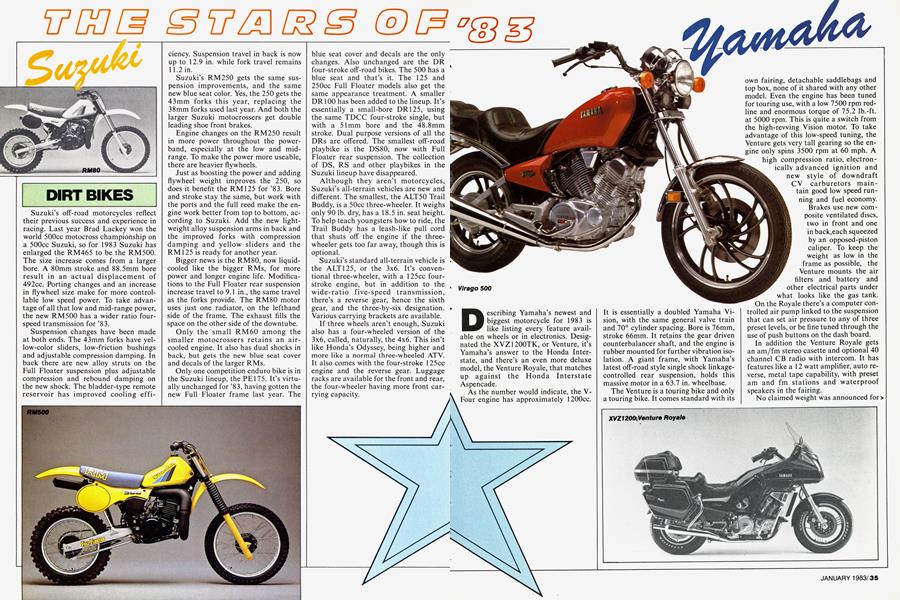
Yamaha
Describing Yamaha's newest and biggest motorcycle for 1983 is like listing every feature available on wheels or in electronics. Designated the XVZ1200TK, or Venture, it's Yamaha's answer to the Honda Interstate, and there's an even more deluxe model, the Venture Royale, that matches up against the Honda Interstate Aspencade.
As the number would indicate, the VFour engine has approximately 1200cc.
It is essentially a doubled Yamaha Vision, with the same general valve train and 70° cylinder spacing. Bore is 76mm, stroke 66mm. It retains the gear driven counterbalancer shaft, and the engine is rubber mounted for further vibration isolation. A giant frame, with Yamaha’s latest off-road style single shock linkagecontrolled rear suspension, holds this massive motor in a 63.7 in. wheelbase.
The Venture is a touring bike and only a touring bike. It comes standard with its own fairing, detachable saddlebags and top box, none of it shared with any other model. Even the engine has been tuned for touring use, with a low 7500 rpm redline and enormous torque of 75.2 lb.-ft. at 5000 rpm. This is quite a switch from the high-revving Vision motor. To take advantage of this low-speed tuning, the Venture gets very tall gearing so the engine only spins 3500 rpm at 60 mph. A high compression ratio, electronically advanced ignition and new style of downdraft CV carburetors maintain good low speed running and fuel economy. Brakes use new composite ventilated discs, two in front and one in back,each squeezed by an opposed-piston caliper. To keep the weight as low in the frame as possible, the Venture mounts the air filters and battery and other electrical parts under what looks like the gas tank. On the Royale there’s a computer controlled air pump linked to the suspension that can set air pressure to any of three preset levels, or be fine tuned through the use of push buttons on the dash board.
In addition the Venture Royale gets an am/fm stereo casette and optional 40 channel CB radio with intercom. It has features like a 12 watt amplifier, auto reverse, metal tape capability, with preset am and fm stations and waterproof speakers in the fairing.
No claimed weight was announced for> ^the Venture, but Yamaha engineers ex pect it to weigh no more than a Gold Wing.
For lightweight performance Yamaha has the 900 Seca, a bigger version of the original 750 Seca. By using the bottom end parts from the 650 Turbo, Yamaha could add a 67mm bore and 60.5mm stroke, creating a 853cc engine in a bike the size of a lightweight 750. Claimed dry weight is 483 lb. Yamaha people have talked about close to 100 bhp, for an excellent power to weight ratio.
Features of the 900 Seca include the new lightweight ventilated brakes, remote reservoir shocks, adjustable handlebars, an integral fork brace and air ducts for added cylinder head cooling.
The other new model in Yamaha’s street range is the Virago 500, a smaller and lighter Virago, but still with the aircooled V-Twin engine. A bore of 73mm, stroke of 59mm and 70° cylinder angle are used.
Styling is just like the larger 750 and 920 Viragos, with the teardrop gas tank, pull-back bars, stepped seat and fat rear tire. The stressed engine frame still has a single shock rear suspension and carries a shaft drive.
Ornamentation on the Virago series is kept to a minimum this year, with the 920 Virago getting simpler round instruments, a round headlight and normal steel tube handlebars.
For something special, there’s Midnight Virago, in 750 and 920 versions. Like the original Midnight Special Yamahas, the Midnight Viragos get all black and gold paint and trim. Gold headlight rim, carb covers, wheels and brake discs are included. Everything else is shiny black. On the 920 there’s a backrest on the sissy bar.
Yamaha’s Maxims are still available, still fast and stylish. The 1100 Maxim is gone, the 750 now being the biggest Maxim. It gets simpler round headlight and instrumentation, and has conventional tube handlebars, but retains the adjustable footpegs. Similar styled Maxims are available as the 650, 5$0, or the 400cc Twin. A Midnight Maxim 750 is the black and gold version of the shaftdrive dohc Four.
Black and gold colors have found their way onto the Vision for 1983, along with a host of mechanical improvements and a sporty new fairing. The dohc 552cc VTwin now has a sports-touring fairing, with lower handlebars and more rearset footpegs. The styling is not so noticeably odd with the new pieces.
More horsepower has been added to the Vision with larger 36mm downdraft carbs, the addition of vacuum controlled intake flaps in the airbox, lower friction piston rings and modified exhaust system. Forks now have air adjust and adjustable damping, to better cope with the added weight from the fairing. A double front disc provides more stopping power. In back the single shock now has adjustable damping. A wider front wheel and tire have been added.
Some sporting Yamahas have been eliminated in 1983, including the Seca 650 and the XV920. But the Turbo 650 is back, now with 1mm larger fork tubes. Also continued is the Seca 550 and Seca 400.
One of motorcycling’s longest lived models, the 650 Twin continues as the Heritage Special. Yamaha’s four-stroke dual purpose bikes, from the XT125, to the XT200 and XT250, all the way to the XT550 continue unchanged.
DIRT BIKES
Yamaha is adopting new suspension designs and lighter weight parts to most of its motocross bikes for 1983, and including most of the new features in the IT enduro line as well.
Most of the news in recent years has been in single shock rear suspensions, and Yamaha has another in its long line of Monocross suspensions. This year the linkage is more like Honda’s Pro-Link, with a pair of linked levers at the forward end of the swing arm pushing on the end of the single shock. The entire package is lower and lighter than the previous system, as well as providing a more progressive suspension rate and lots of easy adjustment. To make the suspension more compliant in the middle of the stroke, where most riding is done, the suspension rate is softer, but becomes stiffer as the shock is compressed. The shock is smaller and lighter than the ’82 shock, and it’s mounted lower in the frame for a lower center of gravity. A short hose connects the shock to the large reservoir mounted on a frame rail beside the shock.
A knurled collar at the bottom of the shock controls rebound damping through 20 positions. The 15-position compression damping knob is on the top of the shock. Even spring preload adjustment is easier this year, with the adjustment collar in easy reach.
A new extruded aluminum swing arm is lighter and stronger and it’s anodized for improved appearance. This new rear suspension is used on the YZ490, YZ250, YZ125 and YZ80.
Forks on the 125, 250 and 490 are modified with a linear compression valve. The valve changes compression damping based on suspension velocity so the forks can be more compliant over stutter bumps, yet not bottom over big jumps.
More important than making the motorcycle light, is reducing unsprung weight. To do that, Yamaha’s new motorcrossers use a lighter aluminum rim, with the bead areas folded over to produce a hollow shape. Combined with new aluminum spoke nipples and new die cast aluminum hubs, the new motocrossers have lost 4.4 lb. of unsprung weight.
On the YZ490, these changes and others like the new gas tank, the revised airbox and the new, simpler throttle, reduce dry weight to 224 lb. Repositioned handlebars allow the rider to move farther forward for better turning. The 487cc reed valve engine now puts out more power.
Even more changes have been made to the YZ250. The liquid-cooled motor is all new, with 68mm bore and stroke. The YPVS variable exhaust port has been strengthened on the new engine and power is up throughout the rpm range, according to Yamaha. A new reed cage uses eight petal reeds. New gear ratios are used to take advantage of the newfound power.
Obviously the radiators are new, moved from the steering head to the frame tubes to lower the center of gravity and make turning easier. Large plastic scoops with louvers surround the radiators, increasing cooling capacity and protecting the radiators from debris.
The same changes to the cooling system have been made to the 125. With its new cylinder, head, crank, piston, water pump and straight-cut gear primary drive, the YZ125 motor is lighter and more powerful. Claimed dry weight is only 190 lb.
A lower frame-mounted and larger radiator helps the more powerful YZ80 keep making power longer. It gets the new Monocross suspension with 9.8 in. of travel. The leading axle 33mm forks have 9.4mm of travel. For the smallest class, there’s the YZ60, with Monoshock rear suspension and air-cooled 58cc reed valve engine.
Yamaha’s enduro bikes share many of the motocross improvements, including the new Monocross rear suspension. The IT490—obviously it gets the large engine from the motocrosser—has the 43mm forks and multi-adjustable rear suspension of the YZ490, plus a wide ratio five-speed transmission that the motocrosser doesn’t have. Because the new ITs come with more suspension travel than some organizations allow for enduro competition, Yamaha will sell a short-travel kit. For high speed competition the stock bikes with nearly 12 in. of travel are fine, but for slow speed competition, short legged riders or ISDE events, there will be the 10.5 in. kit.
About the only speed secret not on the new ITs are the lightweight wheels and aluminum spoke nipples. Still, claimed dry weight is down to 238 lb. for the 490, or 229 lb. for the air-cooled 250cc IT. Both share a new quick-release wheel design, as does the IT 175. Other shared features include handguards, quickchange air filter, and a toolkit mounted on the rear fender.
All the suspension refinements found in the motocrossers and big enduro bikes are also mounted on the TT600, the King Kong of off-road four-strokes. With basically the same motor as the XT550, the TT600 gets a 3mm larger bore for a total size of 595cc, all in one giant cylinder. But with the magnesium sidecases and aluminum kickstart arm along with other changes, the TT600 is 8.4 lb. lighter than the engine in the 550.
Claimed dry weight of the bike is 271 lb. That includes a new frame with a separate oil tank for the dry sump system, aluminum swing arm and the progressive rate single shock rear suspension. Travel is 10.6 in. in back and 11.8 in. in front.
Forks are 43mm, a tool bag is mounted on the rear fender, and it is equipped with enduro lighting. Axles are quick release, handguards are mounted on the handlebars and it has a double leading shoe front brake. S