Fast Burning Desired
FAST BURNING DESIRED
As the pace of motorcycle engine design has accelerated during the last few years, one of the most prominent trends is toward new (or at least recycled) combustion chamber shapes and turbulence-generating intake tracts. The objectives of these designs are more power, lower emissions, and better fuel economy, and the roads used to reach these goals are quicker combustion and swirl techniques that lead to less change in combustion time over the load and speed range. Quick burn times mean less heat is lost to the cylinder head and piston crown, and also mean higher compression ratios can be used for a given octane rating fuel. The swirl induced by intake trickery allows these benefits to be maintained over the entire engine operating range.
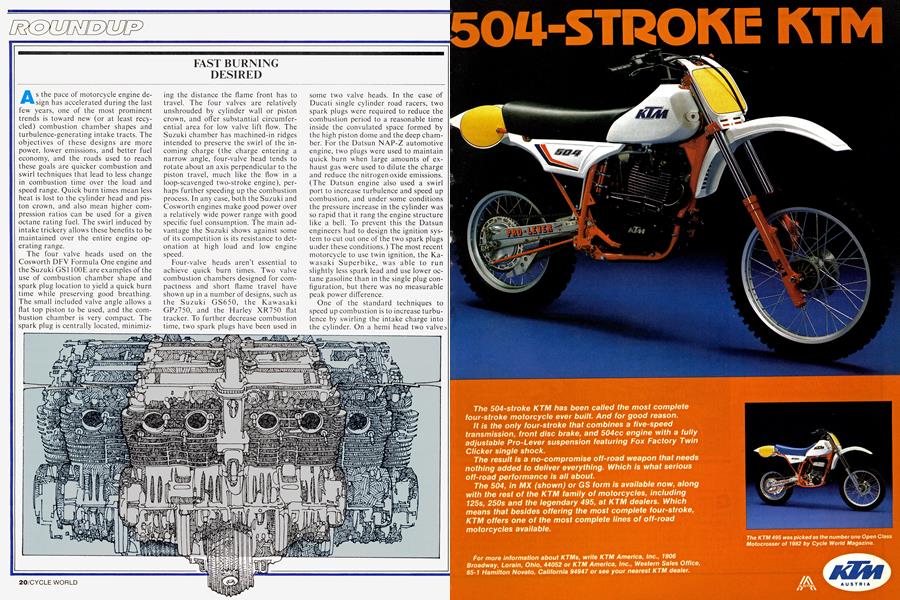
The four valve heads used on the Cosworth DFV Formula One engine and the Suzuki GSI 100E are examples of the use of combustion chamber shape and spark plug location to yield a quick burn time while preserving good breathing. The small included valve angle allows a flat top piston to be used, and the combustion chamber is very compact. The spark plug is centrally located, minimizing the distance the flame front has to travel. The four valves are relatively unshrouded by cylinder wall or piston crown, and offer substantial circumferential area for low valve lift flow. The Suzuki chamber has machined-in ridges intended to preserve the swirl of the incoming charge (the charge entering a narrow angle, four-valve head tends to rotate about an axis perpendicular to the piston travel, much like the flow in a loop-scavenged two-stroke engine), perhaps further speeding up the combustion process. In any case, both the Suzuki and Cosworth engines make good power over a relatively wide power range with good specific fuel consumption. The main advantage the Suzuki shows against some of its competition is its resistance to detonation at high load and low engine speed.
Four-valve heads aren’t essential to achieve quick burn times. Two valve combustion chambers designed for compactness and short flame travel have shown up in a number of designs, such as the Suzuki GS650, the Kawasaki GPz750, and the Harley XR750 flat tracker. To further decrease combustion time, two spark plugs have been used in some two valve heads. In the case of Ducati single cylinder road racers, two spark plugs were required to reduce the combustion period to a reasonable time inside the convulated space formed by the high piston dome and the deep chamber. For the Datsun NAP-Z automotive engine, two plugs were used to maintain quick burn when large amounts of exhaust gas were used to dilute the charge and reduce the nitrogen oxide emissions. (The Datsun engine also used a swirl port to increase turbulence and speed up combustion, and under some conditions the pressure increase in the cylinder was so rapid that it rang the engine structure like a bell. To prevent this the Datsun engineers had to design the ignition system to cut out one of the two spark plugs under these conditions.) The most recent motorcycle to use twin ignition, the Kawasaki Superbike, was able to run slightly less spark lead and use lower octane gasoline than in the single plug configuration, but there was no measurable peak power difference.
One of the standard techniques to speed up combustion is to increase turbulence by swirling the intake charge into the cylinder. On a hemi head two valve> design this can be done by slightly offsetting the intake valve, or by having the intake port directed tangentially into the cylinder. While this has the desired effect of speeding up combustion and improving part load fuel economy, high speed power suffers. Why? The swirl does speed up combustion, but under high speed and loads, more heat is actually lost because of the increased scrubbing of the turbulent gases with the cylinder head and piston than is saved by the quicker burn time. Also, the increased turbulence has been bought with a reduction in volumetric efficiency, and there’s simply less charge than there would be for a non-swirl design.
The ideal then would be to specify the amount of turbulence for a given engine condition. At high rpm and high load, when the high charge density and inherent turbulence ensure rapid burn rates, almost no additional swirl induced turbulence would be used. At lower speeds and loads, swirl could be used to improve power and economy. Some of the most recent engine designs are approaching this ideal. The Yamaha YICS used on four cylinder motorcycle engines consists of small ports poking out the side of the main intake ports, and aimed in tangentially at the cylinder. Because the small ports are fed by all four carburetors, and the main ports are fed by only one, the small ports add swirl to the charge under small throttle openings, and have almost no effect under full load. The result is an improvement in low load running with no drop in peak power. Last year, Yamaha carried this a step further with the two stage carburetor and two intake ports used on the XT550 Single. In this case, the mechanically controlled carburetor throat opened at low throttle settings, and the vacuum controlled carburetor throat remained closed. Under this condition the charge entered far off the cylinder center, creating substantial turbulence. Under full load, both carburetors would be open, the charge flow would be symmetrical, and no additional swirl would have been added. Honda is playing the same game this year on single cylinder engines with radially disposed valves and two stage carburetors. The main advantages of the radial valve arrangement may be that the more hemispherical combustion chamber will cause less disruption of the swirl than a pentroof design; larger valves can be used, and it looks different from the Yamaha design.