Honda
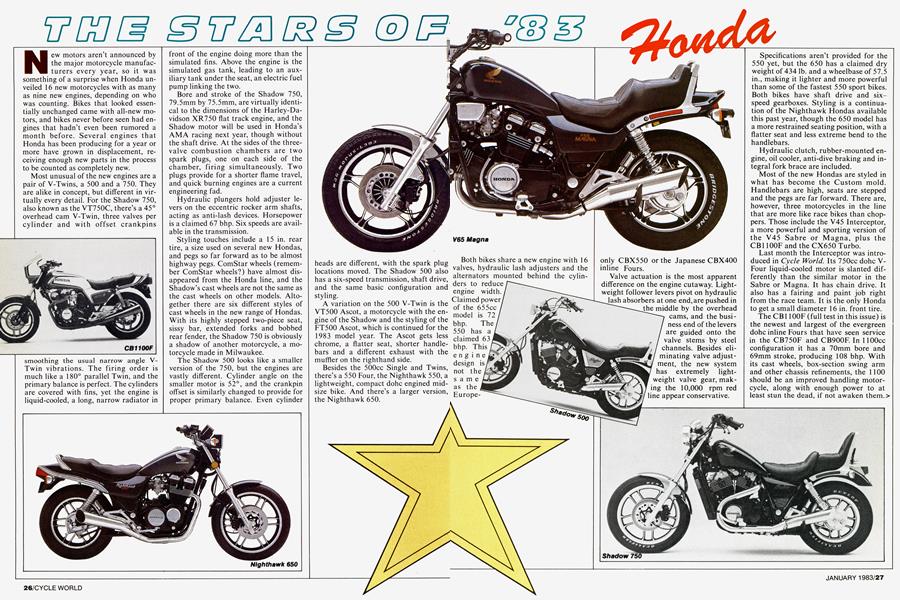
THE STARS OF '83
New motors aren't announced by the major motorcycle manufacturers every year, so it was something of a surprise when Honda unveiled 16 new motorcycles with as many as nine new engines, depending on who was counting. Bikes that looked essentially unchanged came with all-new motors, and bikes never before seen had engines that hadn't even been rumored a month before. Several engines that Honda has been producing for a year or more have grown in displacement, receiving enough new parts in the process to be counted as completely new.
Most unusual of the new engines are a pair of V-Twins, a 500 and a 750. They are alike in concept, but different in virtually every detail. For the Shadow 750, also known as the VT750C, there’s a 45° overhead cam V-Twin, three valves per cylinder and with offset crankpins smoothing the usual narrow angle VTwin vibrations. The firing order is much like a 180° parallel Twin, and the primary balance is perfect. The cylinders are covered with fins, yet the engine is liquid-cooled, a long, narrow radiator in front of the engine doing more than the simulated fins. Above the engine is the simulated gas tank, leading to an auxiliary tank under the seat, an electric fuel pump linking the two.
Bore and stroke of the Shadow 750, 79.5mm by 75.5mm, are virtually identical to the dimensions of the Harley-Davidson XR750 flat track engine, and the Shadow motor will be used in Honda’s AMA racing next year, though without the shaft drive. At the sides of the threevalve combustion chambers are two spark plugs, one on each side of the chamber, firing simultaneously. Two plugs provide for a shorter flame travel, and quick burning engines are a current engineering fad.
Hydraulic plungers hold adjuster levers on the eccentric rocker arm shafts, acting as anti-lash devices. Horsepower is a claimed 67 bhp. Six speeds are available in the transmission.
Styling touches include a 15 in. rear tire, a size used on several new Hondas, and pegs so far forward as to be almost highway pegs. ComStar wheels (remember ComStar wheels?) have almost disappeared from the Honda line, and the Shadow’s cast wheels are not the same as the cast wheels on other models. Altogether there are six different styles of cast wheels in the new range of Hondas. With its highly stepped two-piece seat, sissy bar, extended forks and bobbed rear fender, the Shadow 750 is obviously a shadow of another motorcycle, a motorcycle made in Milwaukee.
The Shadow 500 looks like a smaller version of the 750, but the engines are vastly different. Cylinder angle on the smaller motor is 52°, and the crankpin offset is similarly changed to provide for proper primary balance. Even cylinder heads are different, with the spark plug locations moved. The Shadow 500 also has a six-speed transmission, shaft drive, and the same basic configuration and styling.
A variation on the 500 V-Twin is the VT500 Ascot, a motorcycle with the engine of the Shadow and the styling of the FT500 Ascot, which is continued for the 1983 model year. The Ascot gets less chrome, a flatter seat, shorter handlebars and a different exhaust with the muffler on the righthand side.
Besides the 500cc Single and Twins, there’s a 550 Four, the Nighthawk 550, a lightweight, compact dohe engined midsize bike. And there’s a larger version, the Nighthawk 650.
Honda
Both bikes share a new engine with 16 valves, hydraulic lash adjusters and the alternators mounted behind the cylinders to reduce engine width. Claimed power of the 655cc model is 72 bhp. The 550 has a claimed 63 bhp. This engine design not the same as the Europeonly CBX550 or the Japanese CBX400 inline Fours.
Valve actuation is the most apparent difference on the engine cutaway. Lightweight follower levers pivot on hydraulic lash absorbers at one end, are pushed in the middle by the overhead cams, and the business end of the levers are guided onto the valve stems by steel channels. Besides eliminating valve adjustment, the new system has extremely lightweight valve gear, making the 10,000 rpm red line appear conservative.
Specifications aren’t provided for the 550 yet, but the 650 has a claimed dry weight of 434 lb. and a wheelbase of 57.5 in., making it lighter and more powerful than some of the fastest 550 sport bikes. Both bikes have shaft drive and sixspeed gearboxes. Styling is a continuation of the Nighthawk Hondas available this past year, though the 650 model has a more restrained seating position, with a flatter seat and less extreme bend to the handlebars.
Hydraulic clutch, rubber-mounted engine, oil cooler, anti-dive braking and integral fork brace are included.
Most of the new Hondas are styled in what has become the Custom mold. Handlebars are high, seats are stepped and the pegs are far forward. There are, however, three motorcycles in the line that are more like race bikes than choppers. Those include the V45 Interceptor, a more powerful and sporting version of the V45 Sabre or Magna, plus the CB1100F and the CX650 Turbo.
Last month the Interceptor was introduced in Cycle World. Its 750cc dohc VFour liquid-cooled motor is slanted differently than the similar motor in the Sabre or Magna. It has chain drive. It also has a fairing and paint job right from the race team. It is the only Honda to get a small diameter 16 in. front tire.
The CB1100F (full test in this issue) is the newest and largest of the evergreen dohc inline Fours that have seen service in the CB750F and CB900F. In llOOcc configuration it has a 70mm bore and 69mm stroke, producing 108 bhp. With its cast wheels, box-section swing arm and other chassis refinements, the 1100 should be an improved handling motorcycle, along with enough power to at least stun the dead, if not awaken them.> Styling is classic CB750/900F, with the addition of a tiny fork-mount sports fairing and a flashy red and white paint job. Last year the CX500 Turbo looked ex-
citing and was about as fast as the average 650 Four. And it was heavy. This year it looks even more exciting, in red, white and blue paint, with the fairing trimmed away some and weight trimmed off wherever possible. It also gets a larger engine, 674cc, which is shared with the new GL650 and CX650 models. It’s still a pushrod operated four-valve per cylinder V-Twin, but internal parts are beefed up to handle the additional power. The rear suspension is modified, still a Pro-Link single shock design, but with four-way adjustable rebound damping. Honda says the 650 Turbo has a simplified induction system, though what was simplified hasn’t been explained. In any case it should be a faster, better working motorcycle, with the additional displacement boosting low-speed torque, something the Turbo needed.
Honda’s V45 Magna already had good power, and it sold well, too. So in addition to the carryover V45 Sabre and Magna, there’s a new top of the line performance bike from Honda, the V65 Magna.Magna styling is the only version of the new 1 lOOcc V-Four. There is no Sabre or Interceptor at this time. What the Magna offers is power, a claimed 1 13 bhp, the most of any Honda. All that power comes from a dohc VFour, liquid cooled, and rubber mounted, it is transmitted through a six-speed transmission and a shaft drive.
In Honda’s tests, the V65 Magna has turned quartermile times in 10.88 sec. Until the same riders have a chance to ride all three under similar conditions, it will be impossible to pick a winner of the acceleration contest between the V65 Magna, the Suzuki GS1100 and the Kawasaki GPzl 100. All three should be capable of 10 sec. quarter miles.
How many parts are interchangeable between the V45 and V65 models won’t be known until Honda releases specifications on the V65. It has the same basic design as the smaller Magna, but various covers and engine parts have been made larger. The seat is shaped differently, the rear fender is higher and the 41mm forks are beefier. The V65 also gets a rectangular headlight and adjustable tubular handlebars.
Though the V65 will make an excellent touring bike when equipped with the Interstate fairing and saddlebags, Honda’s touring specialist continues to be the Gold Wing, available as the Aspencade with every option known to man, the Interstate with basic touring accessories, or the stripped GL1 100. All models come with a linked brake system, similar to that used on some Yamaha XS1100 models or Moto Guzzis. They also get new cast wheels, larger footpegs, anti-dive brakes and some minor appearance changes.
On the Aspencade model, there’s electronic display panel that does everything but call home. The liquid crystal display shows engine rpm in digits or analog. Velocity is indicated in either mph or kph, with the push of a button. Suspension air pressure is adjusted by button and displayed on the panel. Other buttons on the handlebar apparently set timers and odometers.
A simpler bike adaptable for touring the CB1000 Custom, a larger motored version of the CB900 Custom. It has the same inline dohc Four, with the dual range transmission and rubber engine mounts, but now with a 973cc engine. Bore size has been increased from 64.5mm to 67mm, accounting for the increased displacement.
Honda’s small touring bike, the GL500 is now the GL650, benefiting from the same displacement change gained by the Turbo. There’s also the CX650 Custom, but no standard model.
At the small end of the model range, the 450 Twins have been rearranged into the Nighthawk, the Hondamatic and standard CM450 with a drum front brake and wire spoke wheels. No Hawk model is available. The CM250 Twin gets belt final drive this year and is otherwise unchanged. There is no CB125 any more.
Dual purpose bikes include a new XL600R, a bike that shares a basic new engine design with the XR500R. The lightweight dry sump engine has a radial valve configuration, with the single overhead cam operating valves splayed out from the center of the cylinder. A pair of lever-type followers operate each valve, turning the motion of the single camshaft into the proper force to push the valves in from the corners of the head.
DIRT BIKES
A new radial head design is used on a pair of Honda four-stroke dirt bikes, the XR350R and XR500R. Instead of using the same engine design for both, the 350 gets a wet sump engine and the 500 gets a dry sump engine that uses frame tubes for the oil reservoir. The new engines are lighter and more powerful than the old XR motors, using one gear-driven counterbalancer shaft rather than two chain-driven shafts. Two stage dual carburetors are used, similar to the system used on the Yamaha XT550, but both are mechanically operated on the Hondas.
Remember the Diamond frame? That was the name Honda gave to the stressed-engine frame on the original XR models. Now the 350 and 500 Hondas have full cradle chrome-moly frames. Claimed dry weight of the 350 is 248 lb., and the 500 is listed at 262 lb. Other differences include the six-speed transmission in the 350 and five-speed in the 500. The 500 also gets a disc front brake, while the 350 on display had a single leading shoe drum.
Forks on the 500 are 43mm with 11 in. of travel. Rear suspension also has 11 in. of travel from the Pro-Link single shock. It also has adjustable rebound damping. The 41mm forks on the 350 have 11 in. of travel while the back end has 10.5 in. of travel.
Smaller XRs include the XR200R and XR200, essentially unchanged, and the XR100 and XR80.
Motocross bikes get a thorough revamping, too. The CR480R remains a 480, but it gets a five-speed transmission, after starting the trend to four-speed gearboxes. Revised linkage on the ProLink suspension results in 12.4 in. of travel, with 20 rebound and 12 compression adjustments. The 43mm forks have 14-way adjustable compression damping and 12 in. of travel.
Access to the rear shock and air box is easier now, with an unboltable rear frame section. A new lightweight aluminum silencer, redesigned fuel tank, alloy rims and straight pull spokes all help reduce weight to the AMA minimum of 225 lb. dry, according to Honda.
The same suspension changes are added to the more powerful and lighter CR250R. The radiators have been lowered 2 in., the head now has better cooling and the engine is designed for more power. Like the other new Hondas, it’s immediately identifiable by the blue seat. Dry weight is 213 lb.
Nothing gets changed more than the 125, and Honda has once again introduced a completely new engine in the CR125R. The drive sprocket is now on the left side of the bike, and the new engine produces a claimed 29 bhp at 11,000 rpm. The engine is more compact and the radiators have been moved for a lower center of gravity. It also gets the bolt-on rear frame and rear suspension changes, along with a lower (36.6 in.) seat height. A larger clutch is more durable and the straight pull spokes should be stronger.
The CR80R gets a claimed 20 bhp in a new semi-double cradle frame. It has a single radiator for the liquid-cooled engine, 31mm forks and Pro-Link rear suspension with 8.3 in. of travel. Weight is reduced to 137 lb.
For the 60cc class, there’s the CR60R, with 11.5 bhp, 119 lb. weight and ProLink suspension.
Honda is expanding the range of ATCs to include a fully suspended ATC200X, with the four-stroke motor and 250-style suspension, trailing axle fork, disc brakes and a large diameter, narrow section front tire.