Kawasaki
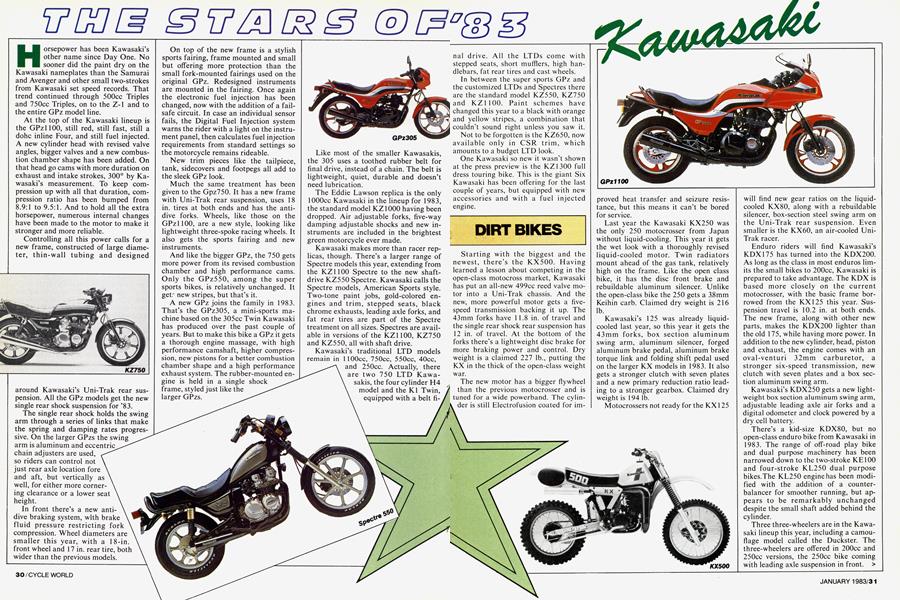
Horsepower has been Kawasaki's other name since Day One. No sooner did the paint dry on the Kawasaki nameplates than the Samurai and Avenger and other small two-strokes from Kawasaki set speed records. That trend continued through 500cc Triples and 750cc Triples, on to the Z-1 and to the entire GPz model line.
At the top of the Kawasaki lineup is the GPz 1100, still red, still fast, still a dohc inline Four, and still fuel injected. A new cylinder head with revised valve angles, bigger valves and a new combustion chamber shape has been added. On that head go cams with more duration on exhaust and intake strokes, 300° by Kawasaki’s measurement. To keep compression up with all that duration, compression ratio has been bumped from 8.9:1 to 9.5:1. And to hold all the extra horsepower, numerous internal changes have been made to the motor to make it stronger and more reliable.
Controlling all this power calls for a new frame, constructed of large diameter, thin-wall tubing and designed around Kawasaki’s Uni-Trak rear suspension. All the GPz models get the new single rear shock suspension for ’83.
The single rear shock holds the swing arm through a series of links that make the spring and damping rates progressive. On the larger GPzs the swing arm is aluminum and eccentric chain adjusters are used, so riders can control not just rear axle location fore and aft, but vertically as well, for either more cornering clearance or a lower seat height.
In front there’s a new antidive braking system, with brake fluid pressure restricting fork compression. Wheel diameters are smaller this year, with a 18-in. front wheel and 17 in. rear tire, both wider than the previous models.
On top of the new frame is a stylish sports fairing, frame mounted and small but offering more protection than the small fork-mounted fairings used on the original GPz. Redesigned instruments are mounted in the fairing. Once again the electronic fuel injection has been changed, now with the addition of a failsafe circuit. In case an individual sensor fails, the Digital Fuel Injection system warns the rider with a light on the instrument panel, then calculates fuel injection requirements from standard settings so the motorcycle remains rideable.
New trim pieces like the tailpiece, tank, sidecovers and footpegs all add to the sleek GPz look.
Much the same treatment has been given to the Gpz750. It has a new frame with Uni-Trak rear suspension, uses 18 in. tires at both ends and has the antidive forks. Wheels, like those on the GPz 1100, are a new style, looking like lightweight three-spoke racing wheels. It also gets the sports fairing and new instruments.
And like the bigger GPz, the 750 gets more power from its revised combustion chamber and high performance cams. Only the GPz550, among the super sports bikes, is relatively unchanged. It getr new stripes, but that’s it.
A new GPz joins the family in 1983. That’s the GPz305, a mini-sports machine based on the 305cc Twin Kawasaki has produced over the past couple of years. But to make this bike a GPz it gets a thorough engine massage, with high performance camshaft, higher compression, new pistons for a better combustion chamber shape and a high performance exhaust system. The rubber-mounted engine is held in a single shock frame, styled just like the larger GPzs.
Like most of the smaller Kawasakis, the 305 uses a toothed rubber belt for final drive, instead of a chain. The belt is lightweight, quiet, durable and doesn’t need lubrication.
The Eddie Lawson replica is the only lOOOcc Kawasaki in the lineup for 1983, the standard model KZ1000 having been dropped. Air adjustable forks, five-way damping adjustable shocks and new instruments are included in the brightest green motorcycle ever made.
Kawasaki makes more than racer replicas, though. There’s a larger range of Spectre models this year, extending from the KZ1100 Spectre to the new shaftdrive KZ550 Spectre. Kawasaki calls the Spectre models, American Sports style. Two-tone paint jobs, gold-colored engines and trim, stepped seats, black chrome exhausts, leading axle forks, and fat rear tires are part of the Spectre treatment on all sizes. Spectres are available in versions of the KZ1100, KZ750 and KZ550, all with shaft drive.
Kawasaki’s traditional LTD models remain in 1100cc, 750cc, 550cc, 40cc, and 250cc. Actually, there are two 750 LTD Kawasakis, the four cylinder H4 model and the K1 Twin, equipped with a belt final drive. All the LTDs come with stepped seats, short mufflers, high handlebars, fat rear tires and cast wheels.
Kawasaki
In between the super sports GPz and the customized LTDs and Spectres there are the standard model KZ550, KZ750 and KZ1100. Paint schemes have changed this year to a black with orange and yellow stripes, a combination that couldn’t sound right unless you saw it.
Not to be forgotten is the KZ650, now available only in CSR trim, which amounts to a budget LTD look.
One Kawasaki so new it wasn’t shown at the press preview is the KZ1300 full dress touring bike. This is the giant Six Kawasaki has been offering for the last couple of years, but equipped with new accessories and with a fuel injected engine.
DIRT BIKES
Starting with the biggest and the newest, there’s the KX500. Having learned a lesson about competing in the open-class motocross market, Kawasaki has put an all-new 499cc reed valve motor into a Uni-Trak chassis. And the new, more powerful motor gets a fivespeed transmission backing it up. The 43mm forks have 11.8 in. of travel and the single rear shock rear suspension has 12 in. of travel. At the bottom of the forks there’s a lightweight disc brake for more braking power and control. Dry weight is a claimed 227 lb., putting the KX in the thick of the open-class weight war.
The new motor has a bigger flywheel than the previous motocrosser and is tuned for a wide powerband. The cylink der is still Electrofusion coated for improved heat transfer and seizure resistance, but this means it can’t be bored for service.
Last year the Kawasaki KX250 was the only 250 motocrosser from Japan without liquid-cooling. This year it gets the wet look with a thoroughly revised liquid-cooled motor. Twin radiators mount ahead of the gas tank, relatively high on the frame. Like the open class bike, it has the disc front brake and rebuildable aluminum silencer. Unlike the open-class bike the 250 gets a 3.8mm Keihin carb. Claimed dry weight is 216 lb.
Kawasaki’s 125 was already liquidcooled last year, so this year it gets the 43mm forks, box section aluminum swing arm, aluminum silencer, forged aluminum brake pedal, aluminum brake torque link and folding shift pedal used on the larger KX models in 1983. It also gets a stronger clutch with seven plates and a new primary reduction ratio leading to a stronger gearbox. Claimed dry weight is 194 lb.
Motocrossers not ready for the KX 125 will find new gear ratios on the liquidcooled KX80, along with a rebuildable silencer, box-section steel swing arm on the Uni-Trak rear suspension. Even smaller is the KX60, an air-cooled UniTrak racer.
Enduro riders will find Kawasaki’s KDX175 has turned into the KDX200. As long as the class in most enduros limits the small bikes to 200cc, Kawasaki is prepared to take advantage. The KDX is based more closely on the current motocrosser, with the basic frame borrowed from the KX125 this year. Suspension travel is 10.2 in. at both ends. The new frame, along with other new parts, makes the KDX200 lighter than the old 175, while having more power. In addition to the new cylinder, head, piston and exhaust, the engine comes with an oval-venturi 32mm carburetor, a stronger six-speed transmission, new clutch with seven plates and a box section aluminum swing arm.
Kawasaki’s KDX250 gets a new lightweight box section aluminum swing arm, adjustable leading axle air forks and a digital odometer and clock powered by a dry cell battery.
There’s a kid-size KDX80, but no open-class enduro bike from Kawasaki in 1983. The range of off-road play bike and dual purpose machinery has been narrowed down to the two-stroke KE100 and four-stroke KL250 dual purpose bikes.The KL250 engine has been modified with the addition of a counterbalancer for smoother running, but appears to be remarkably unchanged despite the small shaft added behind the cylinder.
Three three-wheelers are in the Kawasaki lineup this year, including a camouflage model called the Duckster. The three-wheelers are offered in 200cc and 250cc versions, the 250cc bike coming with leading axle suspension in front. >