Yamaha Dirt Bikes For 1978
YAMAHA DIRT BIKES FOR 1978
The Motocross Models Were Already Good, So Yamaha Made Them Better
Len Vucci
Evolution: A process of continuous change from a lower, simpler, or worse to a higher, more complex, or better state.
In a market as dynamic and demanding as motorcycling, where evolve or die is a basic law, Yamaha Motor Corporation is very much alive.
The site was the New Orleans Superdome, and the sight was the complete Yamaha line for 1978, unveiled before several thousand enthusiastic dealers from across the United States. The showing held few surprises for the majority of wellinformed spectators, but visions of increased sales and revenue brought the Yamaha vendors to their feet more than a few times. The excitement was contagious, no doubt stimulated by the prospect of our obtaining samples for tests in the near future.
We previewed Yamaha’s 1978 street machinery for our November 1977 issue, so w'e’ll refer you there rather than repeat the same here. The DT-series dual-purpose bikes remain essentially unchanged from prior models, as do the extremely successful IT models. The IT250. however, gets a new 6-speed gearbox.
Other noteworthy changes include the accelerator-pumped Mikuni carburetor on the XT and TT model Singles, as well as on the SR500 Streeter. The real news comes with the formidable YZ models. An already competitive model line is made more race-ready by the adaptation of raceproven design and component changes.
But enough generalities. When you lay your money down, here’s what you'll get:
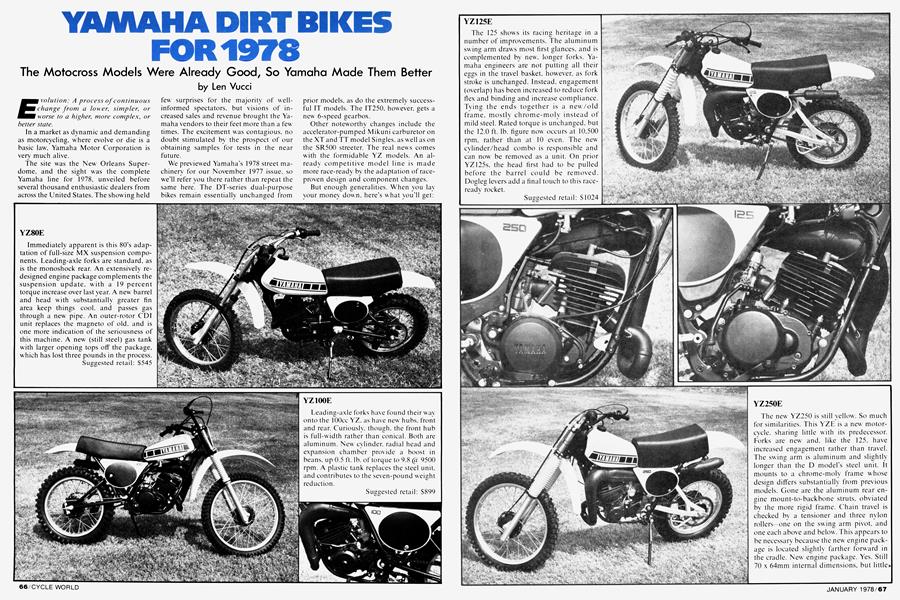
YZ80E
Immediately apparent is this 80’s adaptation of full-size MX suspension components. Leading-axle forks are standard, as is the monoshock rear. An extensively redesigned engine package complements the suspension update, with a 19 percent torque increase over last year. A new barrel and head with substantially greater fin area keep things cool, and passes gas through a new pipe. An outer-rotor CDI unit replaces the magneto of old, and is one more indication of the seriousness of this machine. A new (still steel) gas tank with larger opening tops off the package, which has lost three pounds in the process.
Suggested retail: $545
YZ100E
Leading-axle forks have found their way onto the 100cc YZ, as have new hubs, front and rear. Curiously, though, the front hub is full-width rather than conical. Both are aluminum. New cylinder, radial head and expansion chamber provide a boost in beans, up 0.5 ft. lb. of torque to 9.8 (a 9500 rpm. A plastic tank replaces the steel unit, and contributes to the seven-pound weight reduction.
Suggested retail: $899
YZ125E
The 125 shows its racing heritage in a number of improvements. The aluminum swing arm draws most first glances, and is complemented by new. longer forks. Yamaha engineers are not putting all their eggs in the travel basket, however, as fork stroke is unchanged. Instead, engagement (overlap) has been increased to reduce fork flex and binding and increase compliance. Tying the ends together is a new/old frame, mostly chrome-moly instead of mild steel. Rated torque is unchanged, but the 12.0 ft. lb. figure now occurs at 10.500 rpm. rather than at 10 even. The new cylinder/head combo is responsible and can now be removed as a unit. On prior YZ125s, the head first had to be pulled before the barrel could be removed. Dogleg levers add a final touch to this raceready rocket. Suggested retail: $1024
YZ250E
The new YZ250 is still yellow. So much for similarities. This YZE is a new motorcycle. sharing little with its predecessor. Forks are new and. like the 125, have increased engagement rather than travel. The swing arm is aluminum and slightly longer than the D model's steel unit. It mounts to a chrome-moly frame whose design differs substantially from previous models. Gone are the aluminum rear engine mount-to-backbone struts, obviated by the more rigid frame. Chain travel is checked by a tensioner and three nylon rollers—one on the swing arm pivot, and one each above and below. This appears to be necessary because the new engine package is located slightly farther forward in the cradle. New engine package. Yes. Still 70 x 64mm internal dimensions, but little: else the same. The new powerplant is compact, yet offers more of everything (except weight, of course). Fed by a new, larger airbox and a 38mm Mikuni, the new cylinder/head/piston/pipe configuration produces a higher, wider powerband. Somewhere in this weight reduction process another gain was realized: The new transmission is a six-speed! Helping the rider keep a grip on things are dogleg levers and a recontoured seat. All these plusses in a 216 lb. (claimed) motoscooter make the YZ250E a prime contender for 1978.
Suggested retail: $1498
YZ400E
Last, largest, but definitely not least, is the new YZ400, which shares the same race-bred improvements as its smaller counterparts. Longer forks and an aluminum swing arm are incorporated, as is chrome-moly for frame material. The already potent 400 engine is basically unchanged. but the suspension improvements should get more of that power to the ground. Dogleg levers are standard and. if you haven’t already noticed, all the ’78 YZs feature bright yellow fork gaiters for E-Z identification.
Suggested retail: $1598