What's New In Wheels, Forks And Shocks?
WHAT'S NEW IN WHEELS, FORKS AND SHOCKS?
Mag wheels, or more correctly, cast alloy wheels, have attracted the undi-vided attention of a sizable number of street riders ever since their introduc-tion in 1971.
From an appearance standpoint, the pioneer cast wheels were fantastic, but in reality they proved more trouble than they were worth. First of all, the early cast units required disc brakes front and rear. The front presented no problem, as most modern street bikes come standard with a disc on the leading end. The rear, on the other hand, was a nightmare. The standard drum unit, its backing plate, and the rear brake linkage were useless. In addition to the wheel, the purchaser had to adapt an appropriate drive sprocket, and an aftermarket disc brake. Tabs had to be welded to the frame for attachment of the caliper assembly and master cylinder, and then custom linkage had to be fabricated to connect the new system to the existing rear brake pedal. Not only was cost prohibitive, but the custom work required made installation impossible for the average biker.
Compounding this hassle were problems with breakage. It seems several of the initial builders underestimated strength requirements, so cracks often appeared at the junction of spoke and rim and/or spoke and hub.
The first major breakthrough came from Morris in Santa Ana, California. He began by making cast magnesium wheels for racers that were not only strong, but considerably lighter than the original equipment wheels they replaced. Next came strong cast aluminum wheels for custom builders, but the problem of fitting a disc rear brake remained.
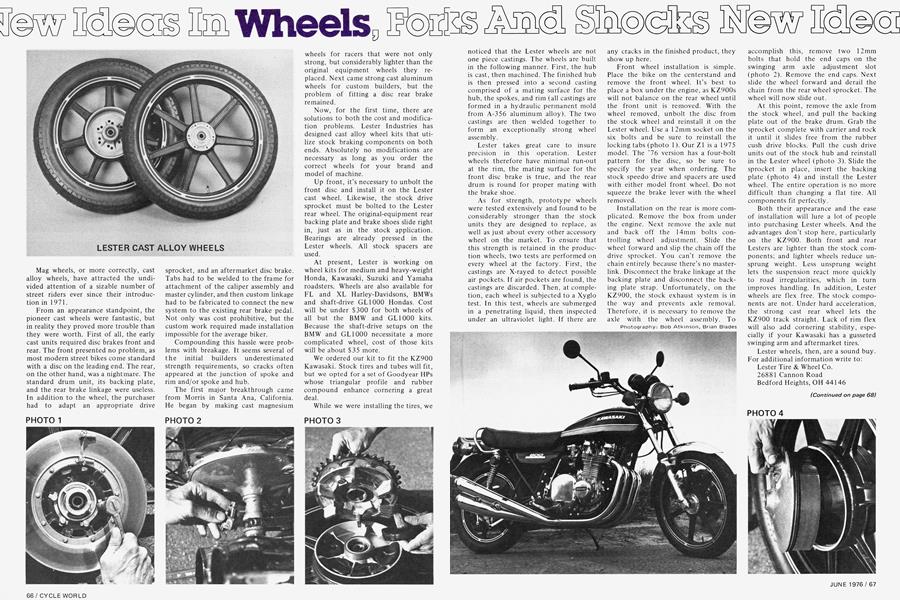
Now, for the first time, there are solutions to both the cost and modification problems. Lester Industries has designed cast alloy wheel kits that utilize stock braking components on both ends. Absolutely no modifications are necessary as long as you order the correct wheels for your brand and model of machine.
Up front, it’s necessary to unbolt the front disc and install it on the Lester cast wheel. Likewise, the stock drive sprocket must be bolted to the Lester rear wheel. The original-equipment rear backing plate and brake shoes slide right in, just as in the stock application. Bearings are already pressed in the Lester wheels. All stock spacers are used.
At present, Lester is working on wheel kits for medium and heavy-weight Honda, Kawasaki, Suzuki and Yamaha roadsters. Wheels are also available for FL and XL Harley-Davidsons, BMWs and shaft-drive GL1000 Hondas. Cost will be under $300 for both wheels of all but the BMW and GL1000 kits. Because the shaft-drive setups on the BMW and GL1000 necessitate a more complicated wheel, cost of those kits will be about $35 more.
We ordered our kit to fit the KZ900 Kawasaki. Stock tires and tubes will fit, but we opted for a set of Goodyear HPs whose triangular profile and rubber compound enhance cornering a great deal.
While we were installing the tires, we noticed that the Lester wheels are not one piece castings. The wheels are built in the following manner. First, the hub is cast, then machined. The finished hub is then pressed into a second casting comprised of a mating surface for the hub, the spokes, and rim (all castings are formed in a hydraulic permanent mold from A-356 aluminum alloy). The two castings are then welded together to form an exceptionally strong wheel assembly.
Lester takes great care to insure precision in this operation. Lester wheels therefore have minimal run-out at the rim, the mating surface for the front disc brake is true, and the rear drum is round for proper mating with the brake shoe.
As for strength, prototype wheels were tested extensively and found to be considerably stronger than the stock units they are designed to replace, as well as just about every other accessory wheel on the market. To ensure that this strength is retained in the production wheels, two tests are performed on every wheel at the factory. First, the castings are X-rayed to detect possible air pockets. If air pockets are found, the castings are discarded. Then, at completion, each wheel is subjected to a Xyglo test. In this test, wheels are submerged in a penetrating liquid, then inspected under an ultraviolet light. If there are any cracks in the finished product, they show up here.
Front wheel installation is simple. Place the bike on the centerstand and remove the front wheel. It’s best to place a box under the engine, as KZ900s will not balance on the rear wheel until the front unit is removed. With the wheel removed, unbolt the disc from the stock wheel and reinstall it on the Lester wheel. Use a 1 2mm socket on the six bolts and be sure to reinstall the locking tabs (photo 1). Our Z1 is a 1975 model. The ’76 version has a four-bolt pattern for the disc, so be sure to specify the year when ordering. The stock speedo drive and spacers are used with either model front wheel. Do not squeeze the brake lever with the wheel removed.
Installation on the rear is more complicated. Remove the box from under the engine. Next remove the axle nut and back off the 14mm bolts controlling wheel adjustment. Slide the wheel forward and slip the chain off the drive sprocket. You can’t remove the chain entirely because there’s no masterlink. Disconnect the brake linkage at the backing plate and disconnect the backing plate strap. Unfortunately, on the KZ900, the stock exhaust system is in the way and prevents axle removal. Therefore, it is necessary to remove the axle with the wheel assembly. To accomplish this, remove two 12mm bolts that hold the end caps on the swinging arm axle adjustment slot (photo 2). Remove the end caps. Next slide the wheel forward and derail the chain from the rear wheel sprocket. The wheel will now slide out.
At this point, remove the axle from the stock wheel, and pull the backing plate out of the brake drum. Grab the sprocket complete with carrier and rock it until it slides free from the rubber cush drive blocks. Pull the cush drive units out of the stock hub and reinstall in the Lester wheel (photo 3). Slide the sprocket in place, insert the backing plate (photo 4) and install the Lester wheel. The entire operation is no more difficult than changing a flat tire. All components fit perfectly.
Both their appearance and the ease of installation will lure a lot of people into purchasing Lester wheels. And the advantages don’t stop here, particularly on the KZ900. Both front and rear Lesters are lighter than the stock components; and lighter wheels reduce unsprung weight. Less unsprung weight lets the suspension react more quickly to road irregularities, which in turn improves handling. In addition, Lester wheels are flex free. The stock components are not. Under hard acceleration, the strong cast rear wheel lets the KZ900 track straight. Lack of rim flex will also add cornering stability, especially if your Kawasaki has a gusseted swinging arm and aftermarket tires.
Lester wheels, then, are a sound buy. For additional information write to: Lester Tire & Wheel Co.
26881 Cannon Road Bedford Heights, OH 44146
(Continued on page 68)
Installing a pair of accessory forks on a motorcycle is somewhat of a throwback to the past in this day of low-buck fork kits, but kits aren’t always a panacea. Take the Yamaha YZ125, for example. A damping kit will certainly straighten out the ill-handling rear end, but the tendency of the front wheel to wash out in turns remains. To eliminate that problem it is necessary to alter the steering geometry. Now, if you could make the front end behave better, as well as tighten up the sloppy steering habits, all in one modification, then you’d really have something. Marzocchi forks can do it.
D&G Performance Specialties is now distributing and selling Italian Marzocchi forks for 125-size motocrossers. We evaluated a YZ125 Yamaha with these forks installed. After our first few laps around the track on it, we could already tell this machine was really special.
The quality of control offered by the Marzocchis is outstanding. Only once before have we ever experienced a ride as responsive, yet plush, as this (and that happens to have been with the standard equipment on this month’s 125 Bultaco Pursang test bike). Marzocchi damping is perfect for motocross. There’s only one way to get the front wheel to break contact with the ground, and that is to extend the forks all the way by either wheelieing or launching off a jump. No set of braking or stutter bumps can kick the iront end into the air. Every jolt is absorbed thoroughly and the digested pressure returned through a softening bath of oil. In addition, the forks on our test Yamaha are of the off-set axle variety, which vastly improves the machine’s line-holding capabilities for cornering. Berms are now a matter of choice. Line changing becomes a thing of precision rather than hit-and-miss. Front-end flex was non-existent; and violent braking (such as the Yamaha is capable of) can be accomplished with confidence-inspiring steadiness.
One reason for the sturdiness of the Marzocchis is their hardened stanchion tubes. These parts are critical to handling precision. The fact that they are hardened can be either a blessing or a curse. Understand that these are very strong forks: much stronger than any O.E.M. units. But should you ever crash severely enough to bend a pair of Marzocchis, be sure to have them magna-fluxed after straightening to ensure that the slightly more brittle hardened tubes haven’t begun to crack.
Another reason for the exceptional strength of the Marzocchis is their massive amount (6.5 in.) of stanehion-toslider engagement. With that much overlap there is never any binding; and “bushing wear” becomes merely a phrase to describe what happens to other forks when they get too many hours on them.
The price of Marzocchis like those we tested is $185 with triple clamps. D&G also sells straight-leg Marzocchis (with 7 in. of travel, as opposed to the others’ 7.5 in.) for $160 without triple clamps. They have stanchion diameters of 35mm and will bolt right onto your Suzuki RM125 and `76 CR125, as well as your Yamaha.
Description: Marzocchi Fork, offset axle, HD-315 oil Fork travel, in.: 7.5 Engagement, in.: 6.5 Spring rate, lb./in.: 19/22 progressive Compression damping force, lb.: 12 Rebound damping force, lb.: 21 Static seal friction, lb.: 1 2
Remarks: Workmanship is outstanding. In order to minimize flex, the stanchion tubes are hardened. The ratio between compression and rebound damping is perfect. Fine tuning to suit individual riding styles is easily done with a change in oil viscosity. Static seal friction is high, but should drop to an acceptable 8 to 10 lb. after a few hours riding time.
Tests performed at Number One Products
if you've found that fork kits are good, but not good enough for you, and have wondered where to get a great pair of forks for your 125, we suggest you call D&G.
D&G Performance Specialties Inc. 552 LaPalma Ave. East Anaheim, CA 92806
As any enthusiast can tell you, the two major technological advancements made in motocross in recent years have been greater horsepower and long-travel suspension.
While it is always great to have an abundance of power, if your suspension is unable to deliver it to the ground and transform it into improved forward thrust, then you would be better off with less punch. However, if your rear suspension is capable of performing its primary function—that of keeping the wheel in optimum contact with the ground—you’re going to go a lot faster.
The suspension and horsepower games each have their own group of innovators who are deeply entrenched in the process of “refining” the basic concepts. Some of these innovators’ ideas work, some don’t. CYCLE WORLD has found one whose ideas do work, and quite well.
Gil Vaillancourt runs a small shop in Chatsworth, Calif. He designed and builds shock absorbers that he calls Works Performance Shocks. Gil has attacked the problems of shock action and fade in a novel way, finding solutions to both in one fell swoop. We obtained a pair of shocks from Gil, and, while at his shop, listened intently as he explained how they function and why they are unique.
The secret to the operation of the Works Performance Shocks is the damper valve. This valve has four holes in it. One remains unobstructed. The other three are covered by small steel balls. One ball has no pressure against it, but the other two are held in place by springs. . .one soft, the other much stiffer. A plate is positioned over these springs, which allows the balls to move as they travel with the valve through the oil, but not move so much as to fall out of position.
The shocks are designed to run in an inverted position. The valve seals against the sides of the shock body. There is no body-within-a-body as on most conventional (non-gas) shocks. Because of this, air must be present within the system in order for it to compress as the shaft’s mass enters the sealed body. In a standard position, this air would be present at the start of the piston’s stroke. Naturally, there would be no damping during this portion of the stroke. By running the shocks upside down, the instant the piston starts to move it does so through oil.
In the shock’s ready position, two of the four damping orifices are open: the unobstructed one and the one with the unsprung steel ball, which, due to the inverted position, is resting against the retaining plate. On a small bump, oil passes through these holes, creating compression damping. As the spring (which Gil theorizes should only be used as a means of supporting the weight of the motorcycle) extends the shock back, the vacuum effect of the oil going through the orifice of the unsprung ball immediately seals the ball against the orifice. Return damping occurs, therefore, only through the unchecked hole.
On a larger bump, or the same one taken at greater speed, the resistance offered by the oil against the motion of the damper valve will be sufficient to cause the check ball with the weak spring to open, allowing oil to pass more freely and reducing the tendency of the rear end to “buck.” Again, as the piston begins its return trip through the oil, both the spring-retained and the unsprung balls seal against their orifices and return damping is controlled only through the unchecked hole.
On a severe bump, resistance is sufficient' to pop all of the orifices open. This variable compression damping feature is the reason that WP shocks don’t fade as readily as others. When the resistance of the oil overcomes the resistance of the check-ball springs, the springs collapse and allow the oil to flow freely through the valve during the compression stroke. This reduces the friction of the damper valve through the oil and maintains a lower operating temperature for the shocks. In addition to the lower operating temperature made possible by the design of the damper valve, the WP shocks come with alloy cooling fins. Each shock is beautifully made and hand-assembled.
Works Performance Shocks are custom tailored to the motorcycle and its application. This is done by means of the number of holes in the damper valve and the strength of the check-ball springs used. We’ve selected Gil’s fourhole damper valve as an example, since it was used in the Suzuki RM370 and Yamaha TT500 shocks that Gil sent us for evaluation. Some of the damper valves have only three holes, while others have as many as six or eight. The shocks also come in varying overall and travel lengths. You can even get a 6-in.-travel shock for an LT-effect rear end without going through the hassles of cutting and rewelding shock mounts on your frame.
Because of the high demand for his product—he’s even sorting out suspension woes for some Team Honda riders— Gil’s small operation faces a dilemma: how to produce in greater quantity and still maintain the quality in which he takes pride. Right now this high-quality, low-volume operation keeps the retail price of his shocks at $1 14.50 a pair. If that seems steep, consider the outstanding ride the dampers deliver, their sturdy construction, complete rebuildability and external anti-corrosive treatment.
Works Performance Products 20970 Knapp St.
Chatsworth, CA 91311 IÔI
Description: Works Performance Shock, I 5.25-in, length Shock travel, in.: 4.5 (limited by rubber bumper compression) Wheel travel, in.: 8.1 (on RM Suzuki) Spring rate, lb./in.: 115 Compression damping force, lb.: 15 Rebound damping force, lb.: 185
Remarks: Works Performance Shocks are unusual in that their compression damp ing is variable. Under a normal impact, the IS-lb. CD force offers a soft ride. Even so, if you hit a square hole with this amount of CD, your bike would be pitched upward. This doesn't occur with Works Performance shocks because, under severe impact, enough pressure is created to open the remaining CD holes. CD then is variable and decreases in proportion to the severity of the bump. Rebound damping is a perfect match for .the 1 15-lb. spring.
Tests performed at Number One Products.