New Ideas In Carburetion. Clothing Tire Balancing.
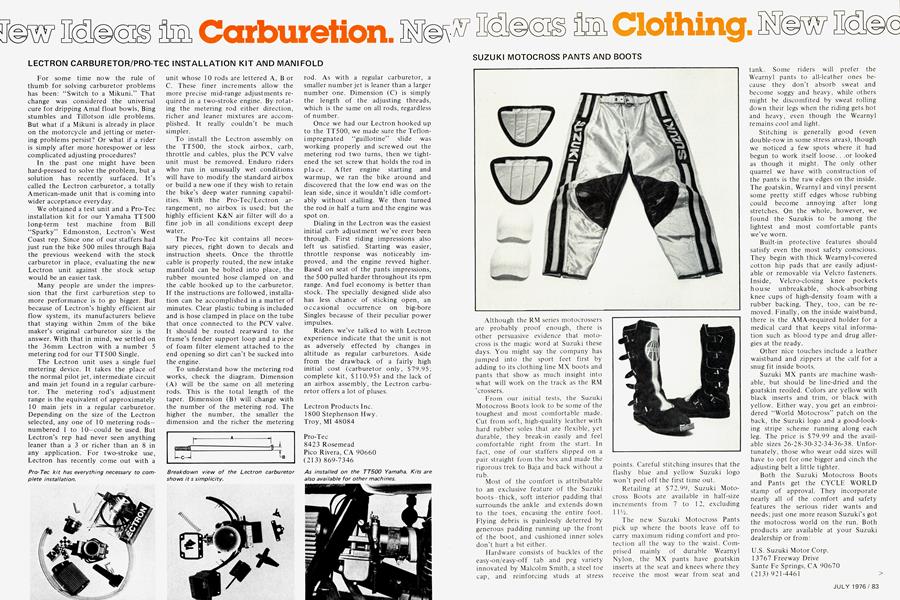
New Ideas in Carburetion. Clothing Tire Balancing.
LECTRON CARBURETOR/PRO-TEC INSTALLATION KIT AND MANIFOLD
For some time now the rule of thumb for solving carburetor problems has been: “Switch to a Mikuni.” That change was considered the universal cure for dripping Amal float bowls, Bing stumbles and Tillotson idle problems. But what if a Mikuni is already in place on the motorcycle and jetting or metering problems persist? Or what if a rider is simply after more horespower or less complicated adjusting procedures?
In the past one might have been hard-pressed to solve the problem, but a solution has recently surfaced. It’s called the Lectron carburetor, a totally American-made unit that is coming into wider acceptance everyday.
We obtained a test unit and a Pro-Tec installation kit for our Yamaha TT500 long-term test machine from Bill “Sparky” Edmonston, Lectron’s West Coast rep. Since one of our staffers had just run the bike 500 miles through Baja the previous weekend with the stock carburetor in place, evaluating the new Lectron unit against the stock setup would be an easier task.
Many people are under the impression that the first carburetion step to more performance is to go bigger. But because of Lectron’s highly efficient air flow system, its manufacturers believe that staying within 2mm of the bike maker’s original carburetor size is the answer. With that in mind, we settled on the 36mm Lectron with a number 5 metering rod for our TT500 Single.
The Lectron unit uses a single fuel metering device. It takes the place of the normal pilot jet, intermediate circuit and main jet found in a regular carburetor. The metering rod’s adjustment range is the equivalent of approximately 10 main jets in a regular carburetor. Depending on the size of the Lectron selected, any one of 10 metering rods— numbered 1 to 10—could be used. But Lectron’s rep had never seen anything leaner than a 3 or richer than an 8 in any application. For two-stroke use, Lectron has recently come out with a
unit whose 10 rods are lettered A, B or C. These finer increments allow the more precise mid-range adjustments required in a two-stroke engine. By rotating the metering rod either direction, richer and leaner mixtures are accomplished. It really couldn’t be much simpler.
To install the Lectron assembly on the TT500, the stock airbox, carb, throttle and cables, plus the PCV valve unit must be removed. Enduro riders who run in unusually wet conditions will have to modify the standard airbox or build a new one if they wish to retain the bike’s deep water running capabilities. With the Pro-Tec/Lectron arrangement, no airbox is used; but the highly efficient K&N air filter will do a fine job in all conditions except deep water.
The Pro-Tec kit contains all necessary pieces, right down to decals and instruction sheets. Once the throttle cable is properly routed, the new intake manifold can be bolted into place, the rubber mounted hose clamped on and the cable hooked up to the carburetor. If the instructions are followed, installation can be accomplished in a matter of minutes. Clear plastic tubing is included and is hose clamped in place on the tube that once connected to the PCV valve. It should be routed rearward to the frame’s fender support loop and a piece of foam filter element attached to the end opening so dirt can’t be sucked into the engine.
To understand how the metering rod works, check the diagram. Dimension (A) will be the same on all metering rods. This is the total length of the taper. Dimension (B) will change with the number of the metering rod. The
higher the number, the smaller the dimension and the richer the metering
rod. As with a regular carburetor, a smaller number jet is leaner than a larger number one. Dimension (C) is simply the length of the adjusting threads, which is the same on all rods, regardless of number.
Once we had our Lectron hooked up to the TT500, we made sure the Teflonimpregnated “guillotine” slide was working properly and screwed out the metering rod two turns, then we tightened the set screw that holds the rod in place. After engine starting and warmup, we ran the bike around and discovered that the low end was on the lean side, since it wouldn’t idle comfortably without stalling. We then turned the rod in half a turn and the engine was spot on.
Dialing in the Lectron was the easiest initial carb adjustment we’ve ever been through. First riding impressions also left us satisfied. Starting was easier, throttle response was noticeably improved, and the engine revved higher. Based on seat of the pants impressions, the 500 pulled harder throughout its rpm range. And fuel economy is better than stock. The specially designed slide also has less chance of sticking open, an occasional occurrence on big-bore Singles because of their peculiar power impulses.
Riders we’ve talked to with Lectron experience indicate that the unit is not as adversely effected by changes in altitude as regular carburetors. Aside from the drawback of a fairly high initial cost (carburetor only, $79.95; complete kit, $110.95) and the lack of an airbox assembly, the Lectron carburetor offers a lot of pluses.
Lectron Products Inc.
1800 Stephenson Hwy.
Troy, MI 48084
Pro-Tec
8423 Rosemead Pico Rivera, CA 90660 (213) 869-7346
SUZUKI MOTOCROSS PANTS AND BOOTS
Although the RM series motocrossers are probably proof enough, there is other persuasive evidence that motocross is the magic word at Suzuki these days. You might say the company has jumped into the sport feet first by adding to its clothing line MX boots and pants that show as much insight into what will work on the track as the RM ’crossers.
From our initial tests, the Suzuki Motocross Boots look to be some of the toughest and most comfortable made. Cut from soft, high-quality leather with hard rubber soles that are flexible, yet durable, they break-in easily and feel comfortable right from the start. In fact, one of our staffers slipped on a
pair straight from the box and made the rigorous trek to Baja and back without a rub.
Most of the comfort is attributable to an exclusive feature of the Suzuki boots-thick, soft interior padding that surrounds the ankle and extends down to the toes, encasing the entire foot. Flying debris is painlessly deterred by generous padding running up the front of the boot, and cushioned inner soles don’t hurt a bit either.
Hardware consists of buckles of the easy-on/easy-off tab and peg variety innovated by Malcolm Smith, a steel toe cap, and reinforcing studs at stress points. Careful stitching insures that the flashy blue and yellow Suzuki logo won’t peel off the first time out.
Retailing at $72.99, Suzuki Motocross Boots are available in half-size increments from 7 to 12, excluding 1 IVY
The new Suzuki Motocross Pants pick up where the boots leave off to carry maximum riding comfort and protection all the way to the waist. Comprised mainly of durable Wearnyl Nylon, the MX pants have goatskin inserts at the seat and knees where they receive the most wear from seat and
tank. Some riders will prefer the Wearnyl pants to all-leather ones because they don’t absorb sweat and become soggy and heavy, while others might be discomfited by sweat rolling down their legs when the riding gets hot and heavy, even though the Wearnyl remains cool and light.
Stitching is generally good (even double-row in some stress areas), though we noticed a few spots where it had begun to work itself loose. . .or looked as though it might. The only other quarrel we have with construction of the pants is the raw edges on the inside. The goatskin, Wearnyl and vinyl present some pretty stiff edges whose rubbing could become annoying after long stretches. On the whole, however, we found the Suzukis to be among the lightest and most comfortable pants we’ve worn.
Built-in protective features should satisfy even the most safety conscious. They begin with thick Wearnyl-covered cotton hip pads that are easily adjustable or removable via Velcro fasteners. Inside, Velcro-closing knee pockets house unbreakable, shock-absorbing knee cups of high-density foam with a rubber backing. They, too, can be removed. Finally, on the inside waistband, there is the AMA-required holder for a medical card that keeps vital information such as blood type and drug allergies at the ready.
Other nice touches include a leather waistband and zippers at the calf for a snug fit inside boots.
Suzuki MX pants are machine washable, but should be line-dried and the goatskin reoiled. Colors are yellow with black inserts and trim, or black with yellow. Either way, you get an embroidered “World Motocross” patch on the back, the Suzuki logo and a good-looking stripe scheme running along each leg. The price is $79.99 and the available sizes 26-28-30-32-34-36-38. Unfortunately, those who wear odd sizes will have to opt for one bigger and cinch the adjusting belt a little tighter.
Both the Suzuki Motocross Boots and Pants get the CYCLE WORLD stamp of approval. They incorporate nearly all of the comfort and safety features the serious rider wants and needs; just one more reason Suzuki’s got the motocross world on the run. Both products are available at your Suzuki dealership or from:
U.S. Suzuki Motor Corp.
13767 Freeway Drive
Santé Fe Springs, CA 90670
(213) 921-4461
ADVANCED CYCLE PRODUCTS LIQUID TIRE BALANCER AND SEALER
One of the foremost fears of both onand off-road motorcyclists is that of flat tires. The problem is, of course, more common with off-roaders, due to the roughness of terrain, but pavementonly riders share the aggravation as well. Many times nails are picked up by the front tire and thrown back toward the rear, causing a puncture; and a sudden loss of air at freeway speeds can mean disaster.
Traffic enforcement officers riding motorcycles probably experience tire problems more than the average cyclist, since they spend extra time on road
shoulders where debris and nails accumulate. We’ve noticed that in California many of the motorcycles in use by various law divisions have a lowmounted rubber flap installed on the front fender in an attempt to prevent nails from being flung up by the front tire and run over by the rear. It helps, but something even more foolproof is necessary to help prevent blowouts that cause accidents and loss of control.
We learned that the Highway Patrol and other law enforcement agencies are using a substance in their tires that not only acts as a puncture sealer, but as a
tire balancer too. Their testing is conclusive: blowout danger is minimized and tire life is increased because of the exact balancing. With our curiosity aroused, we began testing and using an improved version of the substance used by the Highway Patrol in many of our personal machines, as well as in test vehicles.
The ACP Liquid Tire Balancer and Sealer is a gooey, fibrous substance that is squirted into the tube of a tire. Naturally, the valve stem must be removed and the tire deflated first, then all that is necessary is to use the supplied piece of plastic tubing to direct the goop into the tube, one 8-oz. bottle per tire. After reinflating the tire to normal pressure, the machine should be ridden about two miles to spin the substance around on the inside of the tube. The chemical nature of the liquid and centrifugal force distribute the bulk of the liquid to the light position of the wheel/tire assembly and the rest is dispersed around the remaining part of the tube. The product remains liquid for the life of the tire and will readjust its position to compensate for changes in speed, load, road conditions and tire wear, providing continuous balancing for the life of the tire without the need for lead weights.
If a puncture occurs, the liquid runs into the air passage caused by the puncture, or will seal around the object left in the tire if that happens. Torn or ripped tubes are unsealable, but most normal punctures will be sealed and the chance of a sudden loss of air is drastically minimized.
We’ve put tires on with no balancing weights whatsoever and filled the tube with 8 oz. of ACP Balancer, then gone riding. In the first mile or so, the out-of-balance condition is more than apparent. But suddenly, as the ACP liquid starts taking effect, the balance smoothes out perfectly. Puncturing a tire with an ice pick didn’t seem to harm tubes either. We lost 2 lb. of air pressure after the puncture, and loss after that was well within the normal range over a period of two weeks.
The Advanced Cycle Products Liquid Tire Balancer and Puncture Sealer is an innovative product that works. The trucking industry has been using liquid balancers for years; it’s nice that such a product is now available for bikes.
Price: $2.95 per 8-oz. bottle. Available at your motorcycle dealer or from:
Advanced Cycle Products
3238 Oregon Dept. 2442
Costa Mesa, CA 92626