Letters
LETTERS
THE STUPIDITY EXPLOSION
In writing to what is probably the best motorcycle magazine, this voice in the wilderness is hopeful of being heard. Regarding the November ’67 article on the motorcycle boom — yes, I think it is leveling and probably receding — and there are definite reasons why, if my own experience and my friends’ are as universal as I believe.
Stupidity, ignorance, indifference, rudeness, inefficiency, poor service, poor dealerships, poor shops, lack of know-how, lack of tools, lack of parts, expensive parts, months delay in parts orders, incorrect parts supplied or replaced, shops closed Mondays, Wednesdays, Saturdays, mornings, evenings. Dealers in major lines without a single new model for display or sale, or only a few models of a large line. Manufacturers themselves putting out underpowered, undersized, underlighted and tired, but overpriced machines. Responsible publications like yours and others questioning or being against simple rational safety measures like the helmet laws to protect our youth who are too inexperienced for judgments of their own. All of the above and much, much more are hurting motorcycles.
To cycle today, a person has to want to so badly that he will hound a dealer to get the particular machine he wants, then haunt him to get service to get it running right, and then scrounge all over the countryside for parts or accessories as needed. Few of us have the time, patience or money for this. Mechanical know-how of today’s youth is appalling, and is not helped by dealer or factory education. Most service manuals supplied with new machines are inadequate. I have only been motorcycling for about five years, but have had a dozen different machines, and I could go on and on and on about what is wrong and hurting motorcycling today.
Motorcycle manufacturers, dealers, and press will really have to clean house to offset the decline and fall of a great sporting empire.
The above is not a blanket condemnation, for I have been treated well as often as otherwise. It is more of a plea for correction of existing faults, knowing that perfection can only be strived for.
Keep up the good technical articles and stories about touring and trail riding and the honest road tests, but also let’s crusade a little, too. Our lives and your living may even depend on it.
GLENN E. ROSS Washington, Ind.
HAPPY HORSE
One more of those sickening letters that shout hurrahs for a brand, but I couldn’t help myself. Case in point: One W1 650
Kawasaki.
I finally made up my mind that a serviceman’s life would become more livable in Colorado, even in winter, with wheels. Deciding this, I made up my mind to ride my tired old dog back to Fort Carson after my leave.
Preparation for the trip consisted of a new tire, new spark plugs, and a new set of mufflers, also a set of bars for racing crouch which paid off later. The plugs that came out had 4000 miles on them, but still looked good (didn’t want to take chances). The tire had the same mileage, but was completely lacking center tread (4.00 x 18 Dunlop K70). The stock mufflers looked very much like they would fall off if so much as a dime was run over, so they were replaced with a set designed for a Honda Super Hawk. They look very similar to the new SS pipes, but have one pleasant quality in that they do muffle better than W1 stocks, and bolt on with the addition of one hole in the welded-on mount.
Bearing in mind no mention was made of valve adjustment or points, 150 lb. of equipment was then attached (Bunge cords and rope), a big kiss planted on the wife’s doubtful lips, a kick on the start lever, jab on the shift lever, and a 1242-mile trip was underway.
Don’t let me give the impression that all details were not carefully thought out, just because I stopped at an auto shop for 3 qt. of Valvoline 30W because an oil change had been forgotten, or because the oil stayed in the cans until Santa Fe, N.M., where it was changed more out of guilt than necessity, as the old oil was still as clean as was the filter.
(Continued, on page 22)
The legal speed limits were used, plus a little, all the way. The only weather encountered, with the exception of 100 F plus at Needles, was a wind out of Albuquerque, a pleasant tail wind that had the effect of nullifying all noise except that of old faithful. When the road changed from a northeasterly course to a northerly one, that pleasant wind changed to one of the worst crosswinds I’ve ever ridden in. This condition continued until Trinidad, N.M., about 140 miles. This is the point at which it occurred to me that the new bars were an extremely wise choice. All that had to be done was just a bend of the elbows to achieve a full racing crouch and a speed of 70 mph. There was a feeling of complete control that I had never before achieved with the bike. It still has a slightly spooky feel in very fast sweepers, but the bike does as it is told. Probably a big part of this is the uncanny way in which “Made in Great Britain” K70s stick to the road.
To draw a lengthy fan letter to a close, the trip was completed in 26 road hours (breaks every 50 miles), and the gas mileage was 47.3 mpg., not bad for 470 lb. of bike, 140 lb. of junk, and 165 lb. of very happy rider. Although unhappy to leave sunny San Diego for white Colorado, I was happy to have discovered an iron horse that can take that kind of trip as easily and pleasantly as it did.
PFC C. V. SPEELING
Fort Carson, Colo.
FIRST 500 TWO-STROKE?
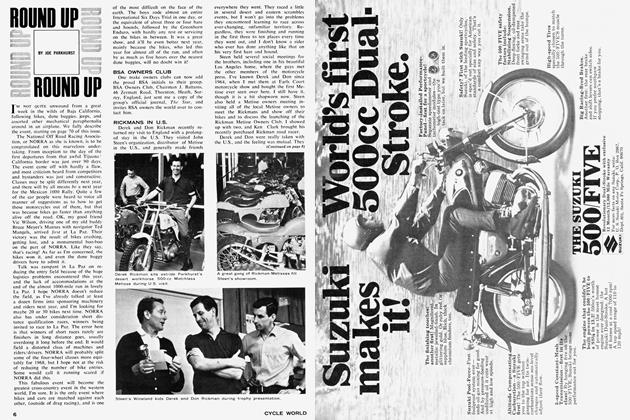
With reference to the center page advertisement for the new Suzuki 500/Five motorcycle (CW, Oct. ’67), I think that Suzuki may have been a trifle hasty in claiming it to be the “World’s First 500-cc Dual-Stroke.”
As a member of the Scott Owners’ Club, I wonder how Suzuki could have overlooked this famous and long-lived marque, winners of the Isle of Man TT senior races in 1912 and 1913. Scott Sports Squirrels, Super Squirrels, and Flying Squirrels were produced in 500-cc watercooled two-stroke twin form from 1912 to 1939, and 600-cc watercooled two-stroke twins have been produced from the mid 1920s to date, the Scott now being in limited production by the Aereo Jig and Tool Co. in Birmingham, England. Other interesting large two-stroke motorcycles produced by the Scott Motor Cycle Co. were a 750-cc watercooled three-cylinder in 1933 and a 1000-cc of similar design from 1934 to 1937. A twoliter two-stroke six-cylinder car engine also was produced in prototype form, together with some 650-cc aircooled two-stroke twin light aircraft engines prior to World War II. More recently, in 1958, a few prototype 500-cc watercooled two-stroke twin Swift motorcycles were produced by the Aereo Co. though the only new model available to the public is the 600-cc watercooled twin two-stroke Flying Squirrel, which is in limited production. At the present time, I own a new Flying Squirrel. By the way, there is absolutely no truth in the rumoi that the squirrel was chosen as the Scot mascot so that it could follow the motor cycle and pick up any nuts tha dropped off.
(Continued on page 24)
oroppea orr. Numerous other unorthodox two-stroke designs also were produced by the Scott factory from time to time, but space does not permit me to describe them at this time.
From my library of motorcycling books, I have made up the following short list, which is by no means complete, of 500-cc and larger two-stroke motorcycles which were produced prior to the new Suzuki 500/Five:
DKW, German, 500-cc twin, 1920s; Dunelt, British, 500-cc single, 1919-1927; Grote, German, 608-cc twin, 1923-1924; New Paragon, British, 500-cc, 1919-1923; Orion, Czechoslovakian, 600-cc single, 1920s; Puch, Austrian, 500-cc twin, 1930s; Reynolds Special, British, Custom 500and 600-cc Scotts, 1930-1933; Stellar, British, 784-cc twin, 1912-1914; Schliha, German, 500-cc single, 1927-1932; Stanger, British, 538-cc V-Twin, 1921-1923; Velamos, Czechoslovakian, 500-cc single, 1927-1930; Vis, German, 500-cc Flat Twin, 192 1-1924; WAGA, British, 500-cc V-twin, 1924-1925; and W&G, British, 500-cc Twin, 19271928.
The above is not meant to detract from the new Suzuki 500/Five which is obvious ly an excellent, good looking motorcycle, but merely to draw your readers' attention to the prior existence of other 500-cc two stroke motorcycles, and also to the fact that the most famous of them all, namely the Scott, lives on.
I would be extremely grateful if you could give this letter some of your precious column space, and should any of your readers be interested in the Scott Owners' Club, I will be happy to put them in touch with the membership secretary. J. GRAEME SHARP do Airwork Corp. Miliville, N.J. 08332
THE BELIEVER
Thanks for printing the pic of the 500-cc Hosk in the Japanese motorcycle history article (CW, Nov. `67), as I used to have one.
By the way, I have a little information on the Victoria Burgermeister that David N. Jacobs wrote about in the "Service" sec tion. It is a 350-cc V-twin, shaft drive, and when he gets it running, it should do about 90 mph.
I used to have one of those, too, since I collect "off-breed" bikes as a hobby. Parts can be had cheaply and quickly (about two weeks airmail) by writing to a German firm which has parts for Victoria all DKW models and other out-of-print German bikes. The complete address is: Zweirad Union Ag., 8500 Nurnberg Nopitschstrasse 70, Germany.
I have two DKWs, and I get everything I need there. Airmail from here to there is 2O~ per oz. Mr. Jacobs need only de scribe the parts, send make and serial num ber of engine and frame, and Zweirad
Union will do the rest. He will receive a bill for the parts before he gets them. I am interested in hearing from anyone who still believes in DKWs, Zundapp, Ho rex, MZ, NSU Victoria, and other German bikes no longer in production. I am trying to locate an English language service man ual for a 1958 350-cc DKW RT/350. Any help would really turn me on. RAY HOOVER 24 Rose Ave. #C Venice, CA 90291
UNDER THE COBWEBS
I have acquired what I believe to be a 1935 or 1936 DKW, approximately 200-cc single two-cycle in original shape, except for cobwebs, dirt, and rust. It has not run for ten years, but with a little luck and a lot of work, it just might live again.
lot Ot worK, it Just might live again. I have no information, technical or otherwise, on this machine. I have been led to believe that the manufacturer was bombed out of existence in the early for ties. If you or any of your readers could aid me in my quest to restore this vintage antique to its original state, I would be forever in your debt. I am especially inter ested in a workshop manual, but would greatly appreciate any data on this machine. Manufacturer's Plate: Auto Union A-6, Motor No. CHEMNITZ 714986, Fahrgetell 387425, Motor P.S. No. 7, Hubnaum 190 ccm, Gewight 125 kg. C. L. LOVEGROVE 174 A LaSalle St. Bourlamaque, P.Q. Canada You might try the above address.-Ed.
TRAGIC MISHAP
I hope this isn't the only letter you get on this subject, and if it isn't, I hope mine will help to emphasize a rather tragic mishap at Grand Prix of Canada on September 30 (CW, Dec. `67).
J'. p L'.. III U'... I ..) U V V U..'... U I How about corner stewards who don't wave the white flag (for ambulance on the track) or at least the yellow flag after an accident? It seems a light drizzle on an already not-too-dry track started off a largely avoidable chain of events. One man in the 5OO~cc World Championship event drops his bike coming out of Moss's Corner, and proceeds to have both his legs run over by the bike following right behind him, which continues on in the race. The unfortunate part is that when the ambulance pulls out onto the track and parks right outside on the edge of it, it has neither its yellow warning light going or the benefit of a white flag. As was fantastically predictable, another man comes along, on the same damp track, stumbles upon all this track-side hubbub with absolutely no warning, and drops his bike, which slides into the rear of the ambulance. Fortunately, the injured rider already was either in the ambulance or out of the way, and the man riding the bike ramming the ambulance was not seriously injured. WILLIAM WEILAND Madison, Wis.