ULTRALIGHT MATERIALS
Could your next high-performance motorcycle have composite connecting rods and pistons?
Could your next high-performance motorcycle have composite connecting rods and pistons?
ULTRALIGHT MATERIALS
ELEMENTS
Could your next high-performance motorcycle have composite connecting rods and pistons?
KEVIN CAMERON
Motorcyclists expect high-end bikes to be covered with weight-saving titanium and carbon fiber parts, but there are worlds beyond.
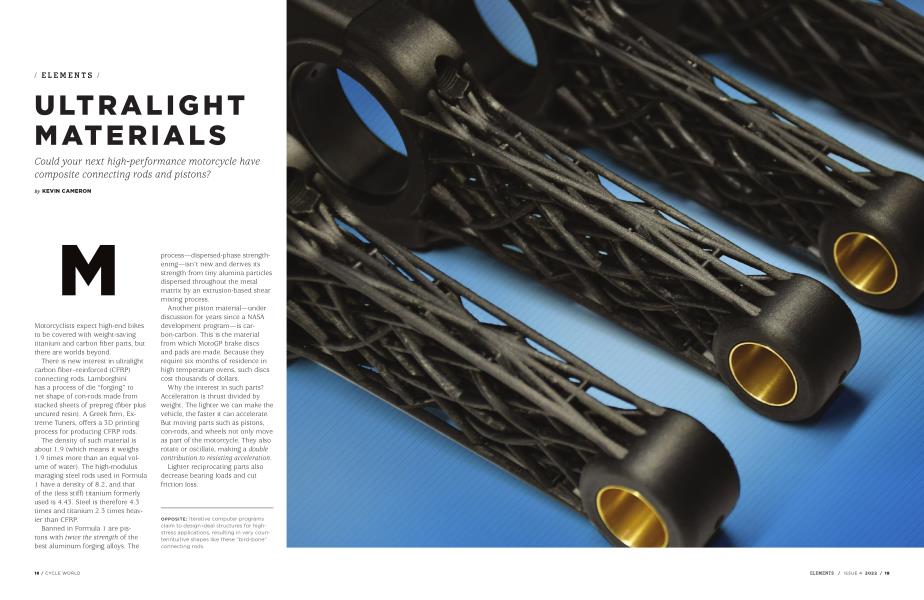
There is new interest in ultralight carbon fiber-reinforced (CFRP) connecting rods. Lamborghini has a process of die “forging” to net shape of con-rods made from stacked sheets of prepreg (fiber plus uncured resin). A Greek firm, Extreme Tuners, offers a 3D printing process for producing CFRP rods.
The density of such material is about 1.9 (which means it weighs 1.9 times more than an equal volume of water). The high-modulus maraging steel rods used in Formula 1 have a density of 8.2, and that of the (less stiff) titanium formerly used is 4.43. Steel is therefore 4.3 times and titanium 2.3 times heavier than CFRP.
Banned in Formula 1 are pistons with twice the strength of the best aluminum forging alloys. The
process—dispersed-phase strengthening—isn’t new and derives its strength from tiny alumina particles dispersed throughout the metal matrix by an extrusion-based shear mixing process.
Another piston material—under discussion for years since a NASA development program—is carbon-carbon. This is the material from which MotoGP brake discs and pads are made. Because they require six months of residence in high temperature ovens, such discs cost thousands of dollars.
Why the interest in such parts? Acceleration is thrust divided by weight. The lighter we can make the vehicle, the faster it can accelerate. But moving parts such as pistons, con-rods, and wheels not only move as part of the motorcycle. They also rotate or oscillate, making a double contribution to resisting acceleration.
Lighter reciprocating parts also decrease bearing loads and cut friction loss.
How much are these benefits worth? The FIA, which regulates Formula 1, evidently decided that pistons made from dispersed-phasestrengthened aluminum cost more than they benefit the sport. Same for brake calipers made from lithium-aluminum alloys.
Yet in 1953, when US armed forces made a decision to develop titanium materials at industrial scale, Jack Williams at AJS in England soon made con-rods of the light metal. Same in the US with maraging steel: When NASA decided it was attractive as a material for large solid rocket booster casings, its price came down. Enough so that rider-engineer Albert Gunter soon had rods made of the stuff for his BSA Gold Star dirt-tracker.
Carbon-carbon pistons received some development work at NASA Langley. C-C material has densities between 1.6 and 1.92, while the 261 8 aluminum used in many forged pistons has a density of 2.75. Some speculate that low-expansion C-C pistons, operating at near-zero clearance in C-C cylinder liners, could reduce unburned hydrocarbon (UHC) emissions by reducing the above-ring volume into which unburned mixture is forced during compression. High cost has kept this application in the basic research stage.
Metals have versatility that will be difficult for advanced materials to match. For example, how can the detachable big-end cap of a CFRP connecting rod be attached? Simply drilling and tapping the bulk material will result in crushing of the low-modulus resin by the steel cap bolts’ threads. Making use of a CFRP stem and ceramic head for an engine valve poses the problems of joining the two, of friction between stem and valve guide, and of transmitting the concentrated local force of the valve stem collets. Solutions based upon metal inserts invite weight growth and joining issues.
During the Cold War period, exotic materials and processes were industrialized by government funding, which is how solid-state integrated circuits, titanium, and carbon fiber have become common. This is not an inevitable process, however. Other materials such as beryllium remain persistently too expensive for wider application.
For years we’ve seen bike engine horsepower-per-liter rise with peak rpm, assisted by development of ever-lighter moving parts. That is now moderating with a shift to fewer cylinders, lower parts counts, and reduced peak rpm. For bikes, the driving force of change is currently price, but on the automotive side, expected future competition from electrics is making efficiency the central issue. While electric motors are highly efficient, the powerplants that generate their electricity are less so, bringing overall efficiencies of vehicles powered by IC engines and electric motors remarkably close. IC engines will be with us for years because major industries cannot afford to scrap existing production systems overnight. To justify continuing production of IC-powered vehicles, relative efficiency is expected to become the hot topic.
Fortunately it will be relatively inexpensive to improve motorcycle fuel economy. Friction loss is lowest when rpm are minimized and cylinder combustion pressure maximized (larger throttle angle). This has been the trend in IC-powered autos and will work just as well to boost the fuel economy of motorcycles, if future regulations require it. And it probably won’t require much beryllium or dispersed-phase-strengthened aluminum.