On Any Sunday Forty Years On
On Any Sunday Forty Years On
Reuniting the stars of motorcycling's quintes sential cinematic classic Malcolm Smith Mert Lawwill and Bruce Brown ride again
JEFF BUCHANAN
11 ^ years old, !i in g in Southern ( aliforma. Stairven to Heaven and Brown Sugar were providing the. back ground track to my budding obsession for motorcycles My next-door neighbor and best friend, Stott Johnson, shared the obsession In ¡hose pi tocable TV pre-streaming video days, there was scant offering in the wav of filmed moto. So. natura!!), when we heard that a motorcycle documentary* w as opening, we bummed a ride to a theater in Westwood, bought a ticket ánd went inside for the f irst matinee We didn’t emerge until midnight, stumbling out onto Broxton Avenue bloated and dehn ous w ith the visual and aural residue of five back-to-back viewings of. On Am Sunday.■ We were in heaven-. The dim spoke directly-to our w ith purpose and immedi u-dy go mg. us thret new heroes M t La !
Malcolm Smith and Sieve McQueen.
Our lives, and the lives of so many oth -ers who saw the film, quite literally, would.ne ver be the same.
On Any Sunday is so much more than just clips of racing action spliced together At the heart of the movie is the persona) touch and consummate skill of a true filmmaker. Bruce Brown captivated us by weaving visceral action with art exploration of the human drama inherent in racing craftily drawing us in with > an uncanny mix of intensity and humor.,
! he -result is a Otra that helped def ine and grow the sport, and it has stood for 40 years as the high w atermark in motorcycle cinema.
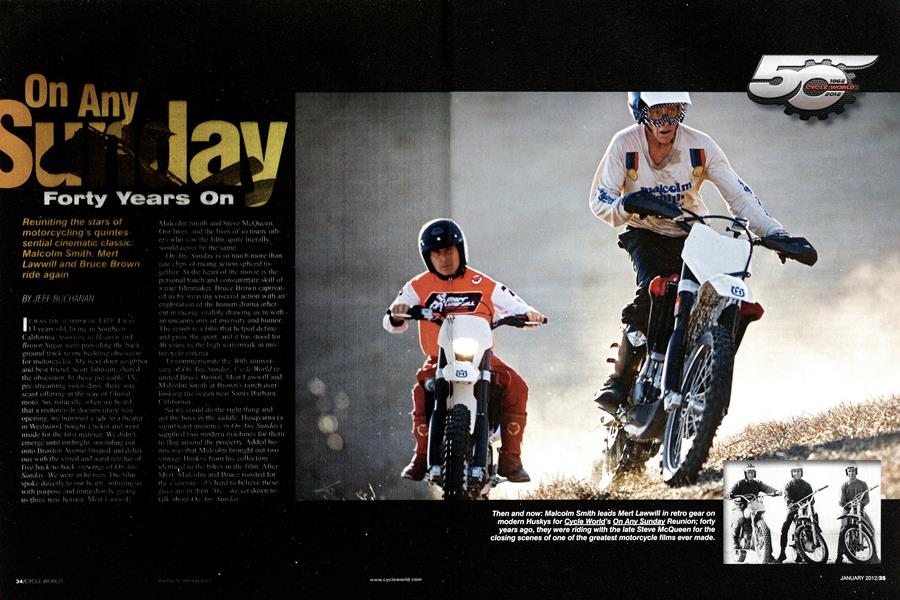
To commemorate the 40th anniversary of On. Any Sunday, Cycle Worldreunited Bruce Brown, Men Lawwill and Malcolm Smith at Brown s ranch overlooking the ocean near Santa Barbara. i .’aliforma
So we could do the right thing and get the boys in the saddle. Husqvarna (a significant presence tn On Any Sunday) supplied two modern machines for them to flog around the property Added bonus was that Malcolm brought out two vintage l.luskvs f rom his collection
idéntica! to the bikes in the f ilm. After
Me - f Malcolm and Bruce roosted for the cameras- it x hard to believe these guvs are m their 70>; we sat down to talk about Or Am Sunday.
34/CYClf WOUí n
www.cycleworld com
How It Began
Fresh off his surfing classic, Endless Summer {1966), Brown started searching for a new subject. A motorcycle enthusiast himself, regularly competing in hare scrambles and desert races, Brown saw how motorcyclists were being marginalized by the press and depicted as slovenly lowlifes in a slew of B-grade exploitation films. He decided to create an in-depth exploration of the people who raced motorcycles that would diametrically oppose the general public’s misconception.
The first thing Brown did was to cold call box-office superstar and big-time motorcycle enthusiast Steve McQueen.
“I told him what I wanted to do,” Brown recalls, “and Steve said, ‘Great, what do you want me to do?’ Well, I want you to finance it. He said, ‘Look, I act in movies, I don’t pay for them.’ So I said, ‘Then you can’t be in my movie.’” Adds Brown, “It was kind of his fault for getting me interested in bikes in the first place.”
Like many of us, Brown had been inspired by the famous jump over the barbed-wire fence in The Great Escape (1963). “The next day McQueen called back and said, ‘Okay, let’s do it.’” Thus began a friendship and two years of filming that would eventually expose more than 200,000 feet of 16mm film.
As a central theme, Brown decided to document AMA Grand National
Champion Mert Lawwill in the defense of his number-one plate. “When Bruce first approached me and asked if I wanted to be in his movie, I said sure,” Lawwill recalls. “I was so focused on racing I didn’t really think about it. I had no idea what it was going to turn into.”
In addition to witnessing a noticeable increase in the number of spectators attending races after the film came out, Lawwill says the recognition factor away from the track was amazing. To this day, people approach him to talk about the film.
Brown jumps in, explaining that despite Mert being national champion, his family didn’t really know what it was he did. “Lawwill’s grandmother-in-law went to see the movie,” Brown says with a laugh, “and in the middle of one of the scenes stood up and shouted, ‘That's my grandson!’ He was a big hero after that.”
Brown traveled the circuit with Lawwill, personally shooting the famous road-trip scenes and immortalizing Mert’s white Ford Econoline in his effort to accurately capture the life of a professional racer.
To give audiences a then-rare glimpse of the racer’s point of view, Brown tried to convince several top-level pros to don a camera helmet. In the age of digital cameras, it’s hard to appreciate the weight of a 16mm camera strapped to your head. The inherent dangers of the bulky rig forced Brown to offer a $ 100 bump to anyone who’d wear it. “They
were lining up after that,” Brown remembers. “I’d tell them not to pass the guy in front. If they got out front, there was no perspective. But they never listened. They were racers, they had to be out front.”
Budget limitations meant Brown couldn’t afford high-speed cameras to capture action in slow motion. To remedy this, he “hopped up” a standard 12-volt camera by splicing in a second camera battery belt, doubling the volts and redlining the frame rate to 80 frames per second, rendering an effective, if somewhat makeshift, high-speed camera.
To help showcase various disciplines of motorcycling, Brown brought in
www.cycleworld.com
So completely capturing the magic of motorcycling on film only truly happened for the first time with On Any Sunday back in 1971. And that magic of riding, related so accessibly, is what makes the movie timeless and enjoyable for riders and non-riders alike. The most feature-laden, highest-quality version available is the $19.95 remastered DVD two-disc set from Monterey Media, with the added benefit that 50 percent of the proceeds go to the Cycle World Joseph C. Parkhurst Education Fund with the Pediatric Brain Tumor Foundation. There have been more than 2000 Sundays since the movie’s release; don’t let another one pass without (re)catching the vibe. To order, call 800/424-2593 and mention Cycle World, or visit www.cycleworld. com/onanySunday for more information.
out California and Mexico, the Daytona 200 in Florida, ice racing in Canada, Utah for the Widowmaker hillclimb and Spain for the International Six Days Trial. As testament to Brown’s ability as a filmmaker, he shot the entire ISDT segment solo with a wind-up Bolex.
When it was all over, Brown locked himself in the editing room, waded through 100 hours of film, tirelessly whittling it all down to a carefully crafted 90 minutes. Along the way, he created the narration that would become the thematic glue of On Any Sunday. At the first screening for the distributors, there were two initial comments, remembers Brown: “It was ‘too long,’ and one guy asked. ‘Where are the girls?’ I couldn’t do anything about the girls. But I ended up cutting 10 minutes out.”
The Film Opens
On Any Sunday premiered in a handful of theaters in the summer of 1971. The opening montage, followed by the brilliantly unexpected BMX credit sequence, subtly primed expectations. (For trivia buffs: The kid wheelying the MiniTrail 50 in slow-motion is none other than 9-year-old future motocross star Jeff Ward.)
Then came the introduction of Lawwill, dressed in a three-piece suit (“I still have that suit,” Mert offers), walking down a San Francisco street and into the now-famous straight-cut of him in a 100-mph powerslide, his number-one-plate XR-750 tapped out and spraying a monster roost. Audiences were hooked.
For the next hour and a half, moviegoers were in sensory overload as a smorgasbord of motorcycle action exploded across 20-foot-tall movie screens.
The images were accompanied with a soundtrack by Dominic Frontière—the title song becoming a mantra for the devout—while Brown’s narration became indelibly planted in our subconscious.
another rider par excellence, Malcolm Smith, an accomplished racer and king of numerous Mexican long-distance offroad races. Smith owned a motorcycle dealership and was hesitant to commit to the project, afraid he would be losing money each day he was gone, which he estimated to be about $80. Brown agreed to pay Smith that amount for every day he worked on the film. “It seemed like a lot of money back then,” Smith says with a laugh today, adding, “I got a million
dollars worth of advertising.”
As with Lawwill. On Any Sunday made Smith’s face and name famously synonymous with motorcycles. He credits the film and subsequent notoriety with making it possible to build his business and remain a key figure in the industry after his racing career was over. Smith says he never gets tired of people telling him how he and the film influenced their lives by getting them into riding. He’s flush with gratitude about having been lucky enough to be asked to be in the film.
The production period was hectic, with Brown and his crew traveling to flat-track races on the national circuit, the Saddleback and Carlsbad InterAms, motocross and off-road races through-
As the film unfolded, we watched Lawwill throwing it sideways at mile and half-mile races. Then, sadly, we witnessed the champ fall victim to a string of mechanical gremlins that slowly eroded his chances of retaining the title. Brown, the consummate filmmaker, captured the immense disappointment and frustration by having tactfully gotten the audience invested in Lawwill, a highly likable individual, allowing them to experience both the euphoria and heartache of racing. Brown then introduced the other protagonists in contention for the championship, brilliantly setting up a classic showdown later in the film.
Smith awed audiences with his prowess in the Mexican off-road races and his seemingly effortless domination of the Elsinore Grand Prix (as well as an impressive showing in his first-ever hillclimb). Brown traveled to Spain to film the challenges Smith faced while chasing his third gold medal in the ISDT— all of which helped establish Malcolm as a motorcycling god. The third star of On Any Sunday was Steve McQueen. Audiences were dazzled by footage of the legendary movie star piloting his Husqvarna around a motocross track and blazing across the California desert—as well as earning a top-10 finish at the Elsinore Grand Prix. What better spokesperson could we motorcyclists have asked for than the King of Cool?
After taking us through the heat, cold, dust and mud. Brown wrapped up his movie with what many believe to be
the best and most inspiring sequence: McQueen, Lawwill and Smith playriding at dusk on the sand dunes and a stretch of beach along the Pacific Ocean. The scene beautifully captured the essence of what riding is all about. Lawwill and Smith say that to this day, people come up to them and tell them how that scene is what got them into riding.
Social and Cultural Phenomenon
On Any Sunday, a homegrown film about motorcycles, spoke to enthusiasts and non-enthusiasts alike. The lingering wave of interest in motorcycles that had been building suddenly crested and became a full-blown affair. Motorcycle sales jumped dramatically. One Husqvarna dealer reported selling 20 bikes the day after the film opened (prior to that, it averaged two units per month). The hysteria culminated with an Oscar nomination in 1972 for Best Feature Documentary. Although the film didn’t win, the fact that the Academy of Motion Picture Arts and Sciences had nominated it served to legitimize the sport. For those of us who saw the film with an audience, it was practically a religious experience. In the darkness of the theater, we shared a common bond, united in a collective fascination for motorcycles.
Two recurring themes surfaced during our interviews. One, none of them ever
imagined how popular the film was going to be. The other, how much they miss their friend, Steve McQueen (who died of cancer in 1980). Lawwill tells a compelling story of smashing his left hand to pieces at a race several years after the film came out. Doctors told him the best they could do was to render it as a fixed club. “I don't know how,” Lawwill says, “but Steve found out. He located a hand specialist to look at the X-rays and arranged for surgery in Los Angeles. He flew me down
www.cycleworId.com
and had me stay at his house. And look,” Mert flexes his hand, “Works fine now.
I owe my eareer to him.” He then adds, “Something else. I never saw one bill. Steve paid for everything.”
As the trio views On Any Sunday together, Lawwill’s eyes glisten when the mile dirt track comes on-screen. Watching himself toss the Harley into the corner at the end of the straight at 130 mph, he smiles and says, “Ooo, that’s fun.”
As Lawwill suited up for riding pho-
Champions still: Smith and Lawwill sport some of the style that made them stars of racing.
tos, he looked at the Husky and said, “1 haven't ridden a dirtbike in 15 years.” You’d never know it. In no time, he was roosting around Brown’s property with a big smile on his face.
After retiring from racing, Lawwill became a fixture in mountain-bike racing, inventing a number of innovative suspension systems. His primary focus today is his prosthetic hand research and development (www.mertshands.org) designed specifically for use with bicycles and motorcycles.
Smith parlayed his recognition from the film into his motorcycle business, Malcolm Smith Motorsports (www.mal colmsmith.com) and, to give back to the country that had given him his racing career, created the non-profit Malcolm Smith Motorsports Foundation (www. malcolmsmithmotorsportsfounda tion.org). The foundation raises money to build schools and orphanages for underprivileged children in Mexico, as well as offering continuing education.
Smith still rides regularly, hosting a special Baja ride each year for his charity and play riding whenever possible. At 70, he's lost nothing of his enthusiasm for motorcycles. During our photo shoot, he eagerly blasted the Husky around the property looking for photo ops. Each time he came back to camera, he was wearing that famous ear-to-ear grin.
Bruce Brown created the quintessential motorcycle documentary with On Any Sunday, paralleling Endless Summer's status as the quintessential surfing film. For a filmmaker to reach this milestone with one film in a career is astonishing, let alone doing it twice, in two radically different sports. After a successful career as an independent filmmaker, having been inducted to both the Motorcycle and Surfing Halls of Fame, today Brown
enjoys mentoring his children, who have followed in his footsteps.
As the sun was setting on the second day of the reunion, Brown and I were sitting on his porch watching Smith and Lawwill, the eternal kids, flog the new Huskys for the cameras at the far end of the property.
Smith used the last remnants of daylight to attempt a hillclimb on Brown's ranch that had never been conquered. 11' you’re a fan of On Any Sunday, you can appreciate the surrealism of sitting with Bruce Brown watching Malcolm Smith gassing a Husqvarna up that mountainside. determined to get the first tire mark on the summit. With darkness falling, the lone Husky’s exhaust echoed out across the valley as Malcolm conquered the mountain. It reminded us of the youthful vigor and personal challenge riding inspires. It's a moment none of us will
ever forget.
Then Brown said. “You wanna see something?” As 1 followed him down a hallwav in his home, he said. “I don't
Scan for more photos and video
know if this will be of interest.” He opened a doubledoor closet to reveal 16mm film cans stacked from floor to ceiling. Outtakes from the film. They were labeled with handwritten strips of tape: Sacramento Mile; Carlsbad;
Aberg; Mert; traveling; crash!; etc., etc.
A celluloid treasure to anyone enamored with On Any Sunday.
Eventually, Lawwill and Smith came in from riding. As they've done thousands of times, they loaded their bikes and banged the mud from their boots before settling into chairs to watch the sun set. It’s hard to believe it’s been 40 years since we first saw these men on screen.
In a poignant finish to an amazing two days, Lawwill shared something from when he was recuperating at McQueen’s house after surgery to his hand. “Steve once said to me,” he remembered, “‘You’re lucky, you’re national champion. No one can ever take that away from you. I’m an actor. I'm alwéiys playing someone else.’” Imagine, the world’s biggest movie star, the King of Cool, revealing that kind of respect and envy for someone who rode motorcycles. Amen.
For those who grew up with it, On Any Sunday still manages to rouse passions. For those who have never seen it, you owe it to yourself to sit down and watch it. The magic is still there. K3