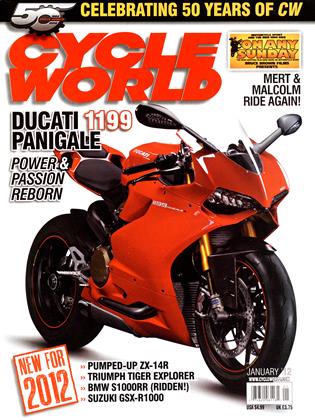
Ducati 1199 Panigale
Ducati 1199 Panigale
Ducati’s first all-new motorcycle in three decades promises to keep V-Twins in the front of World Superbike racing—and perhaps win sportbike comparison tests
STEVE ANDERSON
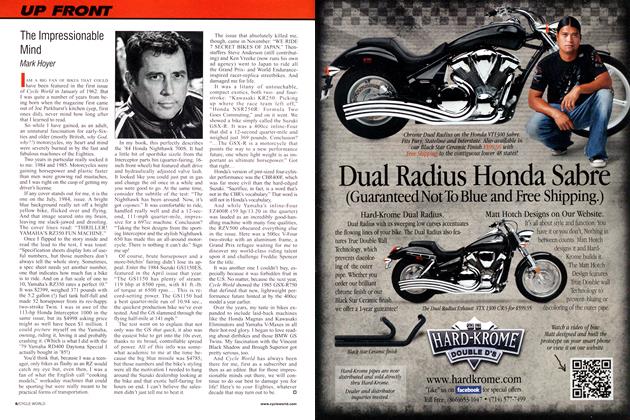
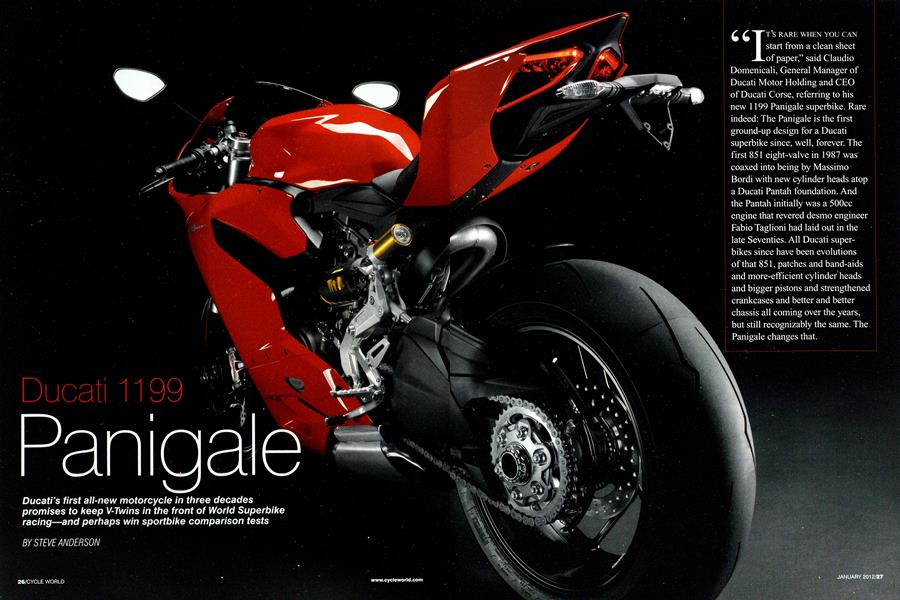
"IT'S RARE WHEN YOU CAN start from a clean sheet paper,” said Claudio Domenicali, General Manager of Ducati Motor Holding and CEO of Ducati Corse, referring to his new 1199 Panigale superbike. Rare indeed: The Panigale is the first ground-up design for a Ducati superbike since, well, forever. The first 851 eight-valve in 1987 was coaxed into being by Massimo Bordi with new cylinder heads atop a Ducati Pantah foundation. And the Pantah initially was a 500cc engine that revered desmo engineer Fabio Taglioni had laid out in the late Seventies. All Ducati superbikes since have been evolutions of that 851, patches and band-aids and more-efficient cylinder heads and bigger pistons and strengthened crankcases and better and better chassis all coming over the years, but still recognizably the same. The Panigale changes that.
But not too much. According to Domenicali, two things were sacrosanct, two parts of the heritage too valuable to leave behind: The new machine would use a 90-degree V-Twin engine and desmodromic valve gear.
Those were essential Ducati features. The other internal goals of the project, which was begun in conceptual form almost the moment the first 1098 was launched, were ambitious. The new bike would be 10 kilograms (22 pounds) lighter than its predecessor and make 25 horsepower more. The final result is claimed to be a wet-minus-fuel weight of 387 lb. and 195 crankshaft hp at 10,750 rpm. Those extreme goals dictated almost everything about the new “Superquadro” engine and the bike built around it.
First, the Superquadro would be the primary frame structure, just like the V-Four engine in Ducati’s MotoGP bike. A monocoque aluminum steering-head bracket, also serving as the airbox, would bolt to the engine in the front, while the swingarm would bolt to the engine in the rear. Footpeg brackets would cantilever from the engine, not from a no-longcr-existent frame. Eleven pounds of the Panigale’s weight advantage over the 1198 are attributed to this design approach.
Second, the Superquadro engine would follow the MotoGP path in another direction, embracing a massively oversquare design that would allow a redline of 11,500 rpm in street trim and even more in racing. Its bore grew to
112mm (about 4.41 in., or substantially bigger than the 4.25-in. bore of a 454 big-block Chevy), while stroke shortened to just 60.8mm for an 1 198cc displacement. This kind of 1.84 bore/stroke ratio has become the norm with Ducati’s MotoGP Fours and in Formula One, but it’s a real outlier in the world of highperformance streetbike engines. The reason is simple: It’s hard to get efficient, repeatable combustion in a chamber that begins to take on the dimensions of
a broad and very thin tortilla. But hard doesn’t necessarily mean impossible. “Performance and weight came first,” Domenicali emphasizes, “then we added civility through secondary systems. It was a massive R&D effort.”
According to the lead engine designer, Marco Sairu, “The old engine was evolutionary. This one is a really big step for us. We started from zero.” The bore/stroke ratio became the first step from null, as simulations performed by Ducati Motor and Ducati Corse showed the big bore was essential to meet the
power objectives. “It was challenging, but we had good experience from MotoG P.”
One concern was the amount of blowby with such a huge piston and long circumference to seal. The key to this became wet liners that fit directly into the vertically split crankcases, assembled without an interference fit. These liners reduce parts count—there no longer are separate cylinders apart from the crankcase—and also stay very round even as the engine goes through normal thermal cycles. In the end, says Sairu, controlling blow-by “wasn’t harder than with the 1 198.”
As for combustion stability, particularly at the low loads and small throttle openings typical of much street riding, the task was more challenging.
“To make our power goal, we had to keep long-duration camshafts with 45 degrees of overlap,” says Sairu, “rather than use cams with short overlap ( 1 1 degrees) as in the Multistrada.” Long overlap increases charge dilution with exhaust gases, further slowing and complicating combustion. “We had to come up with something new,” lie added. That “new” was a very precisely controlled air-injection system that added air to the exhaust gases on their way out of the cylinder heads.
That basic idea was hardly new, but the application was unusual. Ducati engineers programmed the injection for a rich mixture during those conditions when combustion was most troublesome and cyele-to-cycle variations would cause emissions or drivability concerns. A slightly rich mixture ignites more readily and consistently than a stoichiometric (the theoretically ideal 14.7:1 air/fuel ratio) or lean mixture. Then they added just enough air via the air-injection system to bring the exhaust gases back to stoichiometric to make the
catalytic converters in the exhaust work most efficiently and keep the LPA happy. It's not what you’d do for an engine designed to maximize fuel economy, but it allows an engine with GP specifications to be sold in a streetbike.
The clean sheet of paper also allowed many other long-standing wishes and desires to be addressed in the new engine. One was for better overall motorcycle weight distribution.
, The Ducati 90-degree V-Twins have always stretched long, with the crank far from the front rocker cover, making it difficult to get the forward weight bias required by modern racing tires. For the Superquadro, the Vee was rotated 5 degrees clockwise (looking from the left side of the bike) so the front cylinder tilts upward at 21 degrees from horizontal rather than 16 degrees. The connecting rods were shortened by 12.4mm, allowed by a piston design with such a short wristpin that the pin can actually nestle down between and below the crank counterweights at Bottom Dead Center. And a
The codename of the Panigale during development was “Extreme,” and that’s also the lengths of enthusiasm that was brought to Its development.
repackaged gearbox allowed the output shaft to move forward.
In the end, the crankshaft moved 1.2 inches closer to the front rocker cover, while the swingarm grew about 1.6 inches longer with the wheelbase increasing by 0.25 inch. Generally, the weight distribution for the unladen bike shifted from 50/50 front/rear to 52/48—exactly the same as on the works World Superbike racer. Once the bike is saddled with a rider—who was also shifted forward with a 1.2-inch shorter gas tank—the weight distribution becomes 50/50.
These numbers begin to bring Ducati into the modern range of weight distribution, though they wouldn’t impress some chassis designers who have gone substantially more front-heavy. But it’s safe to assume that the lightened and lengthened eventual race version of the 1 199 will be even more front-heavy by another percentage point or two.
Many other wish-list features were incorporated into the engine. The crankcases of the Superquadro are cast using the “Vacural” high-vacuum die-casting process. They are so free of trapped air that they can be heat-treated to T6 condition, rendering them three to four times stronger than typical die-cast crankcases of similar weight. The crank is much stronger and stiffer, with a bigger crankpin and larger main journals, the latter allowed by plain bearings replacing the rolling-element bearings of an 1 198. A centrifugally activated decompressor reduces cranking effort during start-up, allowing the starter motor and battery each to be downsized. A hybrid chain-and-gear drive to the cams
allows the desmo valvetrain to slam the much larger valves open and closed aggressively; the limits of the belt cam drive had been reached.
Down in the gearbox, the shafts are about 0.2 inch farther apart, helping strengthen the gears to cope with the greater power of the new engine. The clutch is a quiet, wet unit, a high-end slipper design from Japan’s FCC, who first supplied a similar clutch to Honda for the CBR1G00RR. Its introduction ended the American Honda race team’s practice of buying expensive Suter and other aftermarket slipper clutches; the production clutch simply worked better. The FCC unit also has a self-energizing clamping ramp that allows the use of light clutch springs for low lever effort.
A gerotor scavenge pump evacuates the crank chamber, pumping three
times the volume of air and oil as the oil-pressure pump and effectively pulling a vacuum in the crank chamber and helping the engine make more power through decreased pumping losses. An air-to-water heat exchanger mounts directly to the side of the engine, eliminating the need for external oil lines and an additional oil cooler; both radiators on the 1199, even the V-shaped lower unit, cool water, not oil. In general, external oil lines have been eliminated and water lines reduced to a minimum. In every way, the Superquadro represents a cleanup and simplification of earlier Ducati engine designs.
On the chassis side of the Panigale, the direction has been to make it as close as possible to the works Ducati Superbikes while, at the same time, according to Domenicali, making “it easier to approach.” The change in riding position is particularly significant, with the seat-tohandlebar dimension shrinking by about 1 '/4 in., the handlebars rising by 3/s in. and the bars widening by more than an inch. Sitting on the Panigale. you can't help but think of the riding position of the Suzuki GSX-R1000, but much narrower across the knees. If you've had the rare opportunity to ride an EBR 1190RS, you'd immediately recognize the riding position: racy but very comfortable. The feeling of doing a continual pushup around a track should be gone and street comfort enormously improved.
Although the wheelbase on the Panigale is just 56.6 in., a quarter-inch longer than that of the 1198, it's a halfinch shorter than on the works WSB machines; the increased maneuverability was judged better for most riders than full racing geometry. Rake is set at 24.5 degrees with trail at 3.97 in.—again, exactly the same as the works bikes, with Vs inch more trail than the 1198. The normal resultant increase in steering effort is offset by the 1199’s lighter overall weight.
There are three models of the Panigale: standard, “S” and “Tricolore,” with two different suspensions. The standard version comes with a very v light, 50mm, gas-pressurized
Marzocchi fork with hard-anodized aluminum stanchion tubes and a gas-charged Sachs rear damper. In all cases, the rear damper mounts to the left of the engine, the linkage clearly visible. The shock linkage allows a choice of two different leverage curves—one flat like the Ducati World Superbike machines, the other progressive like the current 1198 and better for carrying an occasional passenger. A few minutes of wrench twirling will allow you to select one or the other. The moreexpensive versions of the bike run Öhlins with their mechatronic damper adjustment:
Tiny stepper motors are built into fork and shock, replacing knobs/clickers and allowing damping values to be varied automatically by setting the overall riding profile to either Race, Sport or Wet with the push of a button.
Indeed, the electronic features of the Panigale are extensive. All three models come with a ride-by-wire throttle system, electronic quickshifter, traction control and the possibility of anti-lock braking (standard only on the Tricolore). All three also have a fully software-customizable liquid-crystal dash display that will look awfully familiar to anyone with an iPhone. The full range of electronic tunability is too great to be fully detailed here, but almost every aspect of machine performance can be
adjusted via buttons on the left handlebar switch with visual feedback coming from the dash. The ABS system, which adds 5.5 pounds to a Panigale, is linked in “wet” or “sport” mode, with front lever application resulting in some rear brake application along with the expected front, as well as chassis “lift-control” that attempts to limit maximum deceleration to below the rear wheel’s lift limit. In “race” mode, the anti-lock function is limited to the front wheel, lift-control is disabled, and you can do anything you wish with the rear wheel to establish any drift or slide you may want. In other words, along with power comes responsibility.
As for appearance, Ducati designer Gianandrea Fabbro tried to give the Panigale as much of the spirit of the 916 as possible, as well as the sleek appearance of a track bike. Standing in front of the 1199, you can’t even see the buried front headlights,
which are fully LED lit in the “S” and “Tricolore” versions. Fabbro didn’t want to put on mirrors at all, and certainly not ones as wide as those that functionfiend Domenicali insisted upon; but if mirrors were required, they were also a good place to inconspicuously place the LED front turnsignals. The license plate/ turnsignal bracket comes off readily with just four bolts, and the rear turnsignals on the Euro versions are tiny LEDs that we suspect will be popular black-market fitments in the U.S., which gets bigger incandescent signals because of DOT rules regarding minimum turnsignal area. Fabbro paid particular attention to the rear of the gas tank, trying to give it the most comfortable shape for aggressive riding and hanging off.
And in discussions of the Panigale, that’s the strongest impression you get of its Ducati creators. The codename of the Panigale during development was “Extreme,” and that’s also the lengths of enthusiasm that was brought to its development. Everyone at Ducati involved in the project seems to have unlimited ambitions for this all-new superbike. And the first impression is that the enthusiasm may well be deserved. Production begins in January, with the first press rides at a world launch in February. We shall see ... E3