2012 Bmw S1000rr
2012 BMW S1000RR
FIRST RIDE
Bavarian bruiser gets lighter on its feet
BLAKE CONNER
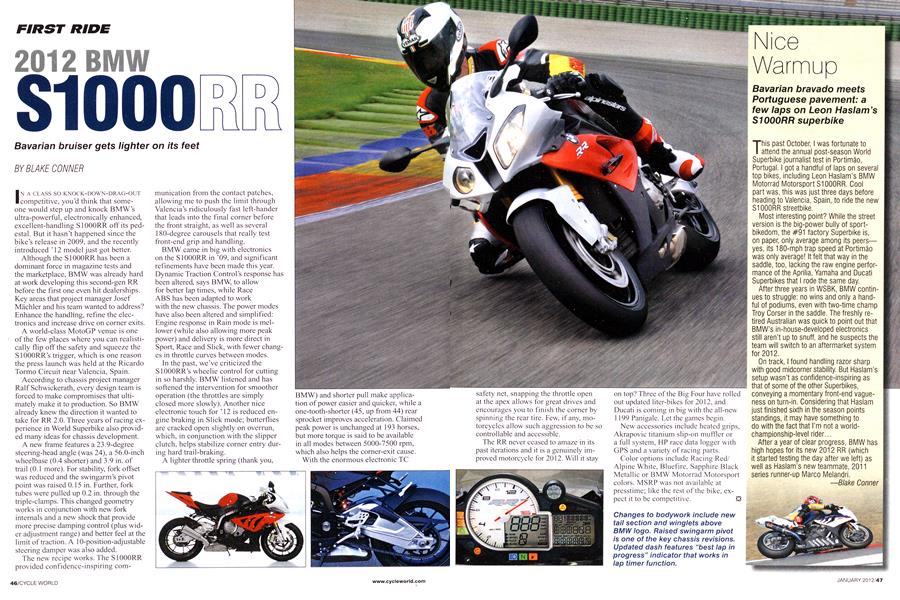
IN A CLASS SO KNOCK-DOWN-DRAG-OUT competitive, you’d think that someone would step up and knock BMW’s ultra-powerful, electronically enhanced, excellent-handling S1000RR off its pedestal. But it hasn’t happened since the bike’s release in 2009, and the recently introduced ’ 12 model just got better.
Although the S1000RR has been a dominant force in magazine tests and the marketplace, BMW was already hard at work developing this second-gen RR before the first one even hit dealerships. Key areas that project manager Josef Mächler and his team wanted to address? Enhance the handling, refine the electronics and increase drive on corner exits.
A world-class MotoGP venue is one of the few places where you can realistically flip off the safety and squeeze the SlOOORR’s trigger, which is one reason the press launch was held at the Ricardo Tormo Circuit near Valencia, Spain.
According to chassis project manager Ralf Schwickerath, every design team is forced to make compromises that ultimately make it to production. So BMW already knew the direction it wanted to take for RR 2.0. Three years of racing experience in World Superbike also provided many ideas for chassis development.
A new frame features a 23.9-degree steering-head angle (was 24), a 56.0-inch wheelbase (0.4 shorter) and 3.9 in. of trail (0.1 more). For stability, fork offset was reduced and the swingarm’s pivot point was raised 0.15 in. Further, fork tubes were pulled up 0.2 in. through the triple-clamps. This changed geometry works in conjunction with new fork internals and a new shock that provide more precise damping control (plus wider adjustment range) and better feel at the limit of traction. A 10-position-adjustable steering damper was also added.
The new recipe works. The S1000RR provided confidence-inspiring com-
munication from the contact patches, allowing me to push the limit through Valencia’s ridiculously fast left-hander that leads into the final corner before the front straight, as well as several 180-degree carousels that really test front-end grip and handling.
BMW came in big with electronics on the S1000RR in ’09, and significant refinements have been made this year. Dynamic Traction Control’s response has been altered, says BMW, to allow for better lap times, while Race ABS has been adapted to work with the new chassis. The power modes have also been altered and simplified: Engine response in Rain mode is mellower (while also allowing more peak power) and delivery is more direct in Sport, Race and Slick, with fewer changes in throttle curves between modes.
In the past, we’ve criticized the SlOOORR’s wheelie control for cutting in so harshly. BMW listened and has softened the intervention for smoother operation (the throttles are simply closed more slowly). Another nice electronic touch for ’12 is reduced engine braking in Slick mode; butterflies are cracked open slightly on overrun, which, in conjunction with the slipper clutch, helps stabilize corner entry during hard trail-braking.
A lighter throttle spring (thank you,
BMW) and shorter pull make application of power easier and quicker, while a one-tooth-shorter (45, up from 44) rear sprocket improves acceleration. Claimed peak power is unchanged at 193 horses, but more torque is said to be available in all modes between 5000-7500 rpm, which also helps the corner-exit cause.
With the enormous electronic TC
www.cycleworld.com
safety net, snapping the throttle open at the apex allows for great drives and encourages you to finish the corner by spinning the rear tire. Few, if any, motorcycles allow such aggression to be so controllable and accessible.
The RR never ceased to amaze in its past iterations and it is a genuinely improved motorcycle for 2012. Will it stay
on top? Three of the Big Four have rolled out updated liter-bikes for 2012, and Ducati is coming in big with the all-new 1199 Panigale. Let the games begin.
New accessories include heated grips, Akrapovic titanium slip-on muffler or a full system, F1P race data logger with GPS and a variety of racing parts.
Color options include Racing Red/ Alpine White, Bluefire, Sapphire Black Metallic or BMW Motorrad Motorsport colors. MSRP was not available at presstime; like the rest of the bike, expect it to be competitive. □
Changes to bodywork include new tail section and winglets above BMW logo. Raised swingarm pivot is one of the key chassis revisions. Updated dash features “best lap in progress” indicator that works in lap timer function.