Ducati 1098
DUCATI 1098
CW FIRST LOOK
The return of seduction, the elevation of performance
ANGELS SANG, PASSIONS WERE fired and there was nary a sportbike maniac on Earth who wasn't helplessly seduced by the Ducati 916. After the 1994 introduction, styling was refined over the years as performance and engine displacement increased, but it was the same sensual shape in 996 and 998 versions that lived on until the redesigned and restyled 999 was introduced in 2003. Now, just four model years later, comes that bike's replacement, the 1098.
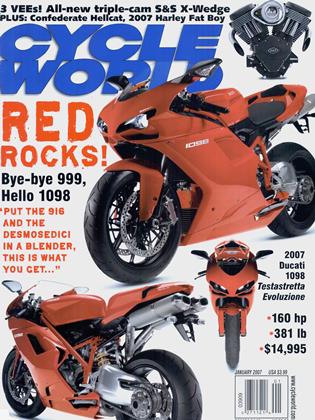
First off, let's get the important figures out of the way. Claimed output is 160 horsepower at 9750 rpm, with 90.4 foot-pounds of torque at 8000 rpm. Dry weight for the standard 1098 Testastretta Evoluzione is 381 pounds, while the S version is 377. These numbers are 29 and 22 pounds lighter than their respective forebears, the 999 and 999R, while power on both models exceeds that of the previous R's claimed 150 hp. Equally impressive, MSRP for the standard bike in red is $14,995, while the tricolore redlwhite/green painted S will be $19,995 at the expected February rollout. The base model is still more expensive than Japanese liter-class machines, but the price is now much more competitive and certainly within "financing distance" for a motivated buyer.
The 1098 comes, for Ducati, relatively quickly after the 999. While performance, technical and
service-oriented improvements were plentiful on the 999, the shape and styling of the bike first shown exclusively in Cycle World (September, 2001) left a lot of people cold and sales suffered. For many, it was like following the Mona Lisa with Lisa Simpson. Entertaining, yes, and even interesting, but lacking the dimension and intrigue of the masterpiece. As one Ducati nut friend of the magazine said, "I don't know about you, but I like my women pretty. . ." The man behind the 999, Pierre Terbianche, is a gifted designer, clearly evident in his recent work on the Hypermotard and the SportClassic line, but his Superbike just didn't seduce the masses the way it needed to. Which is why it had such a short life, half that of a typical Ducati. The Italian company's scale of manufacture means it can't scrap a nearly complete design after a few years with quite the abandon that the Japanese companies seem able. But Ducati also couldn't continue to try to market the contro versial 999, racing success in World Superbike be damned.
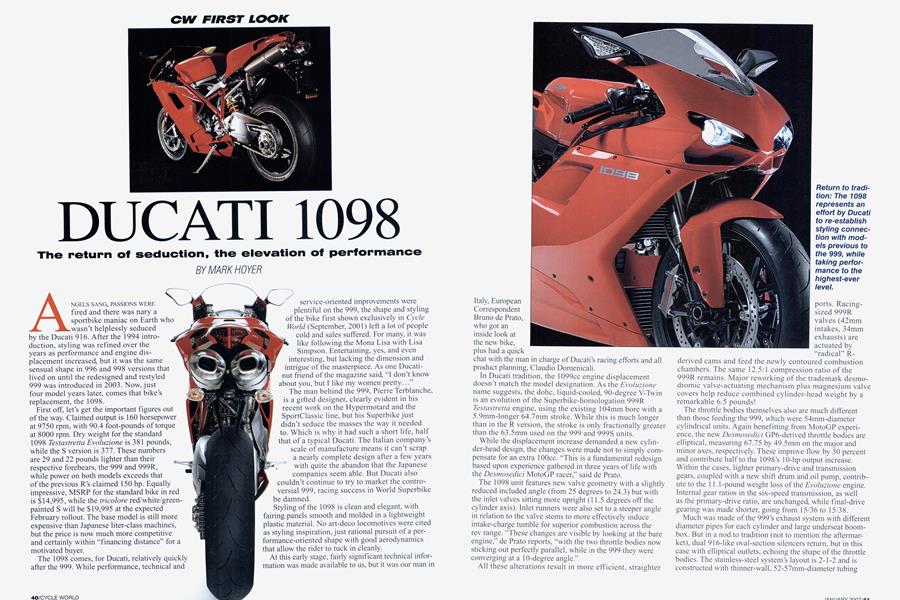
Styling of the 1098 is clean and elegant, with fairing panels smooth and molded in a lightweight plastic material. No art-deco locomotives were cited as styling inspiration, just rational pursuit of a per formance-oriented shape with good aerodynamics that allow the rider to tuck in cleanly.
At this early stage, fairly significant technical infor mation was made available to us, but it was our man in
MARK HOYER
Italy, European Correspondent Bruno de Prato, who got an inside look at the new bike, plus had a quick chat with the man in charge of Ducati’s racing efforts and all product planning, Claudio Domenicali.
In Ducati tradition, the 1099cc engine displacement doesn’t match the model designation. As the Evoluzione name suggests, the dohc, liquid-cooled, 90-degree V-Twin is an evolution of the Superbike-homologation 999R Testastretta engine, using the existing 104mm bore with a 5.9mm-longer 64.7mm stroke. While this is much longer than in the R version, the stroke is only fractionally greater than the 63.5mm used on the 999 and 999S units.
While the displacement increase demanded a new cylinder-head design, the changes were made not to simply compensate for an extra lOOcc. “This is a fundamental redesign based upon experience gathered in three years of life with the Desmosedici MotoGP racer,” said de Prato.
The 1098 unit features new valve geometry with a slightly reduced included angle (from 25 degrees to 24.3) but with the inlet valves sitting more upright (11.5 degrees off the cylinder axis). Inlet runners were also set to a steeper angle in relation to the valve stems to more effectively induce intake-charge tumble for superior combustion across the rev range. “These changes are visible by looking at the bare engine,” de Prato reports, “with the two throttle bodies now sticking out perfectly parallel, while in the 999 they were converging at a 10-degree angle.”
All these alterations result in more efficient, straighter
ports. Racingsized 999R valves (42mm intakes, 34mm exhausts) are actuated by “radical” R-
derived cams and feed the newly contoured combustion chambers. The same 12.5:1 compression ratio of the 999R remains. Major reworking of the trademark desmodromic valve-actuating mechanism plus magnesium valve covers help reduce combined cylinder-head weight by a remarkable 6.5 pounds!
The throttle bodies themselves also are much different than those feeding the 999, which were 54mm-diameter cylindrical units. Again benefitting from MotoGP experience, the new Desmosedici GP6-derived throttle bodies are elliptical, measuring 67.75 by 49.5mm on the major and minor axes, respectively. These improve flow by 30 percent and contribute half to the 1098’s 10-hp output increase. Within the cases, lighter primary-drive and transmission gears, coupled with a new shift drum and oil pump, contribute to the 11.1-pound weight loss of the Evoluzione engine. Internal gear ratios in the six-speed transmission, as well as the primary-drive ratio, are unchanged, while final-drive gearing was made shorter, going from 15/36 to 15/38.
Much was made of the 999’s exhaust system with different diameter pipes for each cylinder and large underseat boombox. But in a nod to tradition (not to mention the aftermarket), dual 916-like oval-section silencers return, but in this case with elliptical outlets, echoing the shape of the throttle bodies. The stainless-steel system’s layout is 2-1-2 and is constructed with thinner-wall, 52-57mm-diameter tubing
that reduces weight by 6.6 pounds.
As for the chassis, design engineers were “encouraged to rethink the design of the single-sided swingarm,” which we can interpret as the styling department and marketing saying, “We need it, make it work!”
This trademark single-sider was ditched in the 999 era, said Ducati, because the conventional swingarm was better able to cope with the cornering and horsepower demands brought about in racing. Ultimately, however, the demands of the showroom win, and the structure of the new singlesided arm consists of cast-aluminum pieces at the main pivot, linkage pickup points and rear hub, all joined by elegantly formed aluminum sheet.
Wheelbase for the new chassis is .4-inch longer at 56.3 inches. Says de Prato, “It all comes from the ‘trim adjustments’ at the swingarm. It retains the 19.3-inch pivot-toaxle measurement of the previous twin arm, only is set more horizontally, thus stretching out for a larger share of its length and effectively lengthening wheelbase.”
The basic dimensional parameters of the frame remain unchanged. Steering-head angle is set at 24.5 degrees with no rake adjustment provided at this time.
The main goals for the steel-trellis main frame were weight savings and increased rigidity, accomplished by
DUCATI 1098
using higher-tensile-strength tubes of larger diameter but thinner wall, upping rigidity by 14 percent and dropping weight by 1.1 pounds. A lighter aluminum subframe results in a 32.2-inch seat height, up from 30.7.
New 330mm-diameter front discs and trick Brembo Monoblock radial-mount, four-piston, two-pad calipers are used in conjunction with a Marchesini front wheel that is a half-pound lighter than before. The rear wheel is 2.2 pounds lighter than “traditional Ducati singlesided-swingarm” fitments. This likely means it is heavier than the wheel used on the 999’s dual-arm setup, but the look is the look.
Controlling wheel movement is an inverted, fully adjustable, titanium-oxide-coated 43mm Showa fork and a fully adjustable Showa shock. Per Ducati practice, there is provision for separate ride-height adjustment at the rear.
The 999’s tach and digital speedo setup has been ditched in favor of a fully electronic MotoGP-inspired dash. The 1098’s digital readout features a bar tach and numeric speedo, with other functions toggled by handlebar switchgear. Further, a fully integrated Digitek dataacquisition system is offered as an accessory on the 1098 and is standard on the S. Data channels monitored are throttle opening, vehicle speed, engine rpm, engine temperature, distance traveled, laps and lap times. The more expensive S also gets Öhlins suspension units front and rear, a machine-finish on its lighter wheels, as well as carbon-fiber fairing ducts and front fender.
Is there an R version in the offing? Rumors suggest that bike will come out in time for the 2008 World Superbike season when it is hoped that the displacement limit for Twins will be raised to 1200cc in nationaland worldlevel Superbike racing. But for the time being, Ducati has pulled out of AMA Superbike and, as of this writing, will not race a 1098 in World Superbike because rules still limit Twins to lOOOcc.
Domenicali has gone on record as saying Ducati’s streetgoing Superbike Twins must not only perform on racetracks better than the four-cylinder Japanese competition, but must also be faster in a straight line. Our recent test of a 999R Xerox yielded a quarter-mile time of 10.22 seconds. Given the 1098’s power increase, substantial weight loss, shorter gearing and longer wheelbase, could this be a 9-second Ducati? Would it be ironic if it did a 9.99-second run? Italian seduction meets ruthless performance.
Are those angels you hear singing? □