Secret Superbike
SECRET SUPERBIKE
CW EXCLUSIVE
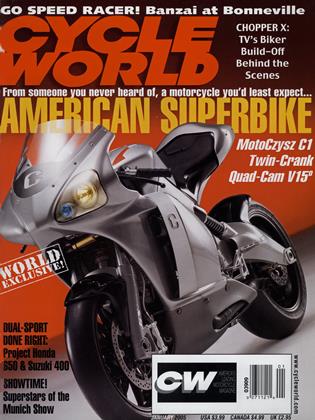
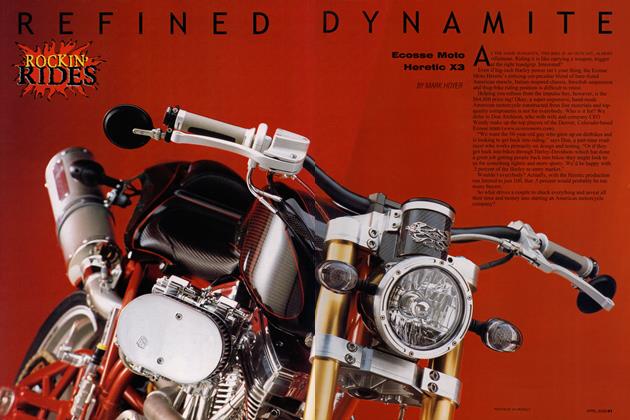
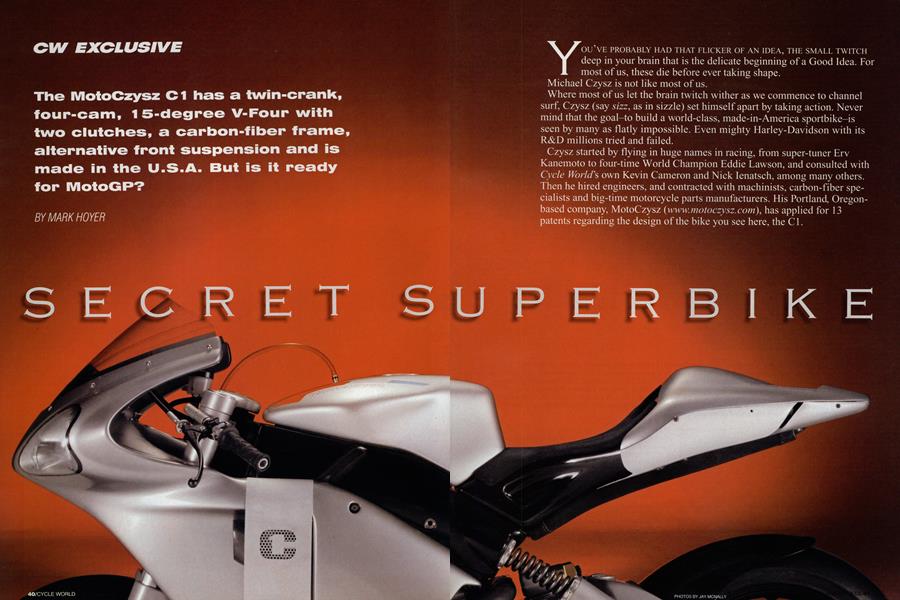
The MotoCzysz C1 has a twin-crank, four-cam, 15-degree V-Four with two clutches, a carbon-fiber frame, alternative front suspension and is made in the U.S.A. But is it ready for MotoGP?
MARK HOYER
YOU'VE PROBABLY HAD THAT FLICKER OF AN IDEA, THE SMALL TWITCH deep in your brain that is the delicate beginning of a Good Idea. For most of us, these die before ever taking shape.
Michael Czysz is not like most of us.
Where most of us let the brain twitch wither as we commence to channel surf, Czysz (say sizz, as in sizzle) set himself apart by taking action. Never mind that the goal-to build a world-class, made-in-America sportbike-is seen by many as flatly impossible. Even mighty Harley-Davidson with its R&D millions tried and failed.
Czysz started by flying in huge names in racing, from super-tuner Erv Kanernoto to four-time World Champion Eddie Lawson, and consulted with C~clc' World's own Kevin Cameron and Nick Ienatsch, among many others. Then he hired engineers, and contracted with machinists, carbon-fiber spe cialists and big-time motorcycle parts manufacturers. His Portland, Oregon based company, MotoCzysz (www.motoczysz.com), has applied for 13 patents regarding the design of the bike you see here, the C 1.
This is a running prototype racing motorcycle built with the intent to take on and beat the best from Honda, Yamaha, Ducati, et al, every major manufacturer who races at the top level, with the lofty goal of competing at the Laguna Seca round of MotoGP this July.
Production potential?
“There is a reason this bike has a headlight,” says the 40year-old. “There is a reason we designed it to have a starter.”
As to why this bike actually exists and makes noise today, the final impetus to put the project in motion-to take it from brain to drawing board-came two years ago, when Czysz was alone afterhours in the Las Vegas Guggenheim’s “Art of the Motorcycle” exhibit. He was there among designer Frank Gehry’s installation of stainless-steel walls and towering chain-link curtains and glass floors for a photo shoot relating to the work in which he made his fortune: architecture. But as a former 250cc roadracer at the club and limited AMA national level, it was while viewing the Britten VI000 on display that Czysz had his Moment in Time
“Is John Britten the last independent guy to build a competitive racing motorcycle?” he wondered.
It was the late Britten’s innovation, his fresh approach to solving the age-old problems of making motorcycles work under the greatest strains at the racetrack, that drew Czysz’s respect and admiration. That Britten was a property developer for his “day job,” a somewhat similar career path to Czysz, was a strange kind of icing.
It was Czysz’s success in architecture with his company,
Architröpolis, that formed the financial foundation that allowed him to begin the project. All the initial design and assembly took place in a carriage house behind the beautiful four-story Portland home where he lives with his wife,
Lisa, and young sons, Enzo and Max.
“When a hotel chain wants to start a whole new brand, we’re one of the people they call,” he says. “Or, I could just do one house every year. I can charge $ 1 million for design and $800,000 to build it, and I’d have people lined up. In the end, though, it’s still their house; it’s not my house.”
To Czysz, building an American sportbike is a more memorable statement than his considerable architectural accomplishments.
And so the idea for the C1 was bom. The project was at first intended to be a lOOOcc Superbike racer, but AMA homologation rules requiring 300 examples be built squashed that. Czysz also feels that the AMA could switch to a 600cc formula for its premier class at some point in the foreseeable future, so MotoGP was the natural choice. Nothing like starting at the top...
What makes Czysz believe he can succeed where Kenny Roberts and Proton, even Kawasaki and Suzuki, are floundering?
“Ignorance!” he exclaims with a laugh. “Seriously, that’s part of it. There’s good and bad in how we’re approaching the project. The good comes in the structure that we don’t have; we have more autonomy and a more creative overall package. At the same time, we don’t have that team of engineers to hand things off to; we don’t have the money to be making multiple different parts to test. It’s insane to do it the way we’re doing it, but we don’t have an option.”
Then he adds, “I also think I want success more than an engineer or manager at a big Japanese company. Hopefully, a company and investors in America want it more, too.”
Why do what Czysz did and reevaluate virtually every aspect of modem racing motorcycle design?
“We’ll never get ahead of the Japanese if we take the same path,” he explains. In Czysz’s eyes, that is trying to defeat the best design refiners in the world by out-refining them. You’re still using a telescopic fork, still using an across-the-frame inline-Four, still employing a conventional rear suspension, etc. So, Czysz hopes to find his advantage through innovation, through a rethink of all the major pieces. The list of new-think solutions to classic motorcycle performance problems on the Cl is long.
A carbon-fiber frame bolts to a longitudinally mounted, dry-sump, 988cc, 15-degree V-Four engine with four valves per cylinder. Each pair of cylinders has its own head and crankshaft, the latter linked to one another via gears. The cranks contra-rotate in billet cases, with a bevel gear to change the “direction” of the power to suit chain final drive. This contra-rotation cancels nearly all the torqueeffect you might get from this north-south setup, and the narrowness allowed by the crank orientation means the bike can have minimal frontal area for less drag.
The unconventional engine design makes for interesting exhaust plumbing. The rear pair of pipes runs forward, wrapping around the front of the powerplant to exit in dual outlets on the right side. The front two cylinders’ pipes cross behind the engine and over the swingarm to exit on the left. The firing order is secret, but the exhaust note is a distinct, sort of busy staccato.
Intake is through four throttle bodies, currently using Suzuki engine management, although former Yoshimura tech specialist Ammar Bazzaz is working on a custom, fully programmable system and wiring harness. A separate airbox is not used-the fuel tank underside and frame spars form the top and sides, while a “floor” is being designed to isolate engine heat from intake air. A small radiator at the front augments another under the tailsection.
A dry clutch is exposed at the front of the engine, while a second wet clutch rides in its own separate oil bath near the rear of the engine. This latter piece is a fully tunable slipper design to control the force of engine braking that reaches the rear wheel. Ultimately, it is planned to have this unit computer-controlled, varying force according to gear ratio and prevailing track conditions.
The bike is designed to be worked on. “Racing is about making the most of the time you have,” says Czysz.
So there are four bolts to remove the frame and front end from the engine and rear suspension.
The design of the cases is such that the six-speed gearbox essentially drops out the bottom, allowing full access for easy ratio changes.
Chassis dimensions are within the realm of “normal” racing motorcycles. Wheelbase is variable from 56.0 to 57.5 inches, roughly a half-inch longer than the wheelbase of a Yamaha YZF-R1, while the Cl’s swingarm is 1.5-inch longer. Rake is approximately 22.5 degrees, while trail is variable from 3 to 3.5 inches (more on that later).
The “Duo” swingarm is perfectly symmetrical to ensure that whatever flex there is in the stout, billet-aluminum piece doesn’t result in a steering effect by the rear wheel. Twin springs act directly on the swingarm; alloy collars adjust ride height and preload. The single Óhlins shock is mounted sans spring in a falling-rate linkage, to provide the most supple action when compressed under high cornering loads.
At something less than 400 pounds, this proof-of-concept bike is still about 80 pounds over the 320-pound MotoGP minimum weight requirement for four-cylinder motorcycles.
Styling is all Czysz, right down to color and texture of materials and finish, the shape zeroed in upon through hours and hours of working with wood, body filler and foam. It was a process he clearly enjoyed.
“If all I ever get from this is the experience of working with these materials and making these shapes, I’d be happy,” he says of the laborious cutting and sanding process.
While all of this is intensely interesting, it is the one piece that we have actually been able to test that seems the most remarkable: the front suspension. This is not a Hossack, a girder or a Telelever-type front end. It works in a similar way to a modem inverted fork, but with significant differences. The lower sections you see are machined from billet aluminum and bolt to male sliders just above the sturdy crossbrace. This billet-lower/male-slider unit moves up and down in truncated female uppers that extend only to the lower triple-clamp. The male sliders have linear bearing races (the “strips” you see in the far-left illustration) in place of bushings. There is no damping or any other moving parts aside from the bearings in the fork tubes. Seals are not necessary because there is no oil to retain in the fork legs-light grease is used on the bearings. A single, fully adjustable Öhlins shock attaches to the crossbrace and is mounted inside the greatly oversized steering head that uses giant tapered-roller bearings some 4 inches in diameter. In this design stiction is greatly reduced, both by removing conventional seals and by the absence of bushings. The shock does have a seal and bushings, but their diameters are small and don’t encounter the twisting force a conventional fork is subjected to.
Besides all but eliminating stiction, the theoretical advantages of this design are manifold: 1) The steering head is giant and rigid, meaning steering inputs are transmitted to the frame directly; 2) the relationship between steering head and swingarm pivot is more constant, aiding stability and predictability; and 3) the shape of the lowers makes them stiff under braking load, yet laterally flexible during cornering (a.k.a. “leaned-over” suspension), improving grip.
Cycle World sampled this “6X Flex” fork at Portland International Raceway, fitted to a 2002 Yamaha YZF-R1 test mule, and we came away convinced that Czysz is onto something. Stability is supreme, feedback phenomenal, grip never in question. It feels like a conventional fork in terms of how the bike responds to steering input, how much it dives under braking and so forth, but it works significantly better.
Czysz flew in five-time AMA 250cc Grand Prix champ Rich Oliver (now running his northern California roadracing camp, the Mystery School, www.richoliver.net) to test the front end fitted to the Rl, and to photo model and give initial feedback on the C1 prototype.
Oliver’s thoughts after several sessions riding and a little fine-tuning on the Rl?
“It feels like a high-end racebike with the front end dialed-in perfectly for a specific track,” Oliver said.
“That’s saying a lot here, because PIR is so bumpy. It’s super-stable-there’s no extra movement in the bars. If you had this front-end setup on a racebike, it would be unbelievable. You’d break some track records.”
Add to this glowing review tunability. The fork’s design features axle-carrier inserts of different offsets, allowing easy and quick adjustment of trail with no alteration in rake. We varied trail from 3.0 to 3.5 inches, which dramatically changed handling character, in about the same time it takes to swap a front wheel! As with most good ideas, you wonder why someone hasn’t done this before.
Next up was for Oliver to ride the Cl. These were not hot laps, but rather low-speed shakedown/photography runs. They nonetheless provided a window into the dynamic behavior of this interesting and unusual motorcycle.
“You can really feel the power pulses hit, and the engine has a really neat sound,” Oliver said. “Once you hang off the bike and move around in the seat, you feel how narrow it is. It’s a lot narrower than a 250! Really, it feels like a 125cc GP bike when you change direction-you can change line instantly. It just feels so light, almost like a bicycle. I wish we weren’t doing photography with it and I could just bum some laps!”
Later, in pit row after the runs, Oliver turned to Czysz and asked with a laugh, “Did you have to tell me how much it was worth just before I took off?!”
This, of course, brings up the financing question.
“The minimum requirement when we started the project was $800,000, but we’ve put in a lot more money,” says Czysz. “Things that are costing us now are patent filings. It’s $20,000 just to file the forms!”
Further, the plan is to race at the Laguna Seca MotoGP round this coming July, for which MotoCzysz is working to have the “Revision Two” bike ready, incorporating what they’ve learned with this first prototype, to be built by a group of 10-12 experienced racing and manufacturing people brought on board by the time you read this. The first group of five or so designers is gone, and the company currently consists of Czysz, his father Terry and a neighbor who roadraces, John Boleski. The latter essentially retired from his own graphic-design company to work for MotoCzysz. Dad Terry is a long-time racer, engine builder and tuner who built successful bikes for the likes of ’60s dirt-tracker Swede Savage. He reentered the sport when Michael took up roadracing in 1996 and has been on board with the Cl project from the beginning.
The younger Czysz knows a new, core group needs to be in place when he takes MotoCzysz from the carriage house to the 17,000-square-foot facility he was remodeling late last year. (“It’ll definitely have a little of our architectural sumthin ’ sumthin ’!” he says with a smile.)
“Hopefully, we’ll be hiring people who come from the industry and have the kind of experience we need to take the bike to the next level, people who can look at our designs and immediately see things that are good and bad and make changes,” he says.
Czysz, like anybody who has tried to start a motorcycle company in the States since the rise and fall of first Excelsior-Henderson and then Indian, has faced a cold investor climate.
“The Indian thing didn’t help, the Cannondale thing didn’t help, the Excelsior-Henderson thing didn’t help,” says Czysz. “Even mid-level investors, just because of the current economic climate, don’t have a lot of extra money. All the financing of the first round was just me making phone calls to people I know. And I just had a meeting that I think took care of round two.”
Funding aside, to be ready to race with an all-new bike (a pair, and four engines, actually) by July is a huge goal, and Czysz knows there are a dramatic number of steps that need to take place. Foremost is actually getting a MotoGP wild-card entry from the FIM and series promoter Dorna. MotoCzysz isn’t yet part of the Motorcycle Sports Manufacturers Association, in which case entering a bike requires special permission. A rider of the proper caliber, who also doesn’t have a current conflicting contract, is a big question too, although Czysz was in discussion with several candidates, most desirable of which is Doug Chandler. Czysz was scheduled to travel to the final MotoGP round in Valencia, Spain, to meet with the series principals, present the Cl project and make his case.
“I would think that Doma, with what is effectively a ‘new’ race at Laguna, would do everything it can to ensure attendance is as high as it can be,” he says. “I would think that if our bike, an American bike, promises to be at all competitive, that they would let us in.”
Laguna Seca being more of a “handling” track than a “power” track is something that Czysz feels will play to the strengths of the C1.
“I think our suspension has the opportunity to be better, that we can better tune our suspension over theirs,” he says. “I think our aerodynamics will be better, which is a much more vital part of top speed than horsepower. Our package has less frontal area and more low-pressure fill, so we may be competitive without needing the big horsepower.”
Big horsepower is certainly a big question. The current cylinder-head design is derived from Japanese streetbike technology, good for about 180-200 horsepower, but the Rev Two versions will be developed in-house with the new, hopefully experienced racing and development engineers. The 250 horsepower that Honda and Ducati are said to be making will certainly be difficult to attain, but that is a project for the new development crew.
“We won’t have the perfect MotoGP bike out there,” admits Czysz. “Kenny Roberts has been working for years and he doesn’t have the perfect GP bike. I don’t think people will expect us to, either. Honestly, if we just finished the race, that would be total success. It might not seem like high expectations, but in the realm of how complicated it is to get from nothing to a running bike, finishing a GP race would be incredible. Even to be on the grid with all those guys, all that money, all that equipment and all that talent, to be out there with them, that would be our tme arrival Obviously, a viable motorcycle manufacturing company has to sell motorcycles, and MotoCzysz plans to build 50 MotoGP race replicas in 2005, priced at $100,000 apiece. Then, in 2006, the first street version will be offered, “like the MV Agusta Serie Oro,” with the 300 units it takes to get AMA homologation, price TBA. After that, a 600cc version is in the works.
This project is still young. Michael Czysz has attained a lot in the last two years though his own efforts and those of the people who have worked for him. To go from a bunch of untested ideas to having some 750 real parts in hand, then assembling those into a motorcycle that looks so good and actually runs, turns and stops is amazing.
“I am gambling everything on this,” Czysz says. “But this is my mark, this is what I want to be known for.”
He has made a very good start. □