Husqvarna: 101 Years And Counting
HUSQVARNA: 101 YEARS AND COUNTING
ROUNDUP
HUSQVARNA CELEbrated its 100th birthday last year, and if recent developments are any indication it is poised to enter its second century in style. The originally Swedish brand, which became a part of the Italian Cagiva empire in 1988, upset the status quo when its four-stroke TE450 took home Best Enduro Bike honors in Cycle World's 2004 "Ten Best Bikes" competition, unseating the multi-term incumbent, KTM. And now, thanks to funding from Italy's Banca Intensa and a pending deal with Malaysian auto-maker Proton, the model line has been improved even further.
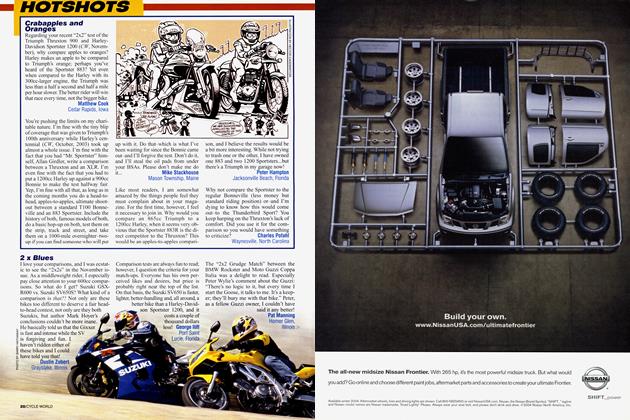
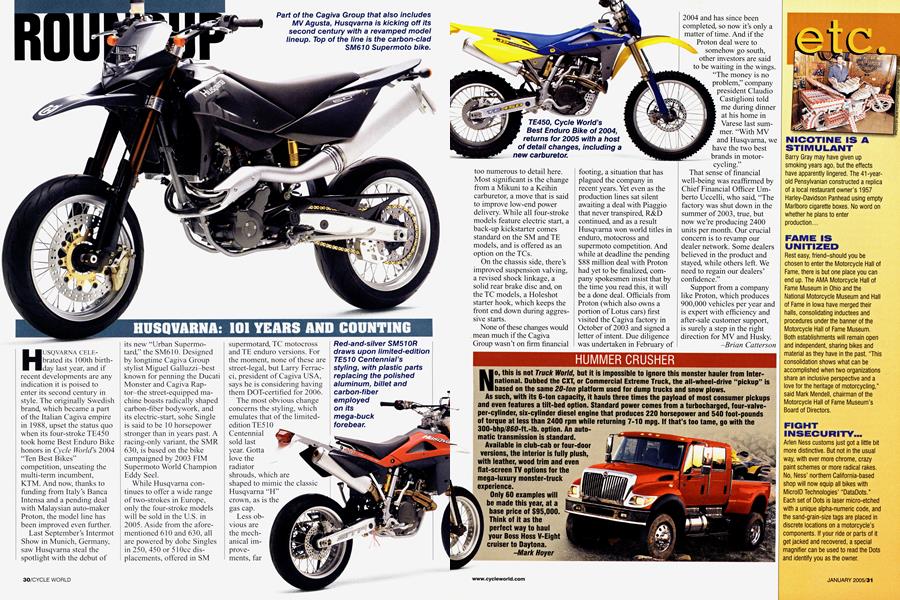
Last September’s Intermot Show in Munich, Germany, saw Husqvarna steal the spotlight with the debut of its new “Urban Supermotard,” the SM610. Designed by longtime Cagiva Group stylist Miguel Galluzzi-best known for penning the Ducati Monster and Cagiva Raptor-the street-equipped machine boasts radically shaped carbon-fiber bodywork, and its electric-start, sohc Single is said to be 10 horsepower stronger than in years past. A racing-only variant, the SMR 630, is based on the bike campaigned by 2003 FIM Supermoto World Champion Eddy Seel.
While Husqvarna continues to offer a wide range of two-strokes in Europe, only the four-stroke models will be sold in the U.S. in 2005. Aside from the aforementioned 610 and 630, all are powered by dohc Singles in 250, 450 or 51 Occ displacements, offered in SM supermotard, TC motocross and TE enduro versions. For the moment, none of these are street-legal, but Larry Ferracci, president of Cagiva USA, says he is considering having them DOT-certified for 2006.
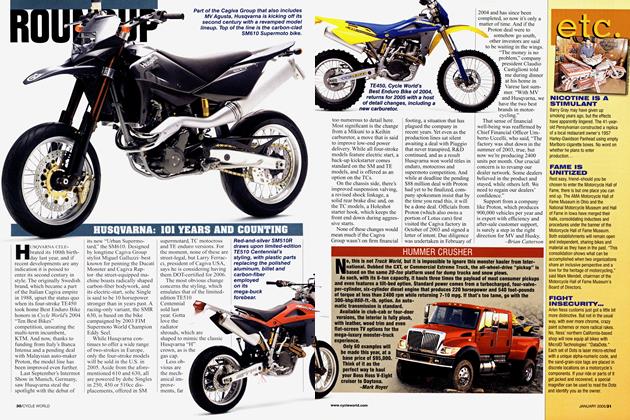
The most obvious change concerns the styling, which emulates that of the limitededition TE510 Centennial sold last year. Gotta love the radiator shrouds, which are shaped to mimic the classic Husqvarna “H” crown, as is the gas cap.
Less obvious are the mechanical improvements, far too numerous to detail here. Most significant is the change from a Mikuni to a Keihin carburetor, a move that is said to improve low-end power delivery. While all four-stroke models feature electric start, a back-up kickstarter comes standard on the SM and TE models, and is offered as an option on the TCs.
On the chassis side, there’s improved suspension valving, a revised shock linkage, a solid rear brake disc and, on the TC models, a Holeshot starter hook, which keeps the front end down during aggressive starts.
None of these changes would mean much if the Cagiva Group wasn’t on firm financial footing, a situation that has plagued the company in recent years. Yet even as the production lines sat silent awaiting a deal with Piaggio that never transpired, R&D continued, and as a result Husqvarna won world titles in enduro, motocross and supermoto competition. And while at deadline the pending $88 million deal with Proton had yet to be finalized, company spokesmen insist that by the time you read this, it will be a done deal. Officials from Proton (which also owns a portion of Lotus cars) first visited the Cagiva factory in October of 2003 and signed a letter of intent. Due diligence was undertaken in February of 2004 and has since been completed, so now it’s only a matter of time. And if the Proton deal were to somehow go south, other investors are said to be waiting in the wings. “The money is no problem,” company president Claudio Castiglioni told me during dinner at his home in Varese last summer. “With MV and Husqvarna, we have the two best brands in motorcycling.”
That sense of financial well-being was reaffirmed by Chief Financial Officer Umberto Uccelli, who said, “The factory was shut down in the summer of 2003, true, but now we’re producing 2400 units per month. Our crucial concern is to revamp our dealer network. Some dealers believed in the product and stayed, while others left. We need to regain our dealers’ confidence.”
Support from a company like Proton, which produces 900,000 vehicles per year and is expert with efficiency and after-sale customer support, is surely a step in the right direction for MV and Husky.
-Brian Catterson