Farewell, 500s
RACE WATCH
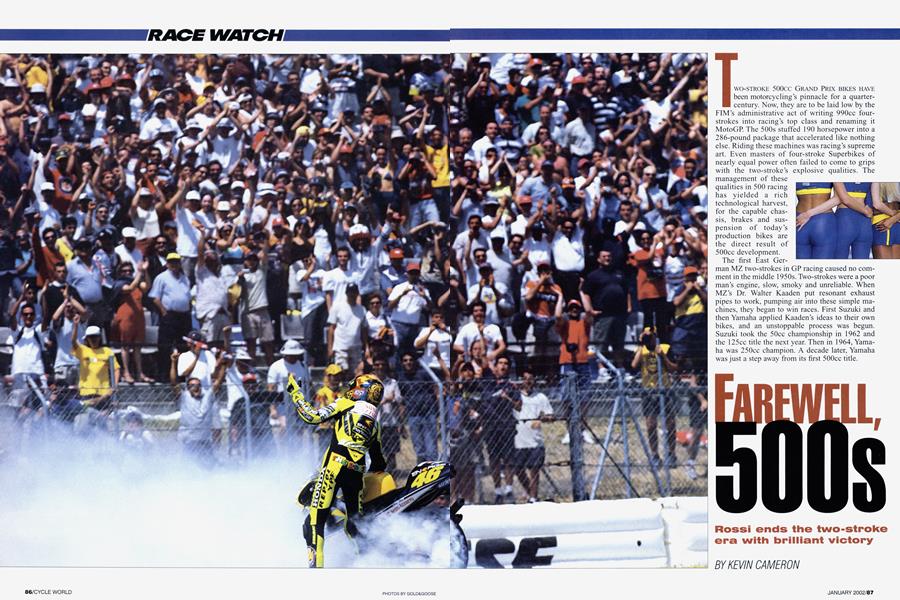
FAREWELL, 500s
Rossi ends the two-stroke era with brilliant victory
BY KEVIN CAMERON
TWO-STROKE 500CC GRAND PRIX BIKES HAVE been motorcycling’s pinnacle for a quartercentury. Now, they are to be laid low by the FIM’s administrative act of writing 990cc fourstrokes into racing’s top class and renaming it MotoGP. The 500s stuffed 190 horsepower into a 286-pound package that accelerated like nothing else. Riding these machines was racing’s supreme art. Even masters of four-stroke Superbikes of nearly equal power often failed to come to grips with the two-stroke’s explosive qualities. The management of these qualities in 500 racing has yielded a rich technological harvest, for the capable chassis, brakes and suspension of today’s production bikes are the direct result of 500cc development.
The first East German MZ two-strokes in GP racing caused no comment in the middle 1950s. Two-strokes were a poor man’s engine, slow, smoky and unreliable. When MZ’s Dr. Walter Kaaden put resonant exhaust pipes to work, pumping air into these simple machines, they began to win races. First Suzuki and then Yamaha applied Kaaden’s ideas to their own bikes, and an unstoppable process was begun. Suzuki took the 50cc championship in 1962 and the 125cc title the next year. Then in 1964, Yamaha was 250cc champion. A decade later, Yamaha was just a step away from its first 500cc title.
On a grass-roots level, the two-stroke meant a person with ideas, a bent file, tinsnips and a gas torch could make his own simple machine faster than any 20,000rpm complexity of gears, cams and valves. This has remained the great strength of two-stroke racing-that development does not cost the Earth.
This past season was the 52nd and final in which GP two-strokes and four-strokes were mandated to run at the same 500cc displacement, though no four-strokes have taken to the grid since Honda’s illfated NR500 of 1982.
The 2001 contest began as yet another triumph-in-the-making for 22-year-old Valentino Rossi, who moved up to 500s the previous season. Prior to this, he had won both the 125 and 250cc titles, each after only a year of study. Winning the first three GPs of the 2001 season, he seemed set to sweep to yet another success. Max Biaggi, the man everyone expected to be his principal rival, was struggling, his Yamaha YZR500 off the pace.
Reigning World Champion Kenny Roberts Jr. found his Suzuki even farther behind than a year ago. The year he won his championship, he could lead off the start, block his rivals as tires aged, and win or finish well. This year, the Suzuki’s powerband still overtaxed the rear tire, while his rivals’ machines were improved more than his own. This left him unable to defend the early leads he so brilliantly achieved. One by one, rivals passed his grip-impoverished bike, leaving him to finish well back.
Soon, Biaggi’s Yamaha YZR500 received a fresh setup more to his liking. He suddenly set pole and won the French GP while Rossi managed only a third. Then at Mugello, Italy, Rossi crashed out, while a third place by Biaggi pulled him to within 21 points. Which man could summon the resources to win a straining seasonlong arm-wrestle?
At Spain’s Catalunya circuit, Rossi perfected the method that would work so well the rest of the season-waiting until everyone’s tires had fatigued to the point that his Honda’s exceptionally smooth torque curve could make best use of the remaining grip. Hard words and even blows between the two camps had by now expanded the Rossi/Biaggi rivalry beyond racing. Life and racing are an amusement for Rossi. His sense of humor and intelligence are always evident, whether he is making witty, two-edged comments about his rival or parading zany inflatable theme dolls on his victory laps. His race management shows that he has the processing power to simultaneously race and plan strategic problems for his opponents.
Biaggi, by contrast, seems a lonely, even desperate figure for whom winning is painfully important. His machine control is wonderful, but he trusts no one-sometimes not even his own crew. This has in the past compromised his machine setup, forcing him to ride harder to compensate.
Rossi’s best performances were full of assurance, planning and control. Biaggi’s rides were brilliant-but with a brittle element. Riding as close to the edge as he must, even a small mistake means a crash.
For Jurgen van den Goor-> bergh and the Kenny Roberts KR3Proton Triple, lack of resources made 2001 frustrating. After seasons wasted in vibration and failure, this breakaway design finally seemed ready to prove its original thesis-that a lighter, narrower, handier bike could match lap times with the power-laden Fours. Promising speed at certain tracks was negated by nuisances-clutch grabbing, surprise tire chatter, mysterious power drops and crank torsional vibration. What for Proton next year? For economic reasons, the two-stroke Triple may soldier on in place of a rumored four-stroke.
Late in the season, Biaggi began to crash. His idea of the cause was “machine imbalance.” Whatever the reason, Rossi pulled away from his rival, while Biaggi in two events remounted after crashing to salvage points. By the Australian Phillip island race, Rossi had only to finish eighth or better to become the last-ever 500cc world champion. He did better, winning the most exciting race of the year over Biaggi in pass after pass with as many as six other riders-and sealing the 500cc title-by a powerful, yet miniscule, 0.013 of a second. Rossi’s comment on the win? “Trying to finish eighth would have been more risky.”
CONTINUED
Thus 500cc two-stroke racing ends at its peak-as a tense, seesaw struggle between two great and contrasting talents and motorcycle brands, building to a climax, against a background of other able riders.
Even those who vividly remember the ascending scales sung by the megaphoned four-strokes of the 1950s and ’60s must admit that we have been treated to a golden, multi-brand age of 500cc competition over the past 30 years.
Since the first two-stroke 500cc title in 1975, we have witnessed continuous chassis, suspension, engine and tire development. Long-travel suspension, gas-pressurized dampers and high-stiffness aluminum chassis have been part of the achievement. Tires advanced from narrow, hard-compound patterned-tread “triangulars” to wide, round-contour belted semi-slicks. Goodyear pushed this to full slicks, and finally Michelin’s pioneering work advanced the art to radial belted tires. These run so cool that rubber compounds formerly usable only in rain can now be run in the dry. Engine power has not only doubled in this period, but has been smoothed and civilized to a degree no one would have believed possible even as recently as 1988.
CONTINUED
Yamaha’s 90-bhp reed engines gave way to Suzuki’s disc valves. Kenny Roberts in 1978-80 put 125-bhp Yamaha piston-port engines on top, only to yield to another generation of 135-bhp Suzuki disc-valve engines in 1981-’82. Then came Honda with motocross-inspired reed valves, and everyone had to follow suit, leading to the closest-ever competition among supermen such as Rainey, Gardner, Lawson, Schwantz and then mighty Mick Doohan. After 1991, lap times stagnated while innovation continued with 190-bhp Big Bang engines, torque controls and computer data acquisition. Doohan, despite his injuries and through dogged recoveries, reigned supreme with five world championships.
CONTINUED
Most recently, the maturing of a new crop of riders like Biaggi, Rossi and Roberts Jr. has revitalized the action. After 52 seasons of 500 racing, this is the end-and a new beginning. Everything stops for the leap to four-stroke MotoGR
How will four-strokes change racing? Their great strength is smoothness in coming on-throttle. Two-stroke 500 riders must try to get away first, block their four-stroke rivals’ smooth early acceleration in mid-corner, then use the speed arising from superior set-up experience to stay ahead. As four-stroke teams and riders gain experience, their big-inch horsepower and early-throttle smoothness will win the day for them. As they say in boxing, “A good big man will always beat a good little man.”
At first, only Honda’s RC211V and Yamaha’s YZR-M1 four-strokes will join the existing two-strokes on starting grids, but change is coming to sweep away all our old certitudes. ÖI