Bring On the Big Guns!
BRING ON THE BIG GUNS!
RACE WATCH
Will Grand Prix racing survive without Mick Doohan?
MICHAEL SCOTT
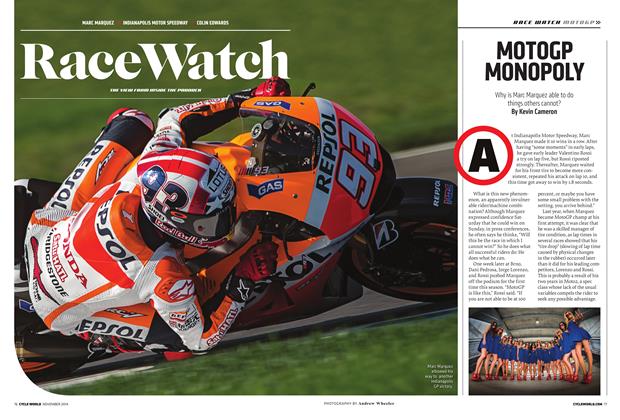
ENTERING ITS 52ND YEAR,GRAND PRIX MOTORCYCLE roadracing is posied somewhere between castastrophe and paradise. Shackled to a dated, multi-class displacement format and running unfashionable and exclusive two-stroke engines, it has become out of touch with real motorcycling. As well, the number of machines and riders in the premier 500cc class is dwindling. A rescue plan that includes Open-class four-strokes is interesting but doesn’t start until 2002. Top-level roadracing is in crisis.
That’s the bad side. The paradise is already happening-a fresh lineup of new talent on highly competitive bikes from three major Japanese factories has already embarked on a struggle for supremacy that made the latter part of 1999 the best in years.
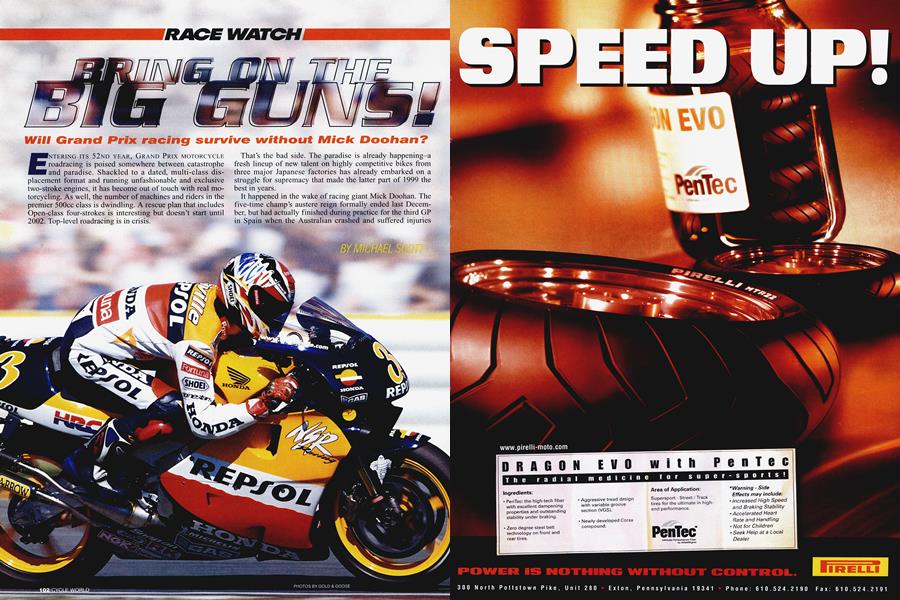
It happened in the wake of racing giant Mick Doohan. The five-time champ’s austere reign formally ended last December, but had actually finished during practice for the third GP in Spain when the Australian crashed and suffered injuries that ended a truly glorious career. With Doohan gone, everyone’s focus changed. Instead of having to confront the master, they had only to race against each other; instead of racing for second, they were going for the win. The new gladiators laid on a series of close finishes-some of the closest in history-and set the scene for a potentially spectacular Y2K.
This begs a number of questions. With a couple of exceptions, last year’s Mickless races were not only more fun for the riders and the fans, but they were also slower. Was the racing better because it was more exciting? Or was it worse, because the riders weren’t circulating quite as fast? Is the value of racing purely in entertainment? Or should it represent something nobler and more Olympian? Is this just a hedonistic game? Or are we also seeking technical and personal improvement?
Then, there’s the shortage of entries. At presstime, there were only 11 confirmed factory entries for the coming season, all Japanese, plus a handful of no-count privateers. Though that number is expected to swell as Aprilia, BSL, MuZ and Team Roberts finalize their plans, not all of these alternative runners are certain. With no national-championship 500s to join the elite and esoteric (some might even say irrelevant) top class to swell the numbers, future grids may look rather empty. As we saw during a similar crisis in the early Nineties, though, if you have high-class bikes and riders going hard for the top-10 positions, this hardly matters. In any case, the television cameras only ever follow the leaders.
These are off-season questions, though. They’ll soon be forgotten when the new gladiators rejoin battle. Their first meeting takes place mid-
March, at the Welkom circuit in South Africa.
Then, they swing off to Malaysia and Japan, before heading to the championship’s European heartland. That is when the 16-round season begins in earnest-a long, hard slog all the way back to Japan and Australia at the end of October. Sadly, the hoped-for revival of the United States Grand Prix, this time at Road America in Elkhart Lake,
Wisconsin, was postponed, but it should be secure for 2001.
It was long-subservient teammate Alex Criville who stepped into Doohan’s vacant position last year, securing his first 500cc title (the first by a non-American/Australian rider since 1982) thanks to a streak of wins in the early part of the season. Criville himself has said that keeping the title will be a far greater achievement. The Spaniard has experience on his side, but by the finish of last year his new generation of rivals was hounding him hard.
None harder than Kenny Roberts, son of a legend, who made the switch from his dad’s uncompetitive Modenas Triple to a factory Suzuki V-Four, and showed from the start that he’d been riding a lot better than his previous results suggested.
In fact, Roberts’ four wins and subsequent challenge for the title happened ahead of schedule. “We expected to win a race or two in 1999, but the real plan was to go for the title in 2000,” says Roberts, who emerged from the family shadow without the “Junior” tag, and with a new level of maturity. Besides taking the lead for improved track safety, he worked handin-gauntlet with Australian technical guru Warren Willing (ex-Yamaha, who came with him from Modenas), and the pair guided the Suzuki back toward the championship-winning form it enjoyed with Kevin Schwantz. Year two of this campaign includes sponsorship from Spanish mobile-phone giant Movistar, plus a pre-season test schedule that will allow bike and rider to take the next step forward.
The third man is Max Biaggi. The Italian, already four-time 250cc World Champion, made a stunning 1998 debut on a Honda, winning two races and finishing second overall, only to find his subsequent switch to Yamaha more difficult. He foundered early on, but finished strong. More recently, he achieved his aim of becoming a “special numberone rider” when he alone was invited to Japan to test the factory’s experimental single-crankshaft V-Four.
Three riders, then, on three makes of motorcycle. But other factory riders have good equipment, too. And in
some cases, perhaps the ability to upset the title battle.
Honda has a strong hand, as usual. The Repsol squad has retained Japanese hot-shoe Tady Okada as well as Spaniard Sete Gibernau, impressive last year for switching from a V-Twin to Doohan’s vacant V-Four. And then, of course, there’s Criville.
Honda also has the excitement card.
Their latest recruit is the hottest property in racing: the hugely talented and highly entertaining 20-year-old Italian Valentino Rossi. Son of former GP winner Graziano Rossi, the kooky kid from near Misano has already taken the 125 and 250cc classes by storm. In his first attempt at riding a 500, he was almost as fast as Gibernau and Okada, with all three well inside last season’s pole-qualifying time at Jerez, Spain. Rossi’s debut will be fascinating for all sorts of reasons. Will he win a race in his first 500 season? Stand by for some welcome fun and games.
Yamaha supports three teams: Besides Biaggi and Carlos Checa on the official factory Marlboro squad, it has the ex-Red Bull WCM team and a Spanish offshoot. Biaggi is the favored rider, and Checa has plenty to prove after a lackluster last season that was strewn with crashes (more than 30, including testing tumbles, but remarkably no injury).
The WCM squad, led by longtime American racing benefactor Bob MacLean, is close to the factory rather than actually of it. The team gained status last year with a win by French rider Regis Laconi, and some marvelous daredevil riding by teammate Garry McCoy, an Australian drafted to replace New Zealander Simon Crafar mid-year. Japanese rider Norick Abe also won a race last year on the Antena 3 squad. Both teams retain the same lineup for 2000.
Suzuki has the smallest team, witll Roberts accompanied by Japanese rider Nobuatsu Aoki, another with memories of a disappointing son to expunge.
There is no doubt that the next 5()0cc World Champion will t aboard a Japanese V-Four. This figuration, developed steadily for most 20 years, has reached a pitch perfection and become the supreme roadracing motorcycle. The Aprilia VTwin may be able to match lap timesas on occasion have four-stroke Superbikes-but when it comes to the hurly-burly of racing, the V-Four is late on the brakes, explosive on acceleration and very, very hard to defeat.
There remains a small degree of
technical variation, however. Honda has stuck to the single-crankshaft design since 1984. It is a layout shared with the Swiss-built MuZ motor, while all the rest use twin counter-rotating cranks. Honda’s layout imposes a distinct torque reaction that the counter-rotation of two crankshafts cancels. This was once thought to be a disadvantage. Now, thinking has come full circle: The torque reaction is considered positive, another control aspect that a rider can use at the limit. Yamaha is testing a single-crank engine in Japan, and Honda may have a twin-cranker in the works. Will 1999 see the ground rules shift once again?
Aprilia came close to matching the V-Fours when it took its V-Twin to full 500cc capacity in 1999 and put former 250cc World Champion Tetsuya Harada on board. This year, additional improvements are promised, plus a two-rider team, with Italian ex250cc privateer Roberto Rolfo a favorite candidate. MuZ’s own V-Four set pole twice last year, but the future of the team is in doubt. One possible rescuer is the New Zealand BSL outfit, which is interested in taking over the whole enterprise. Another alternative for the well-funded enthusiasts is to revive their own three-cylinder machine, a victim last year of near-terminal teething troubles.
What of Kenny Roberts Senior and his three-cylinder Modenas? Late last year, the England-based team was still looking for a sponsor to allow them to continue in 2000, and had not signed any riders. Ironically, this hiatus comes just as the KR3 Mk3 is coming on-line, with a compact new engine that the team hopes will marry the improved performance of the Mk2 with the sweet handling of the Mkl. “We’ll build the new engine anyway, even if we don’t have a team next year,” says Roberts.
For the present, the sound and fury of the V-Fours will compensate for small fields and a lack of diversity. And it is the V-Fours that the proposed new generation of four-strokes will need to beat. Regulations are nearly finalized, ratifying four-stroke prototypes of up to 990cc with a sliding scale of weight limits for different numbers of cylinders.
The notion is interesting. Honda has not shown its hand yet, but everybody knows it would dearly love to conquer the 500cc class with a fourstroke-having tried and failed with the oval-piston NR500 in the late Seventies. Aprilia Chief Engineer Jan Witteveen is another fan of the changes, and relishes the technical challenge. “It will be possible to beat the V-Four two-strokes, but it will be very difficult,” he says. “That is what makes it interesting.”
The four-strokes would also bring GP racing back within touch of the motorcycling mainstream. After all, big-bore two-strokes are manufactured in dwindling numbers for the exclusive use of GP racers. But there are serious questions about the potential cost of the exercise, which could be many times greater than that of a hand-made two-stroke. This is for the future. Racing is now. The V-Four two-strokes may be dinosaurs, but they remain the supreme two-wheeled predators. Y2K’s racing class is small and exclusive. Paradise. And never mind the crisis.