Honda Six
HONDA SIX
RC166 A RACE BIKE THAT REWROTE THE RULES
KEVIN CAMERON
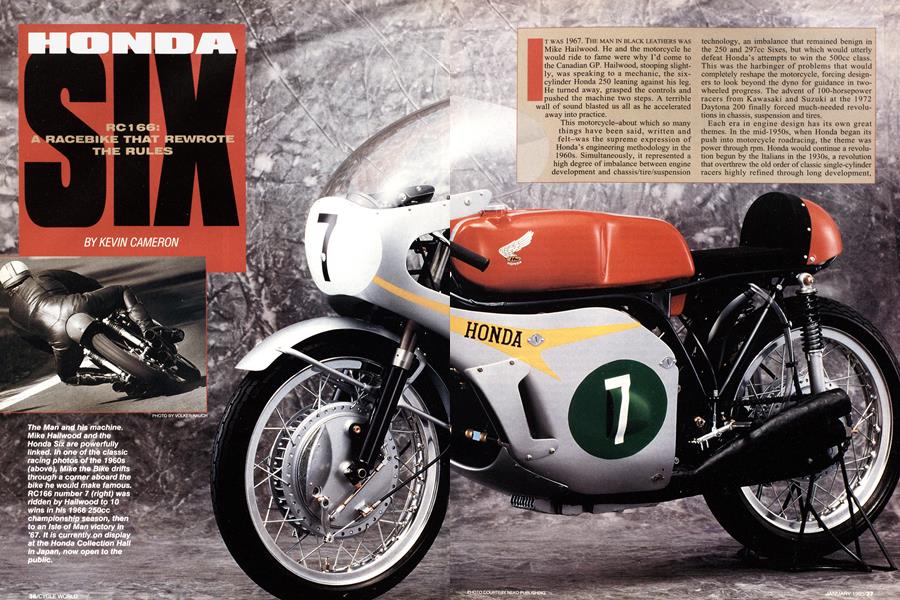
T WAS 1967. THE MAN IN BLACK LEATHERS WAS Mike Hailwood. He and the motorcycle he would ride to fame were why I’d come to the Canadian GP. Hailwood, stooping slightly, was speaking to a mechanic, the sixcylinder Honda 250 leaning against his leg. He turned away, grasped the controls and pushed the machine two steps. A terrible wall of sound blasted us all as he accelerated away into practice.
This motorcycle-about which so many things have been said, written and felt—was the supreme expression of Honda’s engineering methodology in the 1960s. Simultaneously, it represented a high degree of imbalance between engine development and chassis/tire/suspension technology, an imbalance that remained benign in the 250 and 297cc Sixes, but which would utterly defeat Honda’s attempts to win the 500cc class. This was the harbinger of problems that would completely reshape the motorcycle, forcing designers to look beyond the dyno for guidance in twowheeled progress. The advent of 100-horsepower racers from Kawasaki and Suzuki at the 1972 Daytona 200 finally forced much-needed revolutions in chassis, suspension and tires.
Each era in engine design has its own great themes. In the mid-1950s, when Honda began its push into motorcycle roadracing, the theme was power through rpm. Honda would continue a revolution begun by the Italians in the 1930s, a revolution that overthrew the old order of classic single-cylinder racers highly refined through long development, agile, reliable, easily maintained.
In the great Singles of the 1935-55 era, cylinder filling was maximized through the use of tuned intake and exhaust pipes, but there was a limit. The atmosphere, offering only 14.7 pounds per square inch at sea level, has a limited ability to fill engine cylinders. Beautifully shaped ports and tuned pipes can add something to this, but only to the extent of 20-30 percent.
Compression ratio determines how much of the fuel’s energy will do work in driving the piston; the higher the ratio, the better. But here again, development hit a limit. Too much compression, with gasoline as the fuel, produces destructive combustion knock, so the fuel’s anti-knock quality limits the compression ratio-and the power developed.
It took time to find the limits in cylinder filling and higher compression, but once the limits were plumbed, 500cc Singles were essentially stalled at the 50-horsepower level from 1937 onward. With breathing and compression fully exploited, designers turned reluctantly to higher rpm for more power. This works because power is simply the rate at which work is performed. If you repeat the power-producing cycle more frequently (that is, raise the rpm) you are generating work faster.
The reluctance to raise revs came from the long history of mechanical problems that result with every increase in rpm. All engines already had mechanical troubles, chiefly with bigend bearings and with valve control. Valve springs, even when made of the best available materials, broke without warning. Valves cupped and stretched under long exposure to heat and hammering. As revs went higher, pistons had to accelerate faster at top and bottom center. Piston rings, burdened with their own inertia, lifted off the bottoms of their grooves as pistons decelerated near TDC, breaking their seal and allowing them to collapse and break. Engines shook themselves out of chassis. Cycle parts fatigued and broke.
High revs were big trouble, but there was no alternative.
One attractive path to higher revs was to change the engine’s proportions. Making the bore larger and the stroke shorter reduced stress by shortening the distance through which the piston had to rise and fall. Even this change went against the grain because engines had always had small bores and long strokes. Very cautiously, the classic Singles adopted shorter strokes, and were able to squeeze out a few hundred extra safe revs.
There was a better way. Instead of whittling away at the stroke by making the bore bigger, why not cut the stroke dramatically by just using more cylinders? The Italians jumped to four cylinders, each of tiny 52 x 58.8mm dimensions. Where Norton Singles were stretching to reach 6500 rpm, the Güera Rondine whizzed up to a liberating 9500! With a supercharger (legal at the time), the Güera gave 85 horsepower. The blown BMW Boxer, at 66 x 72mm bore and stroke, also handily outrevved the Singles.
All that stopped with WWII, and when the game began again, supercharging was banned. But the higher revs of the Multis still gave them the power advantage, though the nimbleness of the Singles could sometimes overcome the poorer handling of the bulky Italian Fours.
It was clear revs were the future. The British builders, after inconclusive experiments with Twins and rumors of Norton and Velocette Fours, pulled their GP teams in 1954. The bike market was fading as auto factories, which had been slow to rebuild post-war, came back on line.
Economics also put an end to Italian GP teams three years later; all but MV pulled out by mutual agreement at the end of 1957.
The Japanese were ready. In 1959, a U.S. auto magazine showed a photo of a quaint-looking four-cylinder 250 racer from an unknown company called Honda, noting that it could reach an amazing 13,000 rpm. For a time, American servicemen stationed in Japan were the only western witnesses to this development. There would soon be more.
The 125 Twins Honda brought to the Isle of Man in 1959 had four valves per cylinder, like the classic pre-WWl Peugeot engines. Western analysts were amused by this; airflow experiments had long since proved that two valves could flow more air than four. They assumed that the upstart Japanese would soon learn their mistake.
But the rules had changed. Orthodox engineers had refined two-valve breathing to escape the perils of high revs. Honda made high revs safe by adopting four valves. If there was any slight breathing penalty in four valves, Honda’s engines more than compensated for it by doing their “inferior” breathing two or three times more often. They adopted four valves not for flow, but for mechanical reliability.
For orthodox engines, high revs were a mine field. Only 300 revs beyond its power peak, the valves of the famed MV Agusta 500 floated, bringing major engine damage quickly. Riders had to be eagle-eyed powerplant managers as much as track tacticians. Valve-spring reliability was so poor in the early 1950s that Mercedes and Ducati gave up on springs altogether in favor of the complex desmo system, in which one cam opened the valve, and another closed it-without failure-prone springs.
Honda engineers saw a better future in the then-unfashionable four-valve concept. They simply extended the same principle that had created the Güera Four: Cut stress by making the parts smaller and using more of them. Instead of two big valves per cylinder, they used four smaller ones. The advantage arises from the squared/cubed effect. As a valve is scaled down, it loses weight faster than it loses area.
Honda four-valve racing engines were soon able to overrev past peak power by thousands of revs. With the rpm barrier thus broken, the way was open for Honda to make limitless power and win 16 (iP titles almost by formula. This is not to belittle the skill and courage of the riders who won those titles, It is only to say that Honda replaced the touchy artistry of previous engine designs with new, solid science and engineering of its own devising. In the process, 250cc machines would break the lap records previously held by machines of twice the displacement.
Vigorous R&D was another Japanese novelty. While MV could remain comfortably ahead of its single-cylinder opposition with only occasional engineering tweaks, Honda developed its machines at war-emergency rates. In the factory, deep resources in prototyping and testing ensured a high rate of advance. The money for this poured into Honda’s coffers from the mass markets the company had created.
Soichiro Honda, the founder, also had made a point of obtaining the finest test equipment and manufacturing machinery. That approach was a far cry from that of the usual English producer, eking out an uncertain living from 1920s tooling and no test equipment at all. When Jack Williams, the brilliant AJS development engineer, needed lab equipment, he was told policy forbade use of any device not made in the factory! When Rex McCandless designed the famous Featherbed twinloop chassis for Norton in 1950, its manufacture had to be farmed out because the factory lacked welding equipment!
In a 1964 paper, Honda described work done with its research engines, extending out to 27,000 rpm. Studies of flame propagation showed that because in-cylinder mixture turbulence continued to speed up as rpm rose, there was no barrier to engine operation at any foreseeable revs.
In GP racing, Honda had become 125 and 250cc world champion in 1961. Mr. Honda flew to Finland to deliver his now-famous speech, in which he expressed pride at showing the world that “the Japanese are not a nation of copyists.”
But, evolution of two-stroke concepts was forging worthy opponents to Honda's technology of super-rpm fourstrokes. In 1964, Yamaha took the 250 title with an air-cooled Twin. Honda’s fourth-generation 250 Four, now making 45 horsepower at 14,500 rpm, had fallen behind the development pace of the two-strokes.
Honda’s answer, revealed at the Italian GP at Monza in 1964, was even more cylinders and even higher revs: the 54-horsepower RC six-cylinder.
We are fortunate that one of these machines, via a Byzantine provenance worthy of our best spy novelists, made its way into private hands. This example belongs to Team Obsolete, the vintage racing team created by Robert lannucci of Brooklyn, New York, and is under restoration in the skilled hands of Nobby Clark, a career GP mechanic who was an apprentice actually working in the Honda factory when the Six first appeared.
The Six’s engine is straightforward, even simple, but is detailed with strong emphasis on friction-reduction. Its tiny pressed-together, all-roller crank is not like familiar production items. On production cranks, the mains are largediameter ball bearings, clamped between upper and lower cases, but the Six uses the smallest-possible roller mains, seven of them. The smaller the diameter, the shorter the distance the rollers must travel per crank revolution, and the lower the friction.
If the engine’s power were taken from a crank end, each of the pressed joints that hold the crank together would have to be large enough to transmit all the engine’s power-and that would have forced use of larger bearings and higher friction. Therefore, power is taken from crank center.
In a perfectly dry rolling bearing, the only source of friction is the slight deformation (strain) of the rollers and raceways under the load, leading to some local scrubbing. To prevent the surface damage this scrubbing would otherwise cause, oil is needed-but very little. The ideal lubrication for a rolling bearing is an extremely thin film, constantly replaced via air-oil mist as the passage of the rollers squeegees it off again. Anything more and each roller must push a bow wave of extra oil ahead of itself, a wave whose wedging action increases bearing internal load, and whose turbulence generates heat. Both equate to friction.
And now for a fine point. Nobby Clark explains that tiny angled grooves in the outer rings of the Six’s main bearing cages were provided to sweep oil out of the bearing, much like the similar ribbing seen on some oil seals. He adds that Honda engineers were very particular about these cages. In one 1960s-era practice, 125 rider Luigi Taveri reported loss of a few hundred revs in top gear. The engineers instantly ordered the engine stripped; one of the main bearing cages was found to be installed backward. People who know rolling bearings know that the quickest path to failure is too much oil.
The small main bearings, carrying large crank-vibratory forces, would have fretted loose if clamped conventionally between case halves. Therefore, each main-bearing OD was made in pedestal form, and the seven main-bearing outer races are held by 14 bolts to the underside of the aluminum upper case. Upper case and cylinder block are cast in one piece, greatly stiffening the engine against the rocking of what are, in effect, two three-cylinder cranks trying to break the engine in half. Atop the gearbox is the large-diameter ignition generator and triple point sets. A conventional seven-speed gearbox is lubed by engine oil to its shaft centers. As in modern engines like Honda’s 600F2, the oil level is far below any moving parts. No parts are lubed by what is euphemistically called “dip,” or direct contact with the sump oil. Every effort is made to prevent oil from contact with the fast-moving crank, because any transfer of momentum from part to oil is a dead loss of power.
The lower case, having no direct contact with the crank, can therefore be made of the lighter but softer magnesium.
The bottom layer of the engine is a T-shaped aluminum sump, part cast, part welded from sheet. The fore-andaft part of the sump hangs down to present its finned lower surface to airflow under the bike, between the exhaust pipes. In addition to these fins, the Six carries a pair of fairing-mounted oil coolers. Early Honda racers had overheated severely-some had even seized from complete oil breakdown above 400 degrees-but coolers solved this.
The upper casting contains six iron liners, set in close groups of three. To further trim engine width, the cam drive is placed, not between them, but behind them. A central pinion on the crank engages an idler above and behind it, from which the cam-drive geartrain extends upwards to the head, while power is sent rearward to the clutch via a jackshaft that also drives the ignition and tiny oil pump. It is a pair of 22mm spur gears, only 5mm wide.
Up in the cylinder head, each chamber’s four valves are set at a large, 75degree included angle, creating very deep combustion chambers. This wide angle is a necessary compromise with the needs of air cooling; it lets air flow between the two cam boxes. The paired 14mm inverted-bucket tappets are carried in bronze guide blocks-as in other Honda racers of the period. Long-stemmed valves made from gasturbine alloys are returned by conventional steel springs. Each cam is made in two pieces, joined at a central gear by a tongue-and-groove Oldham coupler. Like the crank, each cam is bolted by its bearing yokes to the head, and the magnesium cam covers and end plates are then bolted over them.
The pistons are full-skirted, carrying only two rings, a single 0.8mm gas ring and a plain 1.5mm oil-scraper. The high domes are carefully handcontoured to remove all the sharp edges left by the machining of valveto-piston clearances; Nobby Clark emphasized that this smoothing was an important part of engine-building. Even with such measures, combustion was none too fast in these deep combustion chambers-ignition timing is a long, long 57-58 degrees.
Round-slide Keihin carbs were used on twisty courses, and flat-slide, needle-less smoothbores of various sizes (from 17-20mm bore) were reserved for faster tracks. Exhaust was via the six 26-inch-long megaphones that so deafened me at the Canadian GP.
How effective was the Six as a tool for applying the rpm-equals-power concept? A standard measure of breathing, burning and friction efficiency is the so-called Brake Mean Effective Pressure, or bmep, which is the strokeaveraged combustion pressure in psi, with friction loss subtracted. The classic Singles, with their refined breathing and combustion, combined with moderate low-rpm friction loss, produced peak-power bmeps in the 180-190 psi range. The Honda, advanced though it was, remained in the 165-170 psi range, as did all the Honda four-stroke race engines of the classic 1960s. The causes of this relative shortfall were surely several; despite all efforts to prevent it, friction in a 17,000-rpm engine with six cylinders and 24 valves is high. Heat loss from six tiny cylinders is likewise higher than from a single cylinder of equal displacement. Combustion in the chambers formed between the large pent-roof valve angle and high piston dome was obviously slow and to that degree inefficient.
But the exercise was a total success. Honda gained far more from high rpm than it lost from friction, size effects and poor combustion. Even against the rapidly growing strength of two-stroke opposition from MZ, Yamaha and Suzuki, Honda was able to win championships. The horsepower-laden two-strokes weren't as easy to ride as the four-stroke Hondas, and they weren’t as reliable, either.
Honda’s engineers put this new engine straight into modified versions of the very chassis that had carried the previous, four-cylinder engines. This chassis, like Honda street chassis of the time, employed the engine as a stressed member, bolted-in at both cam boxes and the rear of the gearbox. It was as conventional and marginal as the sixcylinder engine was advanced and solid. Its flexing is attested by the numerous added gussets. W hen I asked Clark what sort of damping parts were inside the slender fork tubes, he replied, “Not much.” Rear dampers were chosen according to whoever offered riders the best contingency-Girlings at the TT, Cerianis at Monza. Handling was made stable and tolerable by hard spring and damping rates, on the theory that if it can’t move, it can’t wobble. There’s no suspension delay if there’s no suspension.
Introduced as an emergency measure at the end of 1964, the Six was fast but needed development. Phil Read and the two-stroke Yamaha took the title. A Read/Yamaha repeat in 1965 overcame Honda’s long loyalty to Jim Redman, the man who had won the company six 250 and 350cc world titles. Mike Hailwood, already viewed as one of the greatest riders of all time, was asked to ride the Six. In Hailwood’s hands, the Six became the dominant machine in both 250 and 350 classes, and it remained so until Honda left the sport at the end of 1967.
Like advanced products of engineering in any era, the Honda Six introduced the future, yet remained limited by obsolete traditions. The future was power through high rpm. The past was the focus on power and disregard of vehicle handling qualities. Engineers are understandably tempted to trust in what they can most easily measure: physical quantities like weight, horsepower and torque. Handling makes engineers feel ignorant, and riders never let them forget it. Honda’s rough formula for chassis design was to put the crankshaft midway between the wheel axles, and use whatever size tubing seemed appropriate for the frame. This formula would work for the last time with this 250 and its brother machine, the 297cc Six used in the 350 class. Honda’s innovations in high-rpm four-valve technology were shortly adopted by all serious makers of four-stroke racing engines.
But even the best formulas have limits. The 85-plus horsepower of Honda’s 500cc RC 181 would defeat the engineers’ (and Hailwood’s) best efforts to make it handle, posing the questions whose eventual answers would underlie the modern era of racing motorcycles.