Riding the Number Ones
RIDING THE NUMBER ONES
SUPERSPORT CHAMPS
DON CANET
YOSHMURA SUZUKI GSX-R750
IN MOTORCYCLE ROADRACING'S HIGHEST FORM, THE 500cc GP series, competing factories often roll out all-new machines at the beginning of each race season. Despite the astronomical cost, they do so in the name of research and development, to demonstrate their mastery of technology, and, of course, for the marketing value that winning a world title brings.
Far removed from the grand prix scene is productionbike racing, where street-based bikes have at it in classes such as the AMA National Supersport Series. While pro duction racing also adheres to the evolve-or-be-eaten principal, at this level of the sport several years may pass before a bike receives any significant change in design. The unveiling of an all-new bike in supersport racing is driven more by showroom sales figures than by actual racing results. As it turns out, AMA supersport racing's newest bikes-the Suzuki GSX-R750W and the Kawasaki ZX-6-were also the champions for 1993.
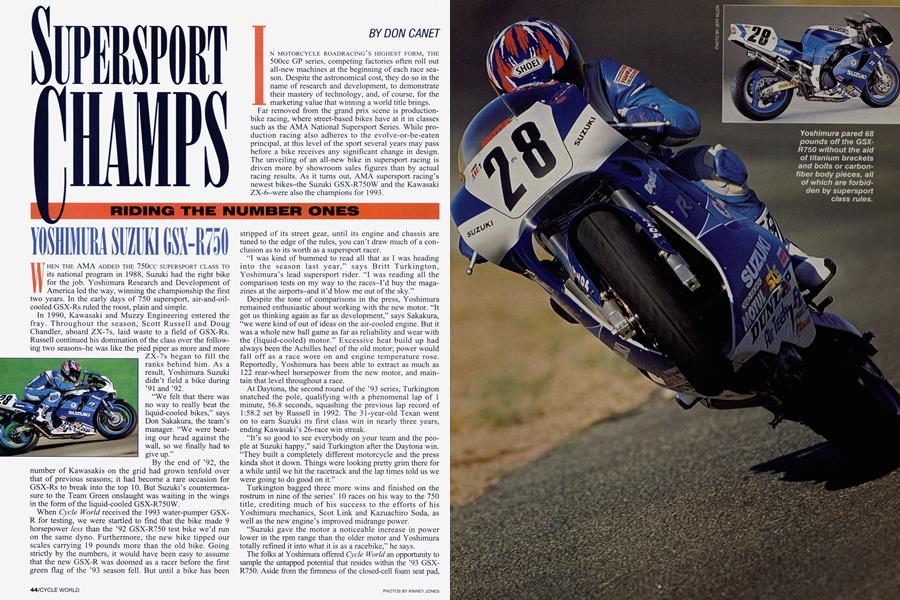
WHEN THE AMA ADDED THE 750cc SUPERSPORT CLASS TO its national program in 1988, Suzuki had the right bike for the job. Yoshimura Research and Development of America led the way, winning the championship the first two years. In the early days of 750 supersport, air-and-oil cooled GSX-Rs ruled the roost, plain and simple.
In 1990, Kawasaki and Muzzy Engineering entered the fray. Throughout the season, Scott Russell and Doug Chandler, aboard ZX-7s, laid waste to a field of GSX-Rs. Russell continued his domination of the class over the follow ing two seasons-he was like the pied piper as more and more ZX-7s began to fill the ranks behind him. As a result, Yoshimura Suzuki didn't field a bike during `91 and `92.
"We felt that there was no way to really beat the liquid-cooled bikes," says Don SakakUra, the team's manager. "We were beat ing our head against the wall, so we finally had to give up."
By the end of `92, the number of Kawasakis on the grid had grown tenfold over that of previous seasons; it had become a rare occasion for GSX-Rs to break into the top 10. But Suzuki's countermea sure to the Team Green onslaught was waiting in the wings in the form of the liquid-coOled GSX-R750W.
;;;;~m~ GSX R for testing, we were startled to fmd that the bike made 9 horsepower less than the `92 GSX-R750 test bike we'd run on the same dyno. Furthermore, the new bike tipped our scales carrying 19 pounds more than the old bike. Going strictly by the numbers, it would have been easy to assume that the new GSX-R was doomed as a racer before the first green flag of the `93 season fell. But until a bike has been
stripped of its street gear, until its engine and chassis are tuned to the edge of the rules, you can't draw much of a con clusion as to its worth as a supersport racer.
"I was kind of bummed to read all that as I was heading into the season last year," says Britt Turkington, Yoshimura's lead supersport rider. "I was reading all the comparison tests on my way to the races-I'd buy the maga zines at the airports-and it'd blow me out of the sky."
Despite the tone of comparisons in the press, Yoshimura remained enthusiastic about working with the new motor. "It got us thinking again as far as development," says Sakakura, "we were kind of out of ideas on the air-cooled engine. But it was a whole new ball game as far as reliability and wear with the (liquid-cooled) motor." Excessive heat build up had always been the Achilles heel of the old motor; power would fall off as a race wore on and engine temperature rose. Reportedly, Yoshimura has been able to extract as much as 122 rear-wheel horsepower from the new motor, and main tain that level throughout a race.
At Daytona, the second round of the `93 series, Turkington snatched the pole, qualifying with a phenomenal lap of 1 minute, 56.8 seconds, squashing the previous lap record of 1:58.2 set by Russell in 1992. The 31-year-old Texan went on to earn Suzuki its first class win in nearly three years, ending Kawasaki's 26-race win streak.
"It's so good to see everybody on your team and the peo pie at Suzuki happy," said Turkington after the Daytona win. "They built a completely different motorcycle and the press kinda shot it down. Things were looking pretty grim there for a while until we hit the racetrack and the lap times told us we were going to do good on it."
Turkington bagged three more wins and finished on the rostrum in nine of the series' 10 races on his way to the 750 title, crediting much of his success to the efforts of his Yoshimura mechanics, Scot Link and Kazuachiro Soda, as well as the new engine's imDroved midrange nower.
"Suzuki gave the motor a noticeable increase in power lower in the rpm range than the older motor and Yoshimura totally refined it into what it is as a racebike," he says.
The folks at Yoshimura offered Cycle World an opportunity to sample the untapped potential that resides within the `93 GSX R750. Aside from the firmness of the closed-cell foam seat pad, and the visual cues of its altered switchgear and instru mentation, the Yoshimura 750 doesn't feel too far removed from a stocker.
A bump of the starter but ton, without choke, fires the engine to life in what seems like a half revolution of crank rotation. It settles into a smooth idle and has surpris ingly crisp throttle response,
even while stone cold. The stock carburetors are fitted with Yoshimura's innovative MJN (multi-jet needle), claimed to improve fuel atomization over a conventional tapered needle. The carburation was extremely crisp as I lapped Willow Springs Raceway, the bike pulling
out of comers with the authority of an Open-class stocker. However, the jetting tended to load up the motor when ridden for too long below 6000 rpm, something I encountered while doing repeated back and forth passes for our photographer.
The chassis was no magic carpet ride through Willow’s rougher sections. The Öhlins shock and stock fork-which has been revalved and fitted with stiffer springs-transmit every bump loud and clear to the rider, but do a good job keeping the DOT Dunlops hooked up with the asphalt.
Turkington’s preferred setup calls for steering geometry much steeper than stock. At some tracks, the fork legs are pulled up in the clamps just as far as the tapper on the tubes will allow in an effort to quicken and lighten the bike’s steering. The bike’s steering geometry was fairly conservative the day I rode it, so high-speed stability was very good, although the transition into Willow’s top-gear Turn 8 took an exerted effort at the bars. Through the track’s tighter sections, the reduced weight and upgraded suspension clearly distinguished the Yoshimura racebike from the stocker.
Just how good is the bike that won the 1993 AMA 750 Supersport Championship? In my first timed session of the day, I clocked a lap of 1 minute, 29.4 seconds, nearly a full second faster than I’ve gone while testing any other bike for Cycle World.