Muzzy Kawasaki Zx-6
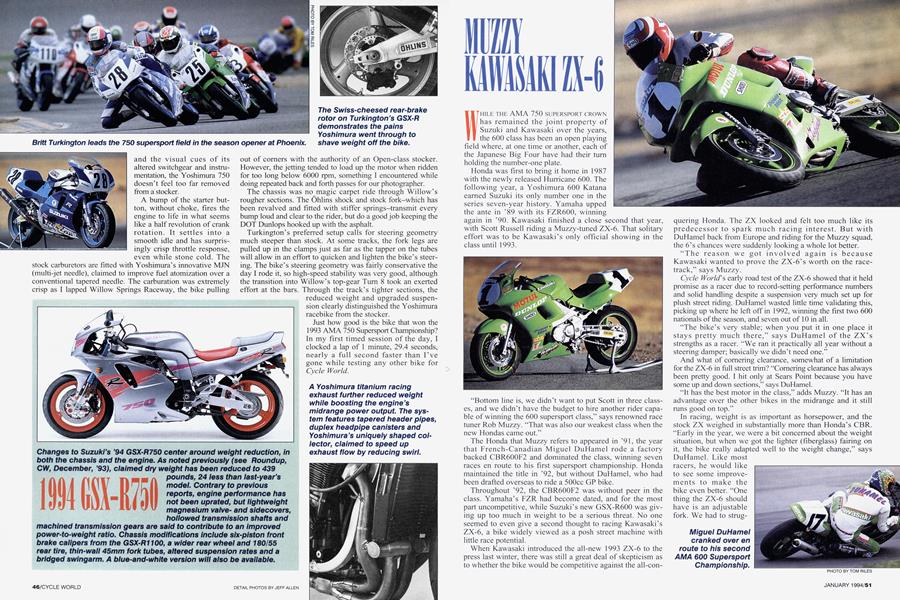
MUZZY KAWASAKI ZX-6
WHILE THE AMA 750 SUPERSPORT CROWN has remained the joint property of Suzuki and Kawasaki over the years, the 600 class has been an open playing field where, at one time or another, each of the Japanese Big Four have had their turn holding the number-one plate.
Honda was first to bring it home in 1987 with the newly released Hurricane 600. The following year, a Yoshimura 600 Katana earned Suzuki its only number one in the series seven-year history. Yamaha upped the ante in ’89 with its FZR600, winning again in ’90. Kawasaki finished a close second that year, with Scott Russell riding a Muzzy-tuned ZX-6. That solitary effort was to be Kawasaki’s only official showing in the class until 1993.
“Bottom line is, we didn’t want to put Scott in three classes, and we didn’t have the budget to hire another rider capable of winning the 600 supersport class,” says renowned race tuner Rob Muzzy. “That was also our weakest class when the new Hondas came out.”
The Honda that Muzzy refers to appeared in ’91, the year that French-Canadian Miguel DuHamel rode a factory backed CBR600F2 and dominated the class, winning seven races en route to his first supersport championship. Honda maintained the title in ’92, but without DuHamel, who had been drafted overseas to ride a 500cc GP bike.
Throughout ’92, the CBR600F2 was without peer in the class. Yamaha’s FZR had become dated, and for the most part uncompetitive, while Suzuki’s new GSX-R600 was giving up too much in weight to be a serious threat. No one seemed to even give a second thought to racing Kawasaki’s ZX-6, a bike widely viewed as a posh street machine with little race potential.
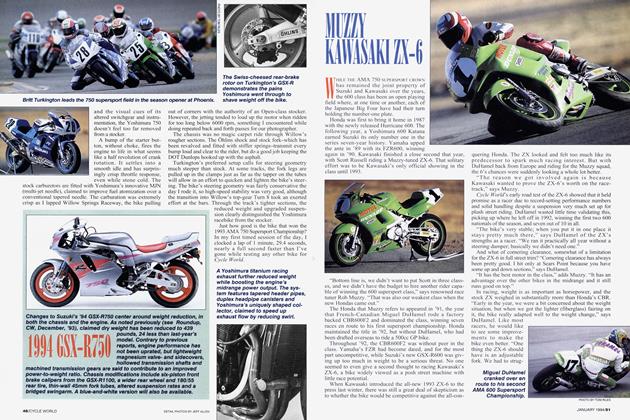
When Kawasaki introduced the all-new 1993 ZX-6 to the press last winter, there was still a great deal of skepticism as to whether the bike would be competitive against the all-conquering Honda. The ZX looked and felt too much like its predecessor to spark much racing interest. But with DuHamel back from Europe and riding for the Muzzy squad, the 6’s chances were suddenly looking a whole lot better.
“The reason we got involved again is because Kawasaki wanted to prove the ZX-6’s worth on the racetrack,” says Muzzy.
Cycle World's early road test of the ZX-6 showed that it held promise as a racer due to record-setting performance numbers and solid handling despite a suspension very much set up for plush street riding. DuHamel wasted little time validating this, picking up where he left off in 1992, winning the first two 600 nationals of the season, and seven out of 10 in all.
“The bike’s very stable; when you put it in one place it stays pretty much there,” says DuHamel of the ZX’s strengths as a racer. “We ran it practically all year without a steering damper; basically we didn’t need one.”
And what of cornering clearance, somewhat of a limitation for the ZX-6 in full street trim? “Cornering clearance has always been pretty good. I hit only at Sears Point because you have some up and down sections,” says DuHamel.
“It has the best motor in the class,” adds Muzzy. “It has an advantage over the other bikes in the midrange and it still runs good on top.”
In racing, weight is as important as horsepower, and the stock ZX weighed in substantially more than Honda’s CBR. “Early in the year, we were a bit concerned about the weight situation, but when we got the lighter (fiberglass) fairing on it, the bike really adapted well to the weight change,” says DuHamel. Like most racers, he would like to see some improvements to make the bike even better. “One thing the ZX-6 should have is an adjustable fork. We had to struggle a bit with the oil mixtures and stuff like that; it was kind of like the good old days when I used to race motocross,” he says. “But once we got everything dialed-in, I didn’t touch anything. The bike was real fast and a real joy to ride from mid-season on.”
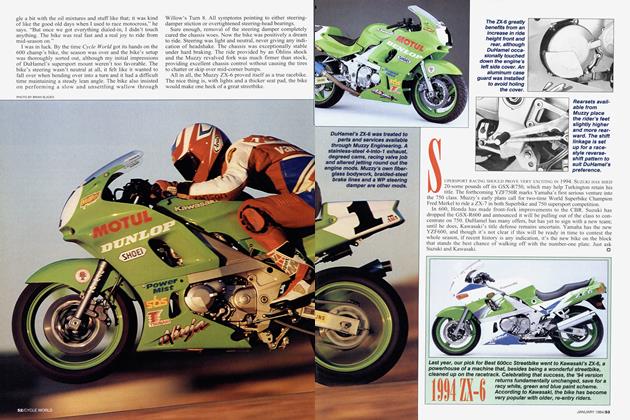
I was in luck. By the time Cycle World got its hands on the 600 champ’s bike, the season was over and the bike’s setup was thoroughly sorted out, although my initial impressions of DuHamel’s supersport mount weren’t too favorable. The bike’s steering wasn’t neutral at all, it felt like it wanted to fall over when bending over into a turn and it had a difficult time maintaining a steady lean angle. The bike also insisted on performing a slow and unsettling wallow through
Willow’s Turn 8. All symptoms pointing to either steeringdamper stiction or overtightened steering-head bearings.
Sure enough, removal of the steering damper completely cured the chassis woes. Now the bike was positively a dream to ride. Steering was light and neutral, never giving any indication of headshake. The chassis was exceptionally stable under hard braking. The ride provided by an Öhlins shock and the Muzzy revalved fork was much firmer than stock, providing excellent chassis control without causing the tires to chatter or skip over mid-comer bumps.
All in all, the Muzzy ZX-6 proved itself as a tme racebike. The nice thing is, with lights and a thicker seat pad, the bike would make one heck of a great streetbike.
SUPERSPORT RACING SHOULD PROVE VERY EXCITING IN 1994. SUZUKI HAS SHED 20-some pounds off its GSX-R750, which may help Turkington retain his title. The forthcoming YZF750R marks Yamaha's first serious venture into the 750 class. Muzzy's early plans call for two-time World Superbike Champion Fred Merkel to ride a ZX-7 in both Superbike and 750 supersport competition. In 600, Honda has made front-fork improvements to the CBR. Suzuki has dropped the GSX-R600 and announced it will be pulling out of the class to concentrate on 750. DuHamel has many offers, but has yet to sign with a new team; until he does, Kawasaki's title defense remains uncertain. Yamaha has the new YZF600, and though it's not clear if this will be ready in time to contest the whole season, if recent history is any indication, it's the new bike on the block that stands the best chance of walking off with the number-one plate. Just ask Suzuki and Kawasaki.