Suzuki Gsx1100g
SUZUKI GSX1100G
CW LONG-TERM TEST
11,000 MILES ON SUZUKI’S SUPER STANDARD
OF ALL THE MOTORCYCLES Cycle World has tested since 1991, Suzuki’s GSX1100G was probably the least likely candidate to become a long-term testbike. The reason? Despite its smooth, powerful engine and high level of comfort, the 1100G rolled off the assembly line with a few niggling faults in stock condition, and, with more exciting machines in the CW garage to choose from, it would be tough for the G to rack up the kind of mileage a long-term testbike must have.
Yet that’s exactly what happened. After returning the bike to Suzuki to have the company’s touring accessories installed, the G became our shop runabout. We not only went to lunch on it, we commuted on it, went on dates with it, and let our photographers use it to haul their camera gear on photo shoots. We took trips on it, too: to Death Valley, Lake Havasu, the Grand Canyon, Kenny Roberts’ Ranch, over the Continental Divide, to Laguna Seca for the Superbike races. By the time we were through, the G’s odometer read 11,000 miles.
So how did Suzuki’s big-bore standard hold up? Pretty well, though we made some significant changes to
address some of the bike’s weaknesses.
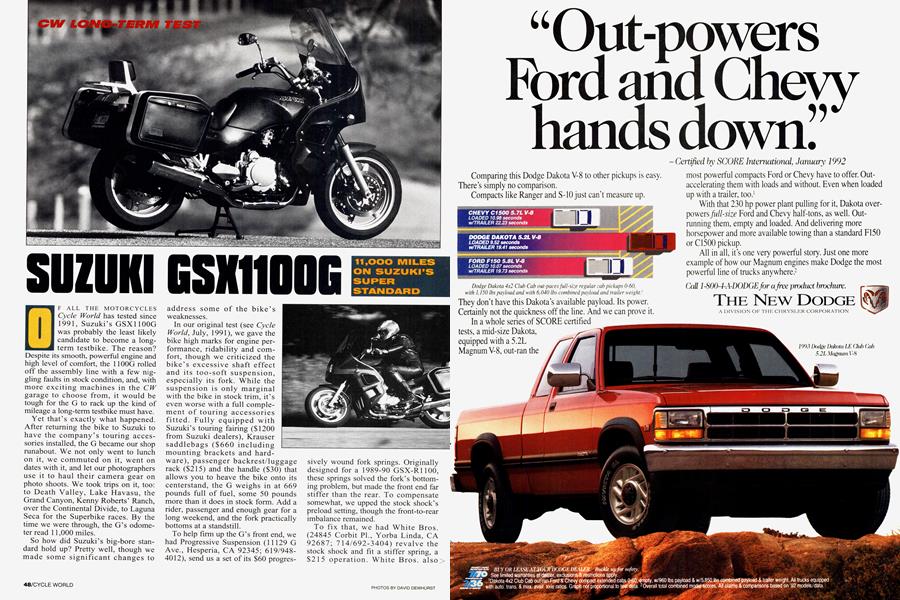
In our original test (see Cycle World, July, 1991), we gave the bike high marks for engine performance, ridability and comfort, though we criticized the bike’s excessive shaft effect and its too-soft suspension, especially its fork. While the suspension is only marginal with the bike in stock trim, it’s even worse with a full complement of touring accessories fitted. Fully equipped with Suzuki’s touring fairing ($1200 from Suzuki dealers), Krauser saddlebags ($660 including mounting brackets and hardmounting ware), passenger backrest/luggage rack ($215) and the handle ($30) that allows you to heave the bike onto its centerstand, the G weighs in at 669 pounds full of fuel, some 50 pounds more than it does in stock form. Add a rider, passenger and enough gear for a long weekend, and the fork practically bottoms at a standstill.
To help firm up the G’s front end, we had Progressive Suspension (11129 G Ave., Hesperia, CA 92345; 619/9484012), send us a set of its $60 progressively wound fork springs. Originally designed for a 1989-90 GSX-R1100, these springs solved the fork’s bottoming problem, but made the front end far stiffer than the rear. To compensate somewhat, we upped the stock shock’s preload setting, though the front-to-rear imbalance remained.
To fix that, we had White Bros. (24845 Corbit PI., Yorba Linda, CA 92687; 714/692-3404) revalve the stock shock and fit a stiffer spring, a $215 operation. White Bros. also> reduced preload up front, which helped soften the front end slightly. The bike is now suspended like a sport-tourer should be: fairly plush, but still capable of spirited cornering.
The prototype optional fairing Suzuki displayed on the show circuit prior to the llOOG’s introduction in ’91 wasn’t exactly a thing of beauty (see “Gilding the GSX,” Cycle World, July, 1991), but it was more aesthetically pleasing than the production version Suzuki fitted to our bike. Nonetheless, the fairing does offer a high degree of wind and weather protection, a plus during a long ride or in foul weather. The windscreen’s design could be better, however; its upper edge is distorted and not optically correct. Also, the need to use different keys to open the fairing’s twin storage compartments is tough to understand.
On the other hand, the llOOG’s engine is wonderful. Essentially a counterbalanced GSX-R1100 motor, the thing seems to have horsepower oozing out of its gaskets. Never mind what gear you’re in, just twist the throttle and the bike accelerates hard, even when fully loaded. We had the initial 4000-mile service performed by Orange County (California) Suzuki at a cost of $244 (including a $45 surcharge for removing and replacing the fairing), and other than routine oil and filter changes, we haven’t touched the G since. The owner’s manual specifies valve-clearance inspection every 3500 miles, but we’ve neglected ours since the initial service without any decrease in performance. Only now, at 11,000 miles, are the valves beginning to clatter slightly.
We replaced both tires at that initial service, fitting another pair of the stock Dunlop K505s ($310/pair at Suzuki dealers), and the bike is about ready for another set-not exemplary service life, but riders with a gentler throttle hand than us could do better. We also replaced brake pads at about 10,000 miles when the rear pads began to make noise and front-brake lever travel became excessive. Other than these parts, the only thing we replaced was a bumed-out tumsignal bulb.
In our original test, we reported that the inspection plate at the G’s secondary-driveshaft juncture had come loose and that the petcock knob had fallen off. After tightening the former and replacing the latter, we had no more problems. We averaged 40.3 miles per gallon, with a low of 28.8 in traffic and a high of 58.5 during openroad touring. The G’s excellent seat softened during our testing, but was still firm enough for long days in the saddle. Passengers appreciated the accessory backrest, too. Our only comfort complaint, in fact, concerned a bit of engine vibration at certain rpm levels that tingled the bike’s levers, and some engine heat that proved bothersome on hot days.
With the touring accessories added and the suspension dialed, the Suzuki GSX1100G is a lot better motorcycle than it was in stock form. In terms of its sport-touring capabilities, though, it’s still no threat to Honda’s ST1100-especially when you consider that a fully equipped G will set you back $8309, compared to $9299 for a non-ABSTCS ST. But it’s close. And it’s still got that killer motor. □