A Harley For the Masses
A HARLEY FOR THE MASSES
12 YEARS BEFORE HONDA, HARLEY WAS WOOING THE NICEST PEOPLE
HARLEY-DAVIDSON'S FAME AND FORTUNE HAS BEEN MADE with great hulking V-Twins, so it's easy to forget that for 15 years a lightweight two-stroke runabout was an important part of the Motor Company's lineup.
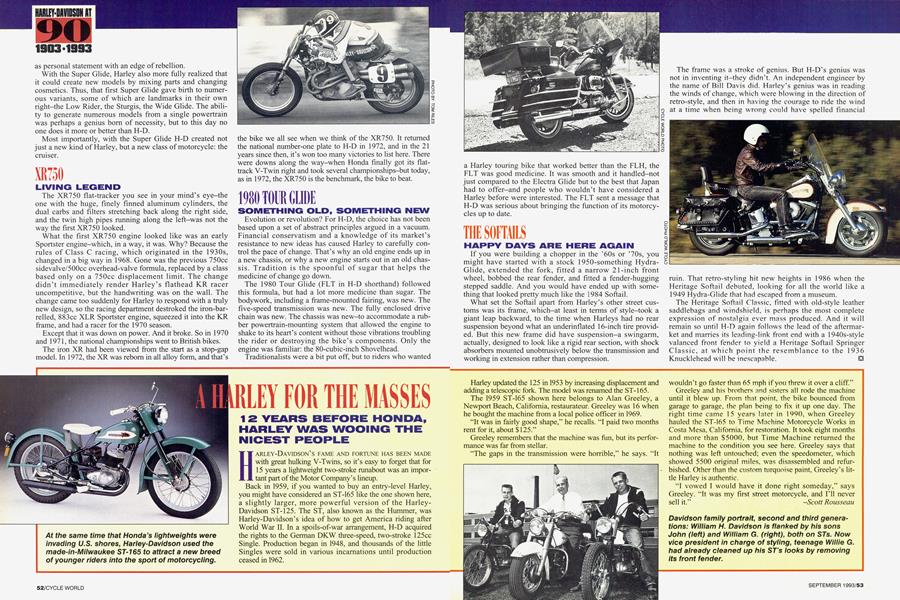
Back in 1959, if you wanted to buy an entry-level Harley, you might have considered an ST-165 like the one shown here, a slightly larger, more powerful version of the Harley-Davidson ST-125. The ST, also known as the Hummer, was Harley-Davidson’s idea of how to get America riding after World War II. In a spoils-of-war arrangement, H-D acquired the rights to the German DKW three-speed, two-stroke 125cc Single. Production began in 1948, and thousands of the little Singles were sold in various incarnations until production ceased in 1962.
Harley updated the 125 in 1953 by increasing displacement and adding a telescopic fork. The model was renamed the ST-165.
The 1959 ST-165 shown here belongs to Alan Greeley, a Newport Beach, California, restaurateur. Greeley was 16 when he bought the machine from a local police officer in 1969.
“It was in fairly good shape,” he recalls. “I paid two months rent for it, about $125.”
Greeley remembers that the machine was fun, but its performance was far from stellar.
“The gaps in the transmission were horrible,” he says. “It
wouldn’t go faster than 65 mph if you threw it over a cliff.”
Greeley and his brothers and sisters all rode the machine until it blew up. From that point, the bike bounced from garage to garage, the plan being to fix it up one day. The right time came 15 years later in 1990, when Greeley hauled the ST-165 to Time Machine Motorcycle Works in Costa Mesa, California, for restoration. It took eight months and more than $5000, but Time Machine returned the machine to the condition you see here. Greeley says that nothing was left untouched; even the speedometer, which showed 5500 original miles, was disassembled and refurbished. Other than the custom turquoise paint, Greeley’s little Harley is authentic.
“I vowed I would have it done right someday,” says Greeley. “It was my first street motorcycle, and I’ll never sell it.”
Scott Rousseau