Moving On
MOVING ON
DAVID BAILEY DISCOVERS LIFE AFTER MOTOCROSS
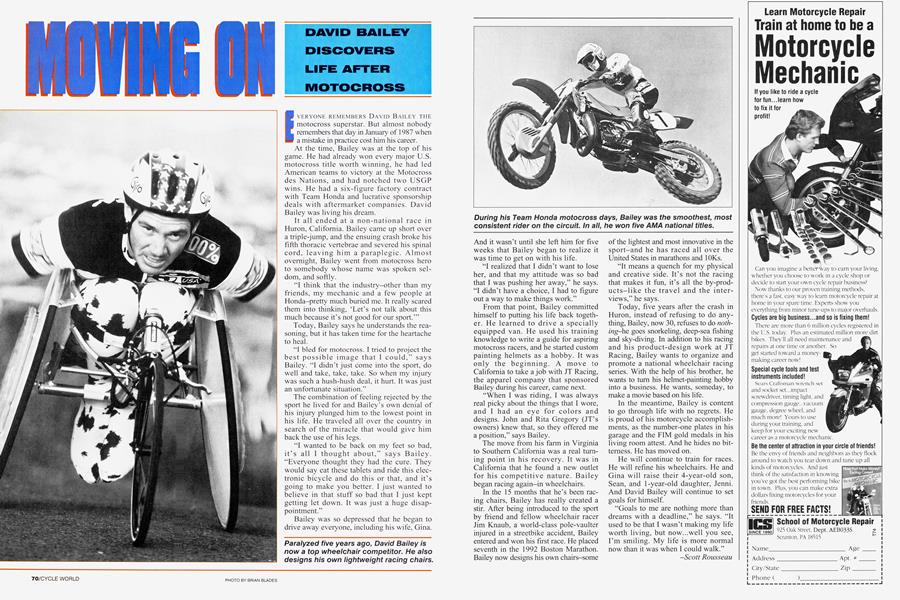
EVERYONE REMEMBERS DAVID BAILEY THE motocross superstar. But almost nobody remembers that day in January of 1987 when a mistake in practice cost him his career.
At the time, Bailey was at the top of his game. He had already won every major U.S. motocross title worth winning, he had led American teams to victory at the Motocross des Nations, and had notched two USGP wins. He had a six-figure factory contract with Team Honda and lucrative sponsorship deals with aftermarket companies. David Bailey was living his dream.
It all ended at a non-national race in Huron, California. Bailey came up short over a triple-jump, and the ensuing crash broke his fifth thoracic vertebrae and severed his spinal cord, leaving him a paraplegic. Almost overnight, Bailey went from motocross hero to somebody whose name was spoken seldom, and softly.
“I think that the industry-other than my friends, my mechanic and a few people at Honda-pretty much buried me. It really scared them into thinking, ‘Let’s not talk about this much because it’s not good for our sport.’” Today, Bailey says he understands the reasoning, but it has taken time for the heartache to heal.
“I bled for motocross. I tried to project the best possible image that I could,” says Bailey. “I didn’t just come into the sport, do well and take, take, take. So when my injury was such a hush-hush deal, it hurt. It was just an unfortunate situation.”
The combination of feeling rejected by the sport he lived for and Bailey’s own denial of his injury plunged him to the lowest point in his life. He traveled all over the country in search of the miracle that would give him back the use of his legs.
“I wanted to be back on my feet so bad, it’s all I thought about,” says Bailey. “Everyone thought they had the cure. They would say eat these tablets and ride this electronic bicycle and do this or that, and it’s going to make you better. I just wanted to believe in that stuff so bad that I just kept getting let down. It was just a huge disappointment.”
Bailey was so depressed that he began to drive away everyone, including his wife, Gina. And it wasn’t until she left him for five weeks that Bailey began to realize it was time to get on with his life.
“I realized that I didn’t want to lose her, and that my attitude was so bad that I was pushing her away,” he says. “I didn’t have a choice, I had to figure out a way to make things work.”
From that point, Bailey committed himself to putting his life back together. He learned to drive a specially equipped van. He used his training knowledge to write a guide for aspiring motocross racers, and he started custom painting helmets as a hobby. It was only the beginning. A move to California to take a job with JT Racing, the apparel company that sponsored Bailey during his career, came next.
“When I was riding, I was always real picky about the things that I wore, and I had an eye for colors and designs. John and Rita Gregory (JT’s owners) knew that, so they offered me a position,” says Bailey.
The move from his farm in Virginia to Southern California was a real turning point in his recovery. It was in California that he found a new outlet for his competitive nature. Bailey began racing again-in wheelchairs.
In the 15 months that he’s been racing chairs, Bailey has really created a stir. After being introduced to the sport by friend and fellow wheelchair racer Jim Knaub, a world-class pole-vaulter injured in a streetbike accident, Bailey entered and won his first race. He placed seventh in the 1992 Boston Marathon. Bailey now designs his own chairs-some of the lightest and most innovative in the sport-and he has raced all over the United States in marathons and lOKs.
“It means a quench for my physical and creative side. It’s not the racing that makes it fun, it’s all the by-products-like the travel and the interviews,” he says.
Today, five years after the crash in Huron, instead of refusing to do anything, Bailey, now 30, refuses to do nothing-\\Q goes snorkeling, deep-sea fishing and sky-diving. In addition to his racing and his product-design work at JT Racing, Bailey wants to organize and promote a national wheelchair racing series. With the help of his brother, he wants to turn his helmet-painting hobby into a business. He wants, someday, to make a movie based on his life.
In the meantime, Bailey is content to go through life with no regrets. He is proud of his motorcycle accomplishments, as the number-one plates in his garage and the FIM gold medals in his living room attest. And he hides no bitterness. He has moved on.
He will continue to train for races. He will refine his wheelchairs. He and Gina will raise their 4-year-old son, Sean, and 1-year-old daughter, Jenni. And David Bailey will continue to set goals for himself.
“Goals to me are nothing more than dreams with a deadline,” he says. “It used to be that I wasn’t making my life worth living, but now...well you see, I’m smiling. My life is more normal now than it was when I could walk.”
-Scott Rousseau