John Kocinski's Yamaha Tz250
John Kocinski's Yamaha TZ250
RIDING THE ONES
DAVID EDWARDS
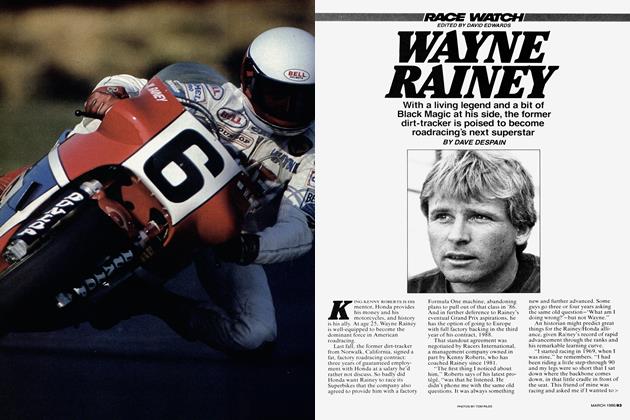
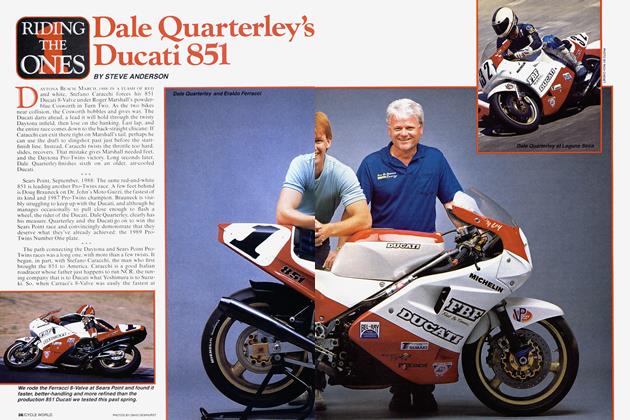
YOU ARE NOT JOHN KOCINSKI. You AREN'T 5-FOOT-5, or 128 pounds, or 20 years old, and you're definitely not the best 250-class roadracer in America. Yet there you are on pit row at Sears Point Raceway, cinching your helmet's chinstrap, preparing to settle your ass onto Kocinski's immaculate, red-and-white Yamaha TZ250.
Bud Aksland, Team Nordica-Roberts’ tuner, and Merrill Vanderslice, the team’s mechanic, are there as well, and so is Kocinski, who less than 24 hours earlier had wrapped up his second consecutive 250cc national title. Kocinski stands next to the bike, gunning the throttle, sending a sharp, two-stroke prattle reeling across the empty paddock, and waits for you to climb aboard. You take the bike on the upswing of a throttle blip and wedge yourself into the foam that serves as a seat. From behind, you hear Aksland’s voice reminding you of the race-style gearshift pattern. “It’s up for first,” he says fatherly. Kocinski takes a half-step back, crosses himself somberly, pauses, then smiles and pats you on the back.
You were fully prepared not to like John Kocinski. You'd heard him described as brash and cocksure, just another go-fast kid with a protruding ego and an overabundance of testosterone. But an hour after he had stung the rest of the 250 field with a runaway win at Sears Point—his sixth win in the seven-race AMA/Castrol 250cc Grand Prix Series—a relaxed and approachable Kocinski had answered your questions with a grace that riders with 10 years more experience sometimes can't muster. You learned that Kocinski has been racing motorcycles since
he was five years old, on dirt tracks at first, but graduating to roadraces when he was 12, winning the 125cc amateur national championship a year later. He told you of the early days when he and his father, Jerry, would load the racing bikes in the back of a van and leave their home in Little Rock, Arkansas, bound for a myriad of racetracks around the country.
Kocinski expounded on the frustrations of his 1986 season, which was spent languishing on the underfunded and underdeveloped Yamaha FZ750 Superbike, and you remembered seeing photographs of him on that bike, looking slight and awkward. Like many formula-bike riders, Kocinski refers to production-based racebikes such as that FZ750 as “streetbikes,” and there’s more than a touch of disdain in his words. “I don’t want to ride a streetbike if I can help it,” he told you. “I just go better on a 250. On a streetbike, my size is a disadvantage. They have to be manhandled, while you ride a 250 with finesse, not brute strength.”
Kocinski got a chance to show off his finesse in 1987 when Kenny Roberts put together a stateside 250 team and hired him as a rider. For Kocinski, it was a dream come true: “From the time I was five or six years old, when I saw Kenny race at the Houston Astrodome, I’d have given anything to have him teach me about racing a motorcycle.”
Roberts didn’t expect a national title that first year— although there were no compaints when it came; he just liked what he saw in Kocinski. “Working with him is a relief,” says Roberts, “because all he wants is to be the best. If I said, ‘Hey, John, when you get up in the morning you've got to do 20 pushups before you go to the can,’ he would do it. Not that I would tell him to do it, but if that’s what it took, he would do it.”
Part of the reason for Kocinski’s success is that Roberts and the others on the team don’t exert undue pressure. “I know I’m going to have a job and a bike next year,” Kocinski said. “I never really feel that I'm in danger of losing my job. Even if I finish fourth, if I come in and tell Kenny that I rode the best I could, that’s okay. It’s a real comfortable situation. I hope that it will lead to a world championship; with Kenny’s help, that’s not out of the question,” he added with genuine modesty.
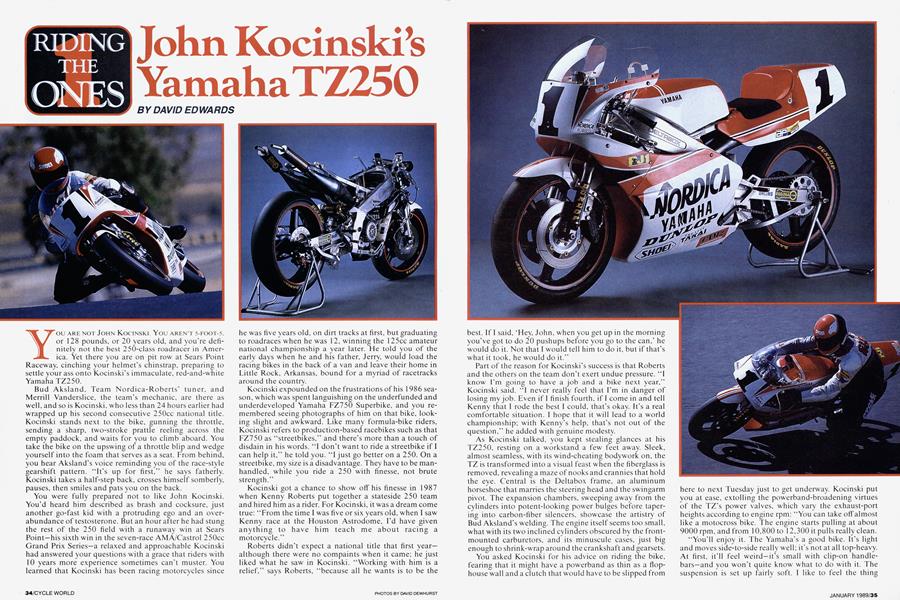
As Kocinski talked, you kept stealing glances at his TZ250, resting on a workstand a few feet away. Sleek, almost seamless, with its wind-cheating bodywork on, the TZ is transformed into a visual feast when the fiberglass is removed, revealing a maze of nooks and crannies that hold the eye. Central is the Deltabox frame, an aluminum horseshoe that marries the steering head and the swingarm pivot. The expansion chambers, sweeping away from the cylinders into potent-looking power bulges before tapering into carbon-fiber silencers, showcase the artistry of Bud Aksland’s welding. The engine itself seems too small, what with its two inclined cylinders obscured by the frontmounted carburetors, and its minuscule cases, just big enough to shrink-wrap around the crankshaft and gearsets.
You asked Kocinski for his advice on riding the bike, fearing that it might have a powerband as thin as a flophouse wall and a clutch that would have to be slipped from here to next Tuesday just to get underway. Kocinski put you at ease, extolling the powerband-broadening virtues of the TZ’s power valves, which vary the exhaust-port heights according to engine rpm; “You can take off almost like a motocross bike. The engine starts pulling at about 9000 rpm, and from 10,800 to 12,300 it pulls really clean.
“You’ll enjoy it. The Yamaha’s a good bike. It’s light and moves side-to-side really well; it's not at all top-heavy. At first, it’ll feel weird—it’s small with clip-on handlebars—and you won’t quite know what to do with it. The suspension is set up fairly soft. I like to feel the thing move; that gives a good feel for what the tires are doing. But at your speeds, it may be too stiff at first. Just keep riding around until you get up to speed. Be smooth, flow with it; the smootheryou are, the fasteryou'll go. You'll be surprised.”
Yamaha TZ250
Kocinski offered one final bit of advice. On his TZ, the stock front brake calipers are»replaced by Lockheed calipers, working through an extra-small master cylinder that Kocinski liberated from the factory race department on one of his trips to Japan. “I don't like to pull hard on the lever.” he explained. “I also use the softest pads available. You might want to be careful until you get used to the brakes.”
You remember that caution as you flip your faceshield down and pull in the TZ's clutch. A tug on the shift lever puts the six-speed transmission in first, and you feed out the clutch, hoping to avoid an embarrassing stall. But true to Kocinski’s word, the Yamaha takes up the slack quickly, and you punch into second and then third gear, tentatively moving the bike side-to-side to help warm the tires.
Sears Point Raceway, an hour north of San Francisco, isn't really the best place to be test-riding someone else’s championship racebike. Two-and-a-half miles in length, the track is punctuated by off-camber corners, blind dropoffs and sections of asphalt that are greasy or rippled, or both. Ringed bv Armco, cement barriers and hillsides, Sears Point promises severe penalties for even a simple get-off.
You keep that in mind as you cautiously circulate the track. At these reduced speeds, well below the powerband, the TZ is still responsive, but begging to be uncorked. When you do nick into the meaty part of the rev zone, the transition is easy. Even when banked over, the bike doesn't hint at sitting up or slewing its rear tire sideways. You are also amazed at the TZ’s size, or rather the lack of it. You literally drape over the bike, at first feeling like your nose is going to rub on the front tire.
In subsequent riding sessions you begin to feel more at home on the bike. You dip deeper and deeper into the powerband, reveling in the addictive wave of acceleration that sweeps over the TZ when you do so. Two-hundredand-fifty cubic centimeters may not sound like much, but the TZ’s engine manufactures close to 80 horsepower. 10 more than a good-running 600cc sportbike. while weighing almost 200 pounds less.
And you’ve never experienced anything that handles as directly as the Yamaha. Merely think about initiating a turn and it's done, with no chassis wind-up. no pogoing of the suspension. The bike skims over bumps and ripples that would have a even a good-handling streetbike nervously waggling its handlebar. When Kocinski is going to the stick and turning lap times just a couple of seconds slower than the best 750 Superbikes, the TZ might shake its head or slide its tires, but at the speeds you're asking of it, it's about as hard-pressed as Bo Derek in a small-town beauty pageant.
Later, you reflected on the criticism leveled against the AMA when it dropped the Formula One class from its race program in favor of Superbikes, effectively killing 500cc, GP-style racebikes in this country, and putting an emphasis on production-based racing. Run just “streetbikes”, the critics had said, and you'll stunt America’s chances of developing future world champions. You had chalked up those comments as just the ravings of a few formula-bike prima donnas, but now you understand. Luckily, the 250s survived. As Kocinski had told you, “Once you ride one of these things, you'll never want to race a 'streetbike' again. It’s the best thing you’ve ever been on.”
Weeks later, the glow of riding the TZ250 still hadn't worn off, and you realize that Kocinski had been absolutely right. E3