Bubba Shobert's Honda Vfr750
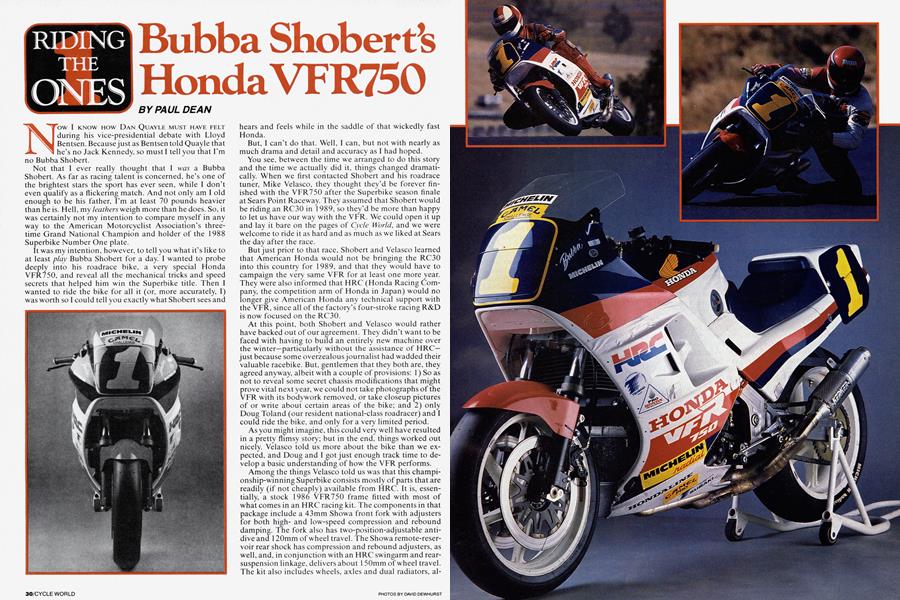
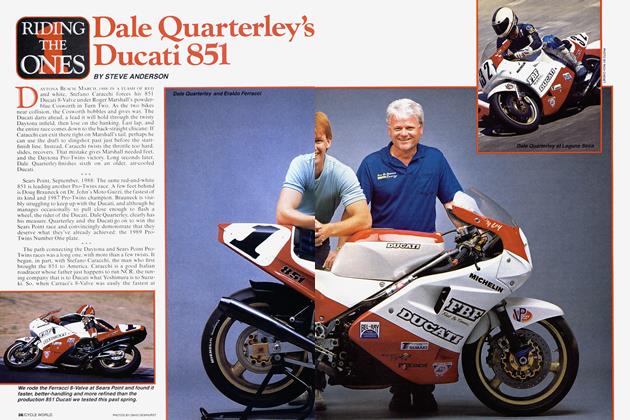
Bubba Shobert's Honda VFR750
RIDING THE ONES
PAUL DEAN
NOW I KNOW HOW DAN QUAYLE MUST HAVE FELT during his vice-presidential debate with Lloyd Bentsen. Because just as Bentsen told Quayle that he's no Jack Kennedy, so must I tell you that I'm no Bubba Shobert.
Not that I ever really thought that I was a Bubba Shobert. As far as racing talent is concerned, he’s one of the brightest stars the sport has ever seen, while I don’t even qualify as a flickering match. And not only am I old enough to be his father, I’m at least 70 pounds heavier than he is. Hell, my leathers weigh more than he does. So, it was certainly not my intention to compare myself in any way to the American Motorcyclist Association’s threetime Grand National Champion and holder of the 1988 Superbike Number One plate.
It was my intention, however, to tell you what it’s like to at least play Bubba Shobert for a day. I wanted to probe deeply into his roadrace bike, a very special Honda VFR750, and reveal all the mechanical tricks and speed secrets that helped him win the Superbike title. Then I wanted to ride the bike for all it (or, more accurately, I) was worth so I could tell you exactly what Shobert sees and hears and feels while in the saddle of that wickedly fast Honda.
But, I can’t do that. Well, I can, but not with nearly as much drama and detail and accuracy as I had hoped.
You see, between the time we arranged to do this story and the time we actually did it, things changed dramatically. When we first contacted Shobert and his roadrace tuner, Mike Velasco, they thought they’d be forever finished with the VFR750 after the Superbike season finale at Sears Point Raceway. They assumed that Shobert would be riding an RC30 in 1989, so they'd be more than happy to let us have our way with the VFR. We could open it up and lay it bare on the pages of Cycle World, and we were welcome to ride it as hard and as much as we liked at Sears the day after the race.
But just prior to that race, Shobert and Velasco learned that American Honda would not be bringing the RC30 into this country for 1989, and that they would have to campaign the very same VFR for at least one more year. They were also informed that HRC (Honda Racing Company, the competition arm of Honda in Japan) would no longer give American Honda any technical support with the VFR, since all of the factory’s four-stroke racing R&D is now focused on the RC30.
At this point, both Shobert and Velasco would rather have backed out of our agreement. They didn’t want to be faced with having to build an entirely new machine over the winter—particularly without the assistance of HRC— just because some overzealous journalist had wadded their valuable racebike. But, gentlemen that they both are, they agreed anyway, albeit with a couple of provisions; 1 ) So as not to reveal some secret chassis modifications that might prove vital next year, we could not take photographs of the VFR with its bodywork removed, or take closeup pictures of or write about certain areas of the bike; and 2) only Doug Toland (our resident national-class roadracer) and I could ride the bike, and only for a very limited period.
As you might imagine, this could very well have resulted in a pretty flimsy story; but in the end, things worked out nicely. Velasco told us more about the bike than we expected, and Doug and I got just enough track time to develop a basic understanding of how the VFR performs.
Among the things Velasco told us was that this championship-winning Superbike consists mostly of parts that are readily (if not cheaply) available from HRC. It is, essentially, a stock 1986 VFR750 frame fitted with most of what comes in an HRC racing kit. The components in that package include a 43mm Showa front fork with adjusters for both highand low-speed compression and rebound damping. The fork also has two-position-adjustable antidive and 120mm of wheel travel. The Showa remote-reservoir rear shock has compression and rebound adjusters, as well, and, in conjunction with an HRC swingarm and rearsuspension linkage, delivers about 150mm of wheel travel. The kit also includes wheels, axles and dual radiators, although Velasco swapped the HRC upper radiator for an RC30 unit that is concave to give more cooling area, and he uses a bigger lower radiator that is part of an HRC endurance-racing kit.
Some chassis components are not from HRC, including the custom-made rear subframe, which is 6 pounds lighter than stock. The sturdy front-fork triple-clamps also are custom-built, one of several sets of clamps Velasco tried in a effort to tune the steering to Shobert’s satisfaction. The VFR chassis is very sensitive to rider size and riding style, he explains, and getting it dialed-in for a given rider is a challenge. But once that is accomplished, the setup changes very little from track to track.
We learned about that sensitivity first-hand once we started riding the VFR around Sears Point’s tricky, 2.5mile circuit. We also learned that Shobert prefers an unusually high and wide handlebar that positions the grips comparatively close to the rider. At first, the handlebar seemed more suitable for mile dirt-tracking than for roadracing.
After a half-dozen or so laps, though, it all started making sense. The VFR750 is quite front-end-light for roadracing, so it tends to slide the front tire earlier than would a GSX-R750 or an FZR750. Indeed, I began to sense some front-wheel drift long before approaching anything close to a racing pace; and as I started pushing harder and harder (but not too hard, for I kept thinking about what Velasco had said to me in the pits just before I headed out onto the track: “You do have enough money to pay for this thing, don’t you?”), the drifting got more pronounced.
Which is where the chassis’ sensitivity comes in. Obviously, I wasn’t turning lap times even remotely comparable with Shobert’s, but I still was experiencing about as much front-wheel slide as I think even he would want. My largeness had given the VFR even more of a rearward
weight bias than it has with Shobert aboard, and that was making the Michelin front slick skate much sooner. It never was an uncontrollable, I’m-gonna-die slide, but it still unnerved me and conjured images of me making payments to Honda for a totalled Superbike until the year 2000. I’m no Bubba Shobert when it comes to bankrolls, either. But even Doug Toland, who is only about 25 pounds heavier than Shobert, commented that the front wheel had slid enough to make him feel uncomfortable, even though he, too, had ridden rather conservatively.
Velasco apparently has the bike set up so this condition is not so pronounced for Shobert, who rides his roadracer much like he does his mile dirt-tracker. He scrubs off some speed entering turns by sliding the front wheel, then uses the application of power to the rear wheel to help steer around the corner. This explains the mile-style handlebar, which gives him the leverage needed to waggle the front wheel back-and-forth as required.
Aside from that one quirk, Toland and I both thought the VFR handled magnificently. It was easy to bank over into turns or toss back-and-forth through tight esses— aided, no doubt, by the wide handlebar—and the fork and shock soaked up everything Sears’ irregular surface could throw at it. We both felt the VFR had probably the finest racebike suspension we’d ever sampled. Same goes for the Nissin front brakes, which seemed to offer enough brute stopping power to snap the fork tubes, but still retained enough feedback that they always delivered only the amount of braking either Doug or I wanted.
My only other reservation about the handling was that the bike tended to wheelie every time I dialed the throttle open. Part of that, of course, was caused by my 200-pound weight, which made the rear suspension—calibrated for Shobert’s 130 pounds—squat excessively. But most of it was the result of the awesomely powerful V-Four engine, which hurtled the bike out of the corners and down the straights like something displacing a lot more than 750cc.
But Velasco claims there’s nothing very special inside. “It’s all HRC stuff that anybody can buy,” he says, “although some of it, like the exotic steel connecting rods, cost more than anyone is likely to pay. Just one of them costs as much as all four of the titanium rods we once used.” Besides, more important than what’s in the engine, he insists, is who puts it all together.
The man who puts Shobert’s engines together is Ray Plumb, a racing technician at American Honda headquarters in Gardena, California. Plumb uses stock-based cases and cylinder heads, and retains the stock bore and stroke, but swaps the VFR’s 180-degree crankshaft for a 360degree crank. The more-even firing order of the 360 configuration allows a simpler and more-efficient exhaust system—which, in this case, is a Kerker-built replica of a system designed by HRC. But the cams, valves, pistons, close-ratio gearbox and even the oil pump all are genuine HRC goodies. And the carbs are flat-slide, aluminum-bodied Keihins that’ve had their 34mm venturis bored out to 37mm. They also have titanium “skis” built into the front of the slide tunnels, which reduce slide friction enough to permit relatively light throttle-return springs.
All this tuning results in a go-for-broke racing motor with an amazingly wide and flat powerband. The engine doesn’t seem to make any more peak power (between 135 and 140 hp, Velasco claims) than the bike that was Shobert’s toughest competition during the 1988 season, Doug Polen’s Yoshimura GSX-R (the very same bike Kevin Schwantz raced in 1987, and that we rode for our February, 1988 issue); but the VFR pulls harder than the Suzuki anywhere between idle and the 13,000-rpm redline, and it feels like the power output doesn’t change one bit between about 7000 and 12,000 rpm.
Consequently, when you whack the throttle open in the fat part of the powerband, you’re catapulted forward with such force—often with the front wheel off the ground— that you almost expect the asphalt to wrinkle up like a cheap throw rug and get spit out behind the rear wheel. All the while, the V-Four engine barks out a fearsome, droning exhaust note that sounds like a chainsaw overdosed on steroids. The VFR is not the least bit fussy about what gear it’s in or what rpm it’s turning for it to cut loose with acceleration that would do an Open-class engine proud.
Toland vividly demonstrated the engine’s unbelievable torque by doing spectacular wheelies out of some of Sears’ faster corners—in sixth gear! Granted, 120-mph wheelstands are not very useful in a race, but having enough power to do them is. And Shobert will find that power very helpful next year if he is to stay competitive against the Suzukis and perhaps even Kawasaki’s hot new ZX-7.
In case you were wondering, no, I didn’t attempt any of those sixth-gear wheelies. Listen, I’m no Doug Toland. And as I'm sure we all now by know, I’m certainly no Bubba Shobert. But after spending some time on his Superbike, I’m just a little bit closer. E3