Yamaha Yzr500
YAMAHA YZR500
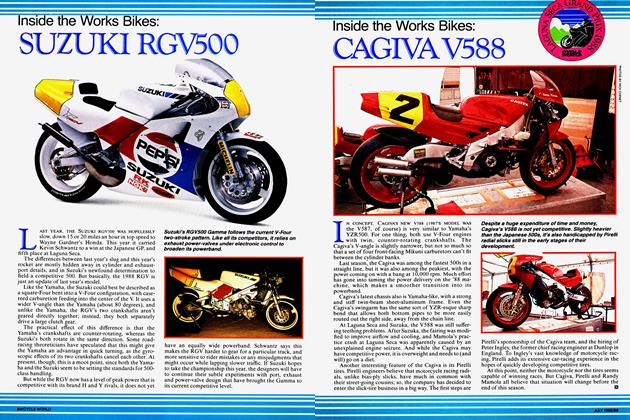
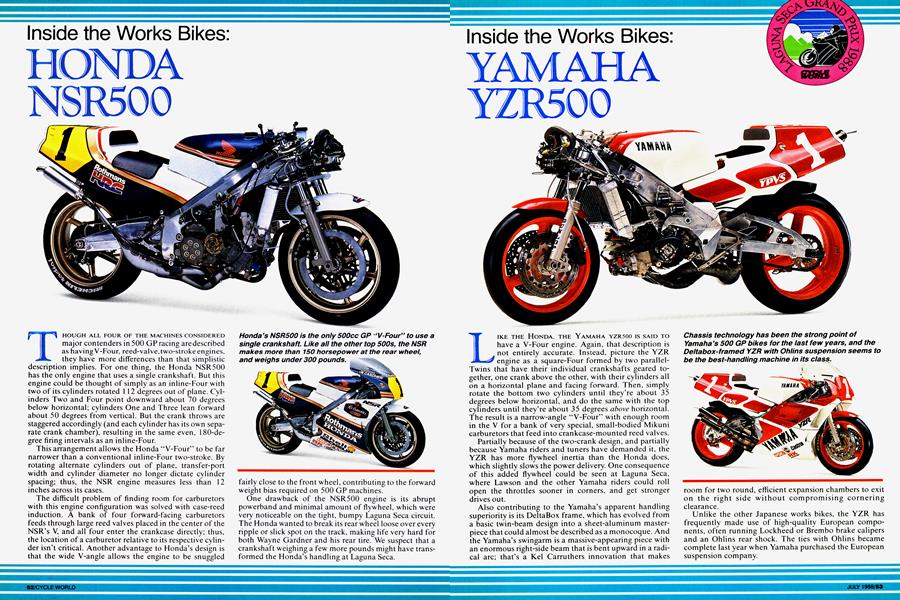
LIKE THE HONDA, THE YAMAHA YZR500 IS SAID TO have a V-Four engine. Again, that description is not entirely accurate. Instead, picture the YZR engine as a square-Four formed by two parallel-Twins that have their individual crankshafts geared together, one crank above the other, with their cylinders all on a horizontal plane and facing forward. Then, simply rotate the bottom two cylinders until they're about 35 degrees below horizontal, and do the same with the top cylinders until they're about 35 degrees above horizontal. The result is a narrow-angle "V-Four" with enough room in the V for a bank of very special, small-bodied Mikuni carburetors that feed into crankcase-mounted reed valves. Partially because of the two-crank design, and partially because Yamaha riders and tuners have demanded it, the YZR has more flywheel inertia than the Honda does, which slightly slows the power delivery. One consequence of this added flywheel could be seen at Laguna Seca, where Lawson and the other Yamaha riders could roll open the throttles sooner in corners, and get stronger drives out.
Also contributing to the Yamaha's apparent handling superiority is its DeltaBox frame, which has evolved from a basic twin-beam design into a sheet-aluminum master piece that could almost be described as a monocoque. And the Yamaha's swingarm is a massive-appearing piece with an enormous right-side beam that is bent upward in a radi cal arc; that's a Kel Carruthers innovation that makes
room for two round, efficient expansion chambers to exit on the right side without compromising cornering clearance. Unlike the other Japanese works bikes, the YZR has frequently made use of high-quality European compo nents, often running Lockheed or Brembo brake calipers and an Ohlins rear shock. The ties with Ohlins became complete last year when Yamaha purchased the European suspension company.