Cagiva V588
CAGIVA V588
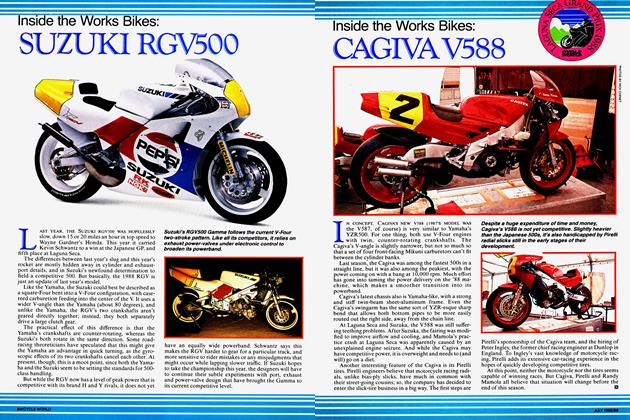
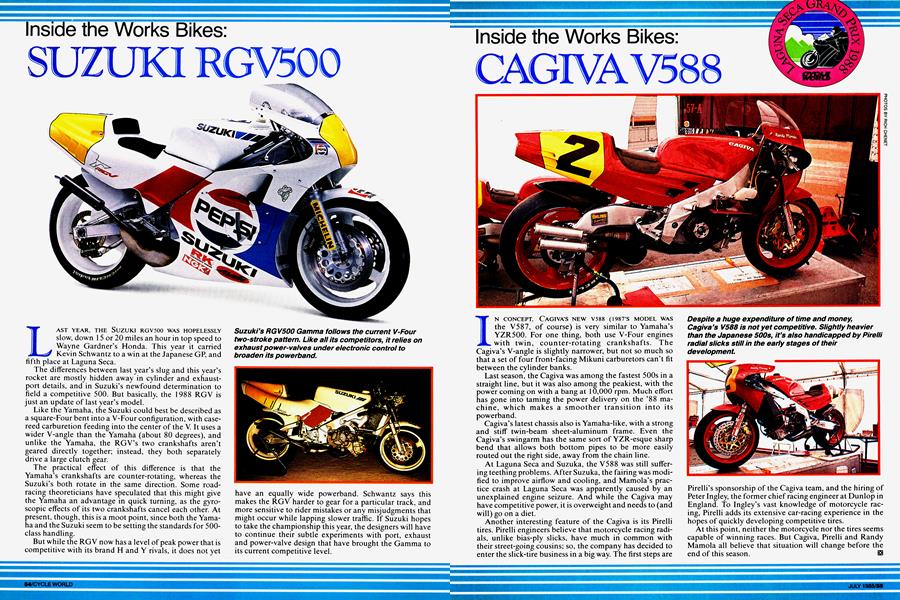
IN CONCEPT, CAGIVA'S NEW V588 (1987'S MODEL WAS the V587, of course) is very similar to Yamaha's YZR500. For one thing, both use V-Four engines with twin, counter-rotating crankshafts. The Cagiva's V-angle is slightly narrower, but not so much so that a set of four front-facing Mikuni carburetors can't fit between the cylinder banks.
Last season, the Cagiva was among the fastest 500s in a straight line, but it was also among the peakiest, with the power coming on with a bang at 10,000 rpm. Much effort has gone into taming the power delivery on the `88 ma chine, which makes a smoother transition into its powerband.
Cagiva's latest chassis also is Yamaha-like, with a strong and stiff twin-beam sheet-aluminum frame. Even the Cagiva's swingarm has the same sort of YZR-esque sharp bend that allows both bottom pipes to be more easily routed out the right side, away from the chain line. At Laguna Seca and Suzuka, the V588 was still suffer ing teething problems. After Suzuka, the fairing was modi fied to improve airflow and cooling, and Mamola's prac tice crash at Laguna Seca was apparently caused by an unexplained engine seizure. And while the Cagiva may have competitive power, it is overweight and needs to (and will) go on a diet. Another interesting feature of the Cagiva is its Pirelli tires. Pirelli engineers believe that motorcycle racing radi als, unlike bias-ply slicks, have much in common with their street-going cousins; so, the company has decided to enter the slick-tire business in a big way. The first steps are
Pirelli's sponsorship of the Cagiva team, and the hiring of Peter Ingley, the former chief racing engineer at Dunlop in England. To Ingley's vast knowledge of motorcycle rac ing, Pirelli adds its extensive car-racing experience in the hopes of quickly developing competitive tires. At this point, neither the motorcycle nor the tires seems capable of winning races. But Cagiva, Pirelli and Randy Mamola all believe that situation will change before the end of this season.