Suzuki Rgv500
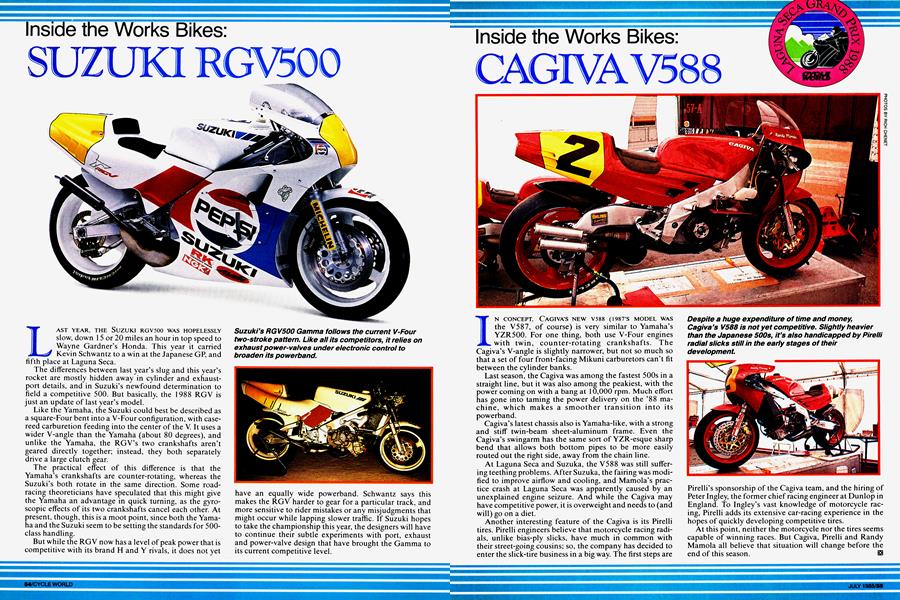
SUZUKI RGV500
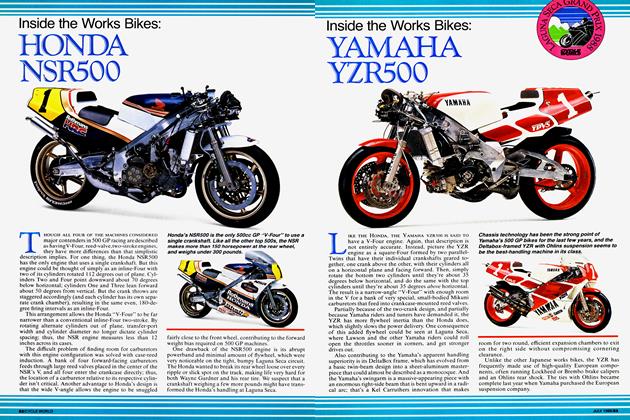
LAST YEAR, THE SUZUKI RGV500 WAS HOPELESSLY slow, down 15 or 20 miles an hour in top speed to Wayne Gardner's Honda. This year it carried Kevin Schwantz to a win at the Japanese GP, and fifth place at Laguna Seca.
The differences between last year's slug and this yea's rocket are mostly hidden away in cylinder and exhaust-port details, and in Suzuki's newfound determination to field a competitive 500. But basically, the 1988 RGV is just an update of last year's model.
Like the Yamaha, the Suzuki could best be described as a square-Four bent into a V-Four configuration, with casereed carburetion feeding into the center of the V. It uses a wider V-angle than the Yamaha (about 80 degrees), and unlike the Yamaha, the RGV’s two crankshafts aren’t geared directly together; instead, they both separately drive a large clutch gear. The practical effect of this difference is that the Yamaha’s crankshafts are counter-rotating, whereas the Suzuki’s both rotate in the same direction. Some roadracing theoreticians have speculated that this might give the Yamaha an advantage in quick turning, as the gyroscopic effects of its two crankshafts cancel each other. At present, though, this is a moot point, since both the Yamaha and the Suzuki seem to be setting the standards for 500class handling. But while the RGV now has a level of peak power that is competitive with its brand H and Y rivals, it does not yet
have an equally wide powerband. Schwantz says this makes the RGV harder to gear for a particular track, and more sensitive to rider mistakes or any misjudgments that might occur while lapping slower traffic. If Suzuki hopes to take the championship this year, the designers will have to continue their subtle experiments with port, exhaust and power-valve design that have brought the Gamma to its current competitive level.