A Legacy of Thumpers
A Legacy of Thumpers
Husqvarna's state-of-theart fourstrokes have roots that go back to 1903.
RICHARD RENSTROM
FOR CONTEMPORARY AMERICAN motorcyclists, it's easy to as sume that four-stroke engines are something Husqvarna knows nothing about. After all, ever since the first Huskys came to our shores in the middle Sixties, we've seen nothing but two-strokes from the Swedish firm-right up until the introduction of the new four-stroke Single in 1983. But Americans have been involved only in the latest chapter of Husqvarna's long history; the company actually has a great legacy of four-strokes.
In fact, the very first Husky was a four-stroke. It was built in 1 903 after Husqvarna Vapen Fabriks AB de cided to produce a motorbike, adding
it to a line of guns, lawnmowers, sew ing machines and appliances. The new motorbike featured a 1 .25-hp, single-cylinder four-stroke engine made by FN in Belgium. The one speeder had pedals for starting and a bicycle-type "coaster" rear brake.
In th~ decades that followed, Husqvarna continued producing four-stroke motorcycles, using en gines built by FN, Moto Reve, J.A.P. and, by Husqvarna itself. By 1930, Husky's sales brochure featured five four-strokes, ranging in size from 175cc to 600cc, and powered by sin gle-cylinder four-stroke engines con nected to three-speed, hand-shifted gearboxes.
In the following year, 1931. 1-Iusqvarna introduced its most exciting model it had built up to that point: the Specia/racer Motorcvkel, a compe tition machine using a 491cc, 33horsepower engine. With a top speed of over 100 mph, the four-stroke Sin gle powered its way to many wins in Scandinavian roadraces and cross country events.
But it was the TT Husqvarna, a rigid-frame, 281-pound, V-Twin roadracing model, that firmly ce mented Husqvarna's early image as a builder of four-stroke performance machinery. In 1932, Ragnar Sunnquist scored a stunning upset over the Norton Singles in the Swed ish Grand Prix to gain Husqvarna considerable fame and prestige. Gun nar Kalen then notched a victory in the 1933 Swedish GP, followed by yet another Sunnquist win in 1934. And the next year, Sunnquist showed the world just how fast his 500cc Husqvarna four-stroke was when he trounced the supercharged BMWs on the Avus track in Germany.
That TT Husqvarna was a beauti ful V-Twin with a 65mm bore and 75mm stroke. The heads and cylin ders were cast in alloy, and pushrods operated the valve gear. The engine produced 44 horsepower at 6800 rpm, good enough for 118 mph. But the tiny factory lacked the fin ancial resources to fully develop a spring-frame version for 1936 and then hire top-flight riders. A classic racer thus faded into :jstory.andjnthepostwafyears Husqvarna concentrated on two-stroke development.
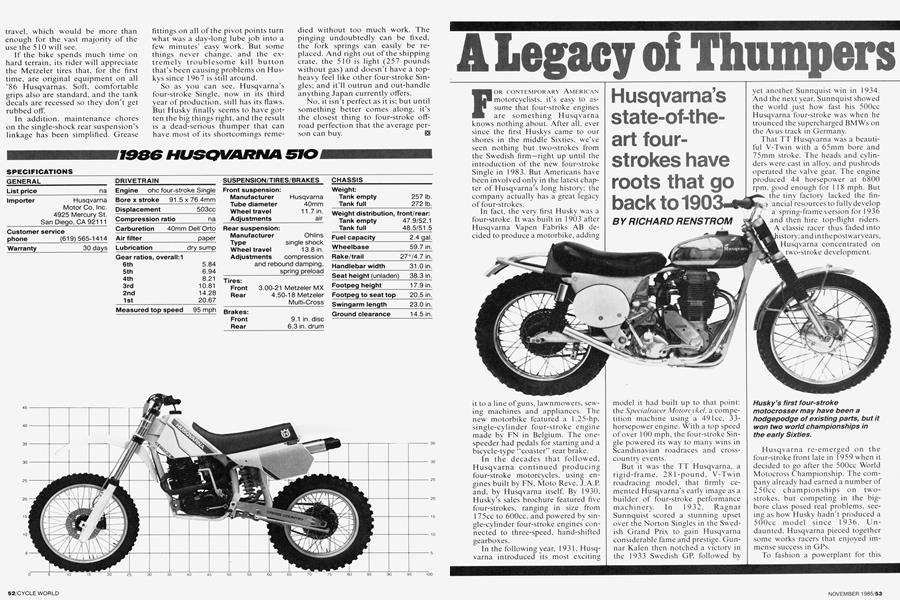
Husqvarna re-emerged on the four-stroke front late in 1959 when it decided to go after the 500cc World Motocross Championship. The com pany already had earned a number of 250cc championships on two strokes, but competing in the big bore class posed real problems. see ing as how Husky hadn't produced a 500cc model since 1936. Un daunted, Husqvarna pieced together some works racers that enjoyed im mense success in GPs.
To fashion a powerplant for this 500cc machine, the factory's racing engineers dug out some old 1936 Swedish Albin Singles, for which they cast alloy heads and cylinders, and altered the bore and stroke. They installed high-compression pistons and a Lucas racing magneto, and ground some cams that allowed 35 horsepower at about 6000 rpm, with incredible mid-range torque. The swingarm frame was fitted with a Norton front fork at first, but later used an Italian Ceriani unit. The gearbox and rear wheel came from an AJS 7R roadracer, While Girling shocks graced the rear. The dry weight was 312 pounds-an absurd figure today, but highly advanta geous compared to the 350-pound FN and BSA Gold Star Singles that had dominated during the Fifties.
Despite the quarter-century-old antiquity of that basic engine design. Husqvarna clobbered its compe tition. Factory rider Bill Nilsson took the world title in 1960, with team mates Sten Lundin finishing second and Roif Tibblin fourth. In 1961, Lundin switched to the tiny Swedish Lito team and won the title, but Nils son got second and Tibblin fifth. Tibblin hit peak form the following year and convincingly took the world championship.
With that 1962 title, Husqvarna retired the aging thumpers to concen trate on two-strokes, and the story of Husky four-strokes appeared to be over. But more than 20 years later, the storyline has resumed with the
Husky thumpers of today.
So'if the &modern~day~ Husqvarna four-strokes seem a radical departure for the Swedish firm, remember, they are nothing more than another chap ter in acontinuingstory rich in four-stroke lore. Only time will tell if this newgeneration of four-strokes will earn as much praise when their part of the history book is written.