Shooting the Coast
Shooting the coast
Or, Travels With Harley
Peter Egan
"Forget the airline tickets,” I told my wife, Barbara. “No decadent air travel for us. We’re going to Seattle on a Harley-Davidson.” A Harley?” Barb looked up from brushing our eldest cat, an animal who is especially well-groomed because she’s too feeble to resist. “Why a Harley-Davidson?” There was an edge of gravity and uneasiness in her voice. Barb’s last Harley ride had been on a Sportster with a passenger seat about the size and density of an upholstered Gideon Bible. She hadn’t forgotten.
“Because we just got a new one in for a test bike and we’ve never taken a long trip on a Harley before. Anyway, this one is different. It’s out in the driveway. I brought it home.” Temporarily unhanded, the cat slunk off beneath the sofa and we went outside for a look at the motorcycle.
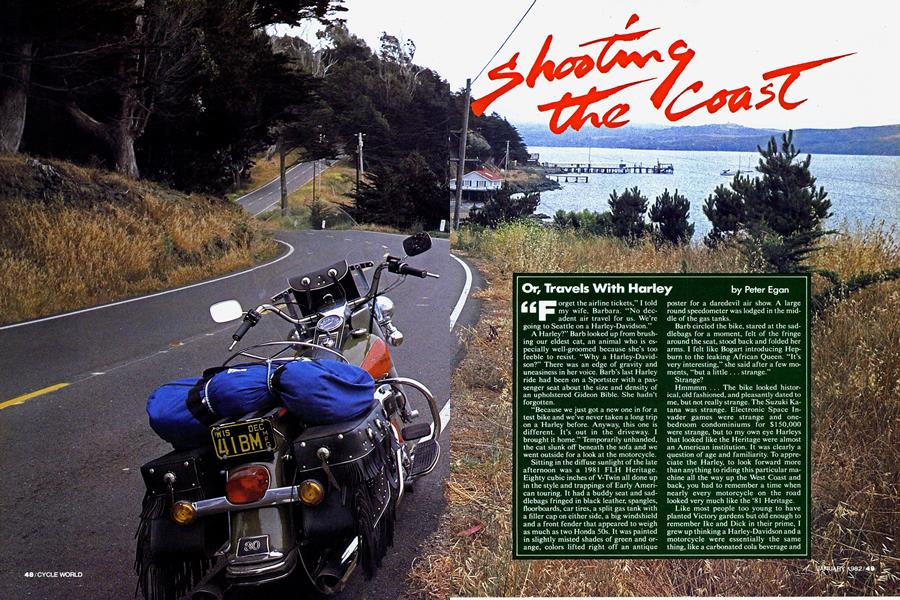
Sitting in the diffuse sunlight of the late afternoon was a 1981 FLH Heritage. Eighty cubic inches of V-Twin all done up in the style and trappings of Early American touring. It had a buddy seat and saddlebags fringed in black leather, spangles, floorboards, car tires, a split gas tank with a filler cap on either side, a big windshield and a front fender that appeared to weigh as much as two Honda 50s. It was painted in slightly misted shades of green and orange, colors lifted right off an antique poster for a daredevil air show. A large round speedometer was lodged in the middle of the gas tanks.
Barb circled the bike, stared at the saddlebags for a moment, felt of the fringe around the seat, stood back and folded her arms. I felt like Bogart introducing Hepburn to the leaking African Queen. “It’s very interesting,” she said after a few moments, “but a little . . . strange.”
Strange?
Hmmmm . . . The bike looked historical, old fashioned, and pleasantly dated to me, but not really strange. The Suzuki Katana was strange. Electronic Space Invader games were strange and onebedroom condominiums for $150,000 were strange, but to my own eye Harleys that looked like the Heritage were almost an American institution. It was clearly a question of age and familiarity. To appreciate the Harley, to look forward more than anything to riding this particular machine all the way up the West Coast and back, you had to remember a time when nearly every motorcycle on the road looked very much like the ‘81 Heritage.
Like most people too young to have planted Victory gardens but old enough to remember Ike and Dick in their prime, I grew up thinking a Harley-Davidson and a motorcycle were essentially the same thing, like a carbonated cola beverage and a Coke or a facial tissue and a Kleenex. The first motorcycle I ever saw close up was a Harley.
It was a huge machine belonging to Buford, our next door neighbor. I was only about seven at the time, but I remember the bike clearly. It had a two-tone windshield, Vicks-bottle blue at the bottom and clear at the top. The brake and throttle cables were red and white striped in a barber pole pattern and there were black leather saddlebags with silver diamondshaped studs and fringe that almost swept the ground. It had a giant version of an upholstered tractor seat, also fringed and bestudded, with cracks in the leather and foam rubber stuffing falling out like dried chunks of angel food cake. The handgrips trailed colored plastic streamers and the engine was kick-started with a bicycle pedal. The tankshift knob had been replaced by an eight-ball. The bike was blue and had at least three headlights. Maybe more.
Buford himself was a quiet youth recently returned from Korea and given to spells of moping. He wore dungarees with 12-inch cuffs rolled up to expose the buckles on his engineer boots (to this day I’ve never seen an actual engineer wear a pair of these forbidding boots—they all look as though their mothers dressed them). He also wore khaki T-shirts stretched out at the neck and never went anywhere on the Harley without first lighting a cigarette and placing a hat on his head. The hat looked like something a yacht captain would wear but was slightly soiled and had wings on the front. When he motored down the street the cigarette sparkled like a short fuse on its way to his mouth.
He rode off every evening leaving his mother on the back porch shouting after him in a one-way discussion of jobs, drink and the kind of friends he hung out with. When Buford thundered back into the driveway in the wee hours of the morning and the Harley gasped to a stop his mother mechanically reappeared on the porch and resumed shouting where she’d left off. Buford himself never said anything. Except once.
I was out in the back yard admiring his Harley and he suddenly took me by the shoulders and looked down at me, squinting fiercely through his cigarette smoke, and said, “Don’t ever buy an Indian. Buy a Harley.”
Being seven I was in no position to buy either brand, but I agreed to buy a Harley if it came down to a choice.
The Indian threat was well under control by the time I could afford motorcycles, as the company went out of business, but the image of that big road cruiser in Buford’s back yard stuck with me as some sort of woolly emblem of the era. With its saddlebags, streamers, chrome pipes, buckles, and fringe it looked like a cross between Roy’s horse Trigger and a carnival ride. Friendly, yet exciting; the kind of machine that would inspire Buford’s pure loyalty. The 1981 Heritage in our driveway was cleaned up and modernized, but styled in the same spirit, and it struck some responsive chord in the grinning and riding portion of my brain, which occupies nearly all of the cranium except for a small, walnut-sized lobe that warns me when I’m cold or hungry for Mexican food. The Heritage looked more friendly than strange.
I had some misgivings about taking a Harley up the coast from L.A. to Seattle. We’d never made the trip before, but somehow it didn’t seem like the right outing for a bike like the Heritage. Certain bikes belong on specific kinds of trips, and the Harley seemed more suited to a ride across Nebraska or elsewhere in the heartland than a winding run through the quiet, chic little villages of seaside California and points north. Steve Kimball, managing editor and seasoned Western vagabond, set our minds to rest (while not actually putting us to sleep). He looked at our planned route, which took us all the way up the Coast Highway to Seattle and back down through central Washington, Oregon and California. “Your trip up the coast will be one thing,” he said cryptically, “while the trip back will be something else entirely. The coast might be better for a sport bike, but the inland return is Harley country.”
We left L.A. early in the morning, sharing the road with bread trucks and paper boys. The city had been tremendously hot for two weeks so we’d packed sweaters and jackets almost as an afterthought. But in the morning it was cool and foggy on the coast and when we rode past the barely visible Queen Mary it appeared to be arriving in Liverpool rather than docked in Long Beach. We stopped north of the city, at Malibu, for breakfast.
The fishing pier at Malibu attracts some strange folks early Saturday morning, and they were having a convention in the diner where we stopped. An elderly gentleman with a two-day growth of beard spotted us and walked over to our table. He had a fishing pole and was wearing an old mailman’s uniform with a loud necktie. He had that earnest but slightly crazed look common to tent preachers and people who collect string. He pointed to our helmets on an empty chair. “I don’t believe in those,” he thundered. “You might as well put your head in a box. The people who sell them should be put in jail forever.”
“That seems rather severe,” I offered.
“Not in this case. Danger is everywhere.”
Apparently danger was even in the diner, because he suddenly spun around as though someone had been sneaking up on him and then left, slamming his fishing pole in the door on the way out. “Salt of the earth,” I said to Barb. “The chamber of commerce hires them so out-of-state tourists won’t go home disappointed.”
We paid our bill and joined the growing flow of traffic headed north for its weekend in Santa Barbara, which is to L.A. more or less what Pompeii and Herculaneum were to Rome; a nearby retreat from the heat and the largeness of the city. We lunched on tacos in Santa Barbara, made a mandatory stop at California Guitar, purveyors of collectable used electric guitars, mostly of Fifties and Sixties vintage, and climbed back on the Harley.
North of Santa Barbara you finally clear the lingering sprawl of L.A. and its surrounding cities, and parts of the landscape become genuinely rural. Where the road loops inland you see farms and ranches that would look right at home in Kansas, except for the occasional pineapple palm in the front yard. Near some of the small Italian communities the cemetaries are filled with winged archangels on monuments, a part of the stoneworking tradition from the old country.
By the time we made our first gas stop, (41 mpg) we’d discovered a couple of things about touring with the Harley. First, the traditional buddy seat doesn’t really work very well for two people. Harley makes an optional dual seat for this bike, but I had insisted on the original sprung pillar saddle because nothing else fit the character of the bike so perfectly. The sprung saddle was wonderfully com> fortable for one, but crowded for two, so Barb spent about half her time perched back on the soft duffel bag full of clothes we’d thrown over the luggage rack. As long as we had soft luggage, seating was no problem, though all my shirts soon looked as though I’d been sleeping in them.
Second, the Harley is an immensely stable bike, even in slow traffic. The Shriners who ride these things in parades know what they’re doing because you can torque along at about 3 mph in slow traffic without ever weaving or putting your foot down. On the highway the Heritage is equally stable, if a little ponderous. The Harley makes you feel more like a ship’s captain than a rider, and you begin to understand the significance of Harley hats. You pilot the bike down the road and changes in direction have real meaning and require a mature sense of responsibility. It takes only a full morning in the saddle to realize that nothing thuds down the road with as much upright majesty, or is less boring to ride than a Harley. Cornering clearance is nil, but it doesn’t matter much because it’s more fun to thunder along and look at the scenery then it is to make time through the corners. Healthier too. The bike molds you to its own pace, rather than the other way around.
Leaving the station, a third facet of its personality surfaced. Filling the tanks full is a mistake. Unless the right hand tank is left about 3 or 4 in. low, gasoline will jitterbug out of the filler cap as you motor down the road and blow a fine mist of gas into the wind and onto your pants. Buford may have smoked while riding, but I didn’t.
A tenacious fog had moved over the coastline and was holding on. The weather was cool and dark and jackets and sweaters came out of the saddlebags. By the time we got to Morro Bay for the night we’d begun to feel like figures in a Bergman film, riding in and out of the mist with the cloud ceiling at about 200 ft. We got the last motel room in town, stashed our luggage and went out to look for a restaurant.
Morro Bay is a small resort town on a pretty bay with a huge Gibraltar-shaped rock in it. The town was filled not so much with tourists from afar, as we’d expected, but with nearby locals escaping from hot, arid places like Bakersfield and Merced in the San Joaquin Valley, searching for shade and cool, damp air. The coast has a peaceful hush about it that makes people calm and subdued. The fog absorbs noise and color. As you go north in California the beaches become less and less like the boisterous beer and bikini beaches of the south; activity becomes more measured and introspective. They are places for quiet walks, not volleyball and Pepsi commercials. Just a few miles inland the sound and brightness returns, but the beaches more often have a moody and brooding quality.
In the morning we passed the gates and parking lots for tours of San Simeon, the lavish hilltop home and estate of the late William Randolph Hearst. All tours were booked until late afternoon, and because we’d been through the place a year earlier we rode on toward Big Sur.
Big Sur is a spectacular stretch of coastline where steep green mountainsides plunge down into the ocean. A road has been carved into the high slopes and it makes a wonderful ride, maybe one of the best in motorcycling. It winds along roadcuts hundreds of feet above the ocean, with vista points where huge chunks of excoastline have fallen into the sea from high cliffs. The air smells like bay leaves, gorse and salt water, like something from the coast of Wales or Cornwall.
We stopped for gas in Big Sur and two guys at the station felt compelled to walk out and sneer at the Harley for a while. They couldn’t help themselves. They wanted to be sure everyone understood they had Good Taste and knew that fringe was Out. We soon discovered on the trip that the Harley had a way of bringing these people out of the woodwork. There are few chances in life to show off your good judgment, and the loud, colorful Harley provided one. It was tiresome having the bike a target for people who didn’t understand, but it was also a nice test of humor and flexibility, a barrier against people you’d rather not talk to anyway.
We stopped at a place called Nepenthe for lunch, a restaurant built next to the old weekend retreat of Orson Wells. Nepenthe is a lovely restaurant out on a cliff over the ocean, a place where tourists and local beautiful people can mingle to have various foods with sprouts on them, a place where bleached white bread is unknown. Many patrons wore clothes of gingham and feathers and wrinkled Egyptian cloth fashioned into the garb of Gypsies, fakirs and camel drivers; the essential stained glass and Mercedes crowd. The food and the coffee were excellent.
Big Sur descends into the Hansel and Gretel-like village of Carmel, once a small artists’ colony and now a place where golf shirts can be bought for fairly high prices. Little stores sell $2000 rocking horses, Scottish woolens and English tea and marmalade. We decided to pay our $4 and ride the famous 17-Mile Drive, a private drive along a very scenic stretch of beach north of Carmel. We waited in line and were turned back at the gate by a man who said, “No motorcycles. If it were up to me I’d let you through, but those are the rules. Sorry. You can turn around over there.”
I put the $4 back in my wallet and rode away, left with the same speechless emptiness I remember feeling when I was kicked out of a high school dance for wearing “beatnik sandals”.
Barb patted my knee. “Always causing trouble,” she said.
“Right. Born to raise hell.”
Goodbye Carmel, hello San Francisco.
Around Carmel and to the north real trees appear in the valleys and along the riverbeds, not the rain-starved runts of the sunny South, and near San Francisco the hills are forested. We cut across from the coast on Highway 84 from San Gregorio to Palo Alto, where my aunt and uncle live. Being kind people, they took us in and fed us despite the bugs and road dust.
The next day we rode into San Francisco, past the old pastel-colored row houses of the surrounding hills and across the bay from Oakland Army Base, site of the Best Day of My Life when I got out of the Army 11 years ago and threw my fatigues into an incinerator and bought some starchy new PX civilian clothes and stepped out onto the street, free at last. We chugged up and down the hills of the city and wound down the famous serpentine bricks of Lombard St., putting the Harley brakes to a hard test.
Hungry for lunch, we headed over to North Beach, an old Italian area of the city famous for its good food, coffee houses and long-standing Bohemianism. We parked the bike and found ourselves just around the corner from the Trieste, probably the best known of the city’s many coffee houses. Every folk singer, poet and musician who is anybody has hung out or performed in this small cafe, and pictures of patrons like Gregory Corso and Ferlinghetti are on the walls.
We walked up to the copper bar and each ordered an espresso. If strong coffee can be said to put hair on your chest, espresso will turn you into a flaming werewolf. It is the distilled essence of the bean, half solid and half fluid; a drink to frighten Turks. We sat down and shared a window table with a six-foot four-inch tall black man who wore a black cloak with half moons embroidered on the cuffs and a fez cap with a tassel. His name was Alonzo, and despite his distinguished and slightly mystical presence he turned out to be an avid motorcyclist with a past of Triumphs and BSA Rocket Threes, as well as a licensed airplane pilot and a violin and flute player. Not the sort of person you meet at Tupperware parties. We had a good talk about bikes and planes, a few more coffees, and left.
Before crossing the Golden Gate Bridge we stopped at a lookout over the bay, where a few hundred Japanese tourists were trying to take photos of the bridge while their buses idled, though the towers were nearly obscured by fog. We crossed over to Sausalito with the Harley’s exhaust rhythmically echoing off alternate beams of the bridge. We turned into the empty hill country toward the coast and passed a farm with several greenhouses and windmills. A sign at the gate said Green Gulch Zen Center.
“I’ll bet that’s a lively bunch of pranksters,” I told Barb. “Always laughing and telling Zen jokes.”
North of San Francisco the coastline quickly becomes primitive and sparsely populated, broken only by small villages and occasional clusters of architect-designed weekend homes, done in the rough wood treehouse-on-the-ground style. The coast highway is narrow and precipitous as it runs along the mountain slopes. It looks like a good place for an accident in a gangster film or a murder mystery. They wouldn’t find you for weeks, what with the pounding surf hundreds of feet below the highway. A high and lonely road. Most corners were marked 20 or 30 mph, and the Harley wasn’t really happy on corners slower than 35 mph. Below that it sort of thuds and shudders around curves, scraping its floorboards and underpinnings unless ridden gently. Repeated gearshifting on tight roads is not terribly pleasant either because the cogs change with a brutal precision that sounds like a 45 caliber slug slamming into a piece of boiler plate. The motor pulls like a train, of course, from very low rpm so shifts come less often than with other bikes. And in the Harley’s defense, this was the first time we’d taken a winding road slowly enough to enjoy the scenery instead of holding our breath and watching the pavement speed by.
The coast remained cold, dark and misty, but we headed inland toward the village of Olema, where the sun was shining. We stopped for lunch at the Olema Inn, a reconditioned hotel and stage stop where both John Steinbeck and Jack London had stayed. We had their eggplant parmesan and voted it Best Restaurant Meal of the Trip So Far. We could see the sunbreak between the marine clouds and the mountains from our table. Rhapsody in Blue was playing in the dining room.
Back on the Coast Highway it was cold and wet and we arrived well chilled in Mendocino by nightfall. We checked into the Mendocino Hotel, a 109-year old establishment with dark wood rafters and paneling, a warm fire in the lobby fireplace, and brass beds and fixtures from the gaslight era. We took hot showers, stood by the hot fireplace, and then went out in search of a hot meal and some hot coffee. By 10 we started to thaw. Mendocino, like so many north coast villages, was an old logging and fishing town that fell into economic ruin and was revitalized in the late 60s by businessmen, artists, etc. escaping San Francisco and other cities in search of rural living. Many of the old hotels and shops are now restored and it’s a popular tourist town. Back in the hotel lobby we sat around the fireplace drinking until midnight with a crowd of other hotel guests, among them a real German psychiatrist who looked like Freud himself and had a very good German or Austrian accent. I half expected to hear horses and carriages clopping by outside instead of cars honking. The most modern touch in the hotel was Rhapsody in Blue playing on the stereo. Gershwin was becoming the patron saint songwriter of inns and hotels.
The morning brought more cool gloom, beautiful wild coastline and smooth winding road through spectacular scenery. The coast highways, 1 and 101, were shaping up as a perfect, continuous motorcycle route. We’d traveled more than three days without a single straight, boring, dull mile of road, and the traffic was light. More than a thousand miles of one breathtaking vista after another; too good to be true. The Harley thundered on without complaint, its only requirements so far being a couple of quarts of oil during the early break-in miles.
For the first time in my life I hadn’t brought any tools along on a motorcycle trip. When we picked up the bike Harley’s Jack Malone had said to check the oil occasionally, oil and adjust the chain as needed and to adjust the primary chain when we got to Seattle. “I never carry any tools,” Jack said. “You can adjust almost anything on the bike using a few hand tools at a gas station, if you have to. The valves have hydraulic lifters, so you can forget about those. The bike shouldn’t give you any trouble.” There was something infectious about this relaxed attitude, so I left my took kit home. Out on the high wire without a net.
North of Ft. Bragg we began to meet logging trucks with huge redwood logs, only three or four to a truck, chained to the trailers. We turned inland through Redwood National Park. The size of the trees there is staggering, even if you’ve seen them before, and it is almost incomprehensible that anyone would want to cut them down. Yet there is a constant battle in this area over some of the last and oldest redwood stands. (“Father, what ever became of the largest, most beautiful trees on earth?” “They cut them down, child. Your mother and I wanted a redwood deck around the jacuzzi.”) I am no naturalist— the only tree I can positively identify, other than the redwood, is the Christmas tree, and only then if it has plenty of lights and a large pile of gifts beneath it—but I worry over the motives of people who can walk up to a 2000-year-old giant redwood and sink an axe blade into its trunk.
We drove out of the park and its giant trees and past a large redwood lumber mill surrounded by clearcut, which is a little like visiting Arlington National after reviewing the troops at West Point. We stopped in Miranda for lunch and a sign on the restaurant door said, “No animals, backpacks, petulia oil or drunks.”
“They forgot pinkos and Trotskyite revisionists,” I told Barb.
“And motorcyclists.”
“Let’s eat at the restaurant across the street.” We had hamburgers and listened to the country station on the radio. There are county stations in L.A. too, but between songs the ads are for Jordache jeans and Toyotas. Here the ads were for Ellen’s Star-Lite Cafe, Tru-Way Hardware and the Methodist Church supper, which adds credibility to the song lyrics.
The coast of Oregon was open, sweeping and windy, more to the Harley’s liking. Huge, rugged chunks of rock stick out of the surf and every so often the rocky coastline is cut by the wide mouth of a river coming down from the mountains. Then the road crosses a long bridge or winds around the bay to a narrower part of the river and a smaller bridge. The coast seems wilder and more remote and the villages less commercial and polished than those in California. North of Coos Bay the road is protected from the sea by massive sand dunes. Amusement spots offer dune buggy rides and rentals. We stopped for the night in Tillamook in a very pink motel and had a good seafood dinner nearby. I asked for wine and the waitress looked at me as though I’d requested some dope and a couple of young virgins. “We don’t sell wine here, sir,” she said calmly. A few hundred miles closer to the Napa Valley a restaurant would go broke without wine, but here it was not in the picture.
We crossed the wide mouth of the Columbia River at Astoria and headed inland toward Olympia and Seattle at Aberdeen. There was a strange copper glint to the sunlight and the smell of wood smoke in the air. A man at a gas station explained that nearby clearcut areas were being burned over for new planting. We rode up the east side of Puget Sound, through Olympia and Tacoma and into Seattle. It was an unusually clear, sunny day and Mt. Ranier was beaming its awesome presence over the whole city. We found the home of our friends, Lyman and Kathy Lyons, without any trouble. They were in the garage, putting the finishing touches on an old wooden boat they’d restored.
The next day they took us for a boat ride on Lake Washington. The boat was an 18ft. Mukilteo, an open wooden craft built in the tradition of old Norwegian fishing boats. Lyman and Kathy had spent the rainy Seattle winter (as distinct from the rainy Seattle summer) restoring the boat; long months of stripping, caulking, painting and varnishing. The completed project was beautiful to look at.
“A wooden boat,” Lyman explained, “is not so much an object as a process. It’s always changing—shrinking, swelling, weathering—you’re never completely done working on it. You can buy aluminum or fiberglass boats that get the job done without any maintenance, of course, but there’s no satisfaction in having them. They don’t look right and they don’t sound right when the waves slap against the hull.”
Lyman was talking about boats, but I knew he had hit upon the exact reason people buy things like Morgans, Waco biplanes, oversized Victorian houses and bikes like the Harley Heritage. There are easier, cheaper things to own, but they don’t always sound right or look right, or have any history behind them. People who couldn’t see the advantage the Lyons’ Mukilteo held over a fiberglass motor launch would never understand.
Before leaving Seattle we washed and waxed the Harley and adjusted the drive and primary chains. I tightened the bolts on one exhaust flange which had begun to work loose and stopped at the Harley shop to get a pair of passenger peg rubbers. Both of ours had slid or vibrated off somewhere on the road. The Harley was then ready.
Steve Kimball was right about the trip back. It was something else entirely. It was an inland return, down Highway 97 through central Washington and Oregon, to 1-5 in northern California, and Highway 101 to 1-5 in southern California. Coastal towns, particularly in warm regions like southern California, draw people, wealth, tourism and industry rather easily. Property values are high and newness predominates, while anything old, quaint or restored is something of a find. But inland towns work a little harder for a living and count their losses and profits more carefully. Tourism is thinner and agriculture is more important. Roads, buildings, houses, main streets and cars are not torn down or traded in lightly. Objects are used until they are worn out, or kept usable indefinitely through care and thrift. Trends take hold more slowly, and a bike like the Heritage looks more at home on the landscape.
I’d always believed the Northwest was all lush timber and mountains, but Highway 97 through Washington and Oregon ran to the east of the Cascade Mountains’ rain shadow. The country was high and cold and arid with snow-capped mountains in the west and rolling desert and wheat country to the east. The land looks alternately like Kansas, Wyoming and Utah. There are large towns like Yakima, Bend, and Klamath Falls, but the towns between them are often small, windswept places where you check your gas and hope the next name on the map has an open gas station. Many of the farms have a lonely, lost look with weatherbeaten buildings tilted by the strong, constant wind that blows down from the mountains. It is stark, beautiful country to ride through.
We circled up into the mountains to see Crater Lake, the world’s most perfectly blue body of water, then descended into California with the lone peak of Mt. Shasta growing on our horizon. South of Shasta the hills immediately assume the unofficial state colors of oak leaf green on a wheat yellow background and the sun becomes markedly warmer. We followed 1-5 through the hot agricultural lands of the Sacramento Valley and south of San Francisco took Highway 101 down the Salinas Valley; Steinbeck Country, East of Eden and just east of Cannery Row and Tortilla Flats.
With the shopping centers, franchise motels, condos and mobile home parks sprouting up outside Salinas, Steinbeck and the Trask boys might have a hard time recognizing their home territory, and Kate’s place is probably buried under a parking lot now. All of them would have approved of Rosita’s Armory Cafe in downtown Salinas, however, because it had the best Mexican food in the state.
We took a slightly northern diversion to Hollister, a thriving farm town whose main claim to national fame is that hundreds of motorcyclists rode into town in the early Fifties to attend a motorcycle race at the city park one weekend and accidentally became drunk and disorderly and ran amok of the local and state police and tore up Main Street. This story, complete with 8 x 10 low-life photographs made it into Life Magazine, and later into the movies with Marlon Brando as the Wild One, securely fixing the image of the leather-and-hot-chrome motorcyclist in the public’s mind for the next 20 years.
We stopped for coffee in the New China Cafe in Hollister and found ourselves sitting at the counter next to a man named Floyd Perry who remembered the whole thing. “There were hundreds of bikes parked on both sides of Main Street and so many people milling around the traffic was stopped. I drove home from work at the hospital early that day and my car was one of the last to make it through. Later I took a walk down the street just to have a beer and look at all the bikes. That evening things got pretty wild and I was called back to the hospital to help dress cuts and injuries. It wasn’t any big thing; just a lot of people drinking and having a good time. I don’t know if the police were really needed or not.”
When we left there was so much highway traffic rumbling through downtown Hollister and so few parking spots on Main Street it would be hard to imagine large numbers of bikers gathering there today. They’d have to wait for the WALK sign at the corner or be flattened by speeding semis.
At Paso Robles we decided to cut over to the Interstate on Highway 46. Highway 46 runs for about 65 mi. across some of the most desolate, sun-baked hills in southern California. At about the halfway point stand a gas station, a few houses, a restaurant called Stella’s Country Kitchen and a post office the size of a phone booth. This is the town of Cholame, and just outside of town James Dean was killed on September 30th in 1955. Dean was on his way from Ventura to a sports car race in Monterey, driving his Porsche Spyder with his German mechanic as a passenger. They came down a long hill outside Cholame, going about 85 mph at dusk, when a Ford driven by a Cal Poly ag student named Donald Turnipseed ran a stop sign and turned in front of them. Dean’s last words to his mechanic were, “That guy has got to stop.”
There is a roadside memorial to Dean in Cholame, built by a Japanese fan and wealthy businessman named Ohnishi. If ever there were a Godforsaken, unlikely spot for a person like James Dean to die in a car accident it’s out on Highway 46; truly in the middle of nowhere. It looks like the landscape from Giant, Dean’s last film, in the west of Texas. On the highway marker is chiseled the young actor’s favorite quote from St. Exuperay: “That which is essential is invisible to the eye.”
South of Bakersfield the San Joaquin Valley was oven-hot and dusty, the sunlight so bright I kept checking to see if my sunglasses were still in place. We pulled off 1-5 for water at a rest stop, where the poorer people without AC and eighttracks to keep their minds off the heat were lying about resting under the tiny lollipop-shaped trees found at all rest stops; grandmothers, grandchildren and traveling families in large Detroit hardtops from the late Sixties; cars with bald tires and all the windows open and hissing radiators.
Once you’ve decided you’re no longer touring but just waiting to get home, the miles drag out. But even on hot, dull roads like 1-5 the Harley was fun to ride, right down to the last. We’d been on these roads with more sophisticated bikes and wanted the ride to be over, pushing the speed limit and wanting to go faster. On the Harley, however, just rolling down the road and listening to the motor and looking at the bike around you is an entertainment. There was no need to hurry the Heritage—there were faster, smoother Harleys like the Tour Glide for that—and we spent little time watching for police because the big Twin’s loafing gait was so pleasant between 55 and 60 mph.
We were hoping to cruise all the way home without stopping again, but we ran onto reserve coming up the Grapevine to Tejón Pass just outside of L.A. so we pulled into an oasis.
At the gas station a balding man in his fifties got out of his car and walked over to look at the Harley. After inspecting the bike for a few minutes he said, “You sure did a nice job of fixing that thing up. It looks like new.” He ran his hand along the top of the leather saddlebag. “My uncle used to have a bike just like this. He gave me rides on it when I was a kid. Too bad they don’t make motorcycles like this any more.”
I didn’t want to intrude on his reverie, so I just said, “Yes. It really is a shame.”
You couldn’t blame the man for not knowing. There were so many things they didn’t make any more. The Harley’s styling, after all, was a throwback to a simpler age of two-lane roads and small towns; an era when you had to drive your Porsche Spyder down State Highway 46 through Cholame just to get from L.A. to Monterey, or a time when there was so little traffic in downtown Hollister you could actually hold a riot in the streets, or when Salinas was a town surrounded by bean and lettuce fields instead of shopping malls and apartments; when small towns held motorcycle races in the city park or sports car races in the streets and nobody worried about insurance or lawsuits. Older people looked at the Heritage and remembered those things.
There were a lot of things they didn’t make any more, and it was just a crazy, colorful stroke of good fortune that the Harley wasn’t among them. H