Bernie Does It
BERNIE DOES IT
Mike Obermeyer
An American Rider Finally Wins the American Round of the World Trials Championship
My trials riding began in 1969, in Colorado. Wiltz Wagner and I used to meet at Coal Creek Raceway and practice. I envied Wiltz because he had a real honest-to-God trials bike. I didn't. By 1971 we had lots of trials bikes in the Rocky Mountain Trials Association and we had a nationally known trial, the Ute Cup. Young California riders like Marland Whaley, George Smith III, Lane Leavitt and Mark Eggar came to ride. They blew our doors off.
A few of the European riders like Miller, Edwards and Rathmell came over. They were much better than even the California whiz kids. A few years back some of us who followed the trials scene, like Len Weed and myself, started cautiously dreaming in print that we might eventually see an American rider as World Champion. I'm not sure any of us believed it. but maybe we wanted those kids to believe it.
They must have believed it. Five years ago Bernie Schreiber was about four years too young for an EIM competition license so he rode the American round of the world championship in a bib with the numbers crossed out. For those of us who saw' him for the first time, it was a revelation. Little beggar was good.
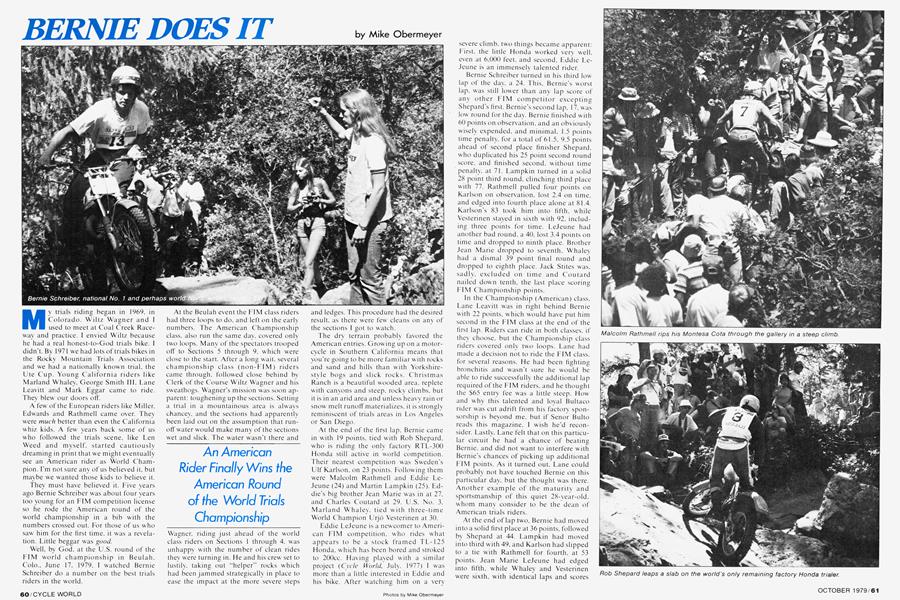
Well, by God. at the U.S. round of the FIM world championship in Beulah, Colo., June 17. 1979. I watched Bernie Schreiber do a number on the best trials riders in the world. At the Beulah event the FIM class riders had three loops to do, and left on the early numbers. The American Championship class, also run the same day. covered only two loops. Many of the spectators trooped oif to Sections 5 through 9, which were close to the start. After a long wait, several championship class (non-EIM) riders came through, followed close behind by Clerk of the Course Wiltz Wagner and his sweathogs. Wagner's mission was soon apparent: toughening up the sections. Setting a trial in a mountainous area is always chancey, and the sections had apparently been laid out on the assumption that runoff water would make many of the sections wet and slick. The water wasn't there and Wagner, riding just ahead of the world class riders on Sections 1 through 4. was unhappv with the number of clean rides they were turning in. He and his crew set to lustily, taking out “helper” rocks which had been jammed strategically in place to ease the impact at the more severe steps and ledges. This procedure had the desired result, as there were few cleans on any of the sections I got to watch.
The dry terrain probably favored the American entries. Growing up on a motorcycle in Southern California means that you’re going to be more familiar with rocks and sand and hills than with Yorkshire -style bogs and slick rocks. Christmas Ranch is a beautiful wooded area, replete with canyons and steep, rocky climbs, but it is in an arid area and unless heavy rain or snow melt runoff'materializes, it is strongly reminiscent of trials areas in Los Angeles or San Diego.
At the end of the first lap. Bernie came in with 19 points, tied with Rob Shepard, who is riding the only factory RTL-300 Honda still active in world competition. Their nearest competition was Sweden’s Ulf Karlson. on 23 points. Following them were Malcolm Rathmell and Eddie Lejeune (24) and Martin Lampkin (25). Eddie's big brother Jean Marie was in at 27. and Charles Coutard at 29. U.S. No. 3. Marland Whaley, tied with three-time World Champion Urjö Vesterinen at 30.
Eddie LeJeune is a newcomer to American FIM competition, who rides what appears to be a stock framed TL-125 Honda, which has been bored and stroked to 200cc. Having played with a similar project (Cycle World, July, 1977) I was more than a little interested in Eddie and his bike. After watching him on a very severe climb, two things became apparent: Ffirst, the little Honda worked very well, even at 6,000 feet, and second, Eddie FeJeune is an immensely talented rider.
Bernie Schreiber turned in his third low lap of the day, a 24. This, Bernie’s worst lap, was still lower than any lap score of any other FIM competitor excepting Shepard's first. Bernie’s second lap, 17, was low round for the day. Bernie finished with 60 points on observation, and an obviously wisely expended, and minimal, 1.5 points time penalty, for a total of 61.5, 9.5 points ahead of second place finisher Shepard, who duplicated his 25 point second round score, and finished second, without time penalty, at 71. Fampkin turned in a solid 28 point third round, clinching third place with 77. Rathmell pulled four points on Karlson on observation, lost 2.4 on time, and edged into fourth place alone at 81.4. Karlson’s 83 took him into fifth, while Vesterinen stayed in sixth with 92, including three points for time. FeJeune had another bad round, a 40, lost 3.4 points on time and dropped to ninth place. Brother Jean Marie dropped to seventh. Whaley had a dismal 39 point final round and dropped to eighth place. Jack Stites was, sadly, excluded on time and Coutard nailed down tenth, the last place scoring FIM Championship points.
In the Championship (American) class. Fane Feavitt was in right behind Bernie with 22 points, which would have put him second in the FIM class at the end of the first lap. Riders can ride in both classes, if they choose, but the Championship class riders covered only two loops. Fane had made a decision not to ride the FIM class, for several reasons. He had been fighting bronchitis and wasn't sure he would be able to ride successfully the additional lap required of the FIM riders, and he thought the $65 entry fee was a little steep. How and why this talented and loyal Bultaco rider was cut adrift from his factory sponsorship is beyond me, but if Señor Bulto reads this magazine, I wish he'd reconsider. Fastly. Fane felt that on this particular circuit he had a chance of beating Bernie, and did not want to interfere with Bernie's chances of picking up additional FIM points. As it turned out. Fane could probably not have touched Bernie on this particular day, but the thought was there. Another example of the maturity and sportsmanship of this quiet 28-year-old. whom many consider to be the dean of American trials riders.
At the end of lap two, Bernie had moved into a solid first place at 36 points, followed by Shepard at 44. Fampkin had moved into third with 49. and Karlson had slipped to a tie with Rathmell for fourth, at 53 points. Jean Marie FeJeune had edged into fifth, while Whaley and Vesterinen were sixth, with identical laps and scores (61). Eddie LeJeune had a disastrous 42 point second lap and dropped to seventh, just ahead of Coutard at 71, who also dropped a hefty 42 points on this lap. Tennessee’s Jack Stites. America’s fifth ranked rider, moved into eighth place with 69.
The event was not without secondary interests. Wiltz Wagner did his usual excellent job of organizing and putting on the trial, with help from experienced oldtimers like starter Jon Callihan and time keeper Arv Hanson. Unfortunately there
are rumbles of dissatisfaction and rebellion among the RMTA membership about the amount of money spent to host the event, reputedly in the SI8.000 range. One of the problems in leading a trials club is grumbles. A visionary like Wagner, who has been involved in the founding of both the RMTA and the North American Trials Council, has to push people, to force them to expand their goals and ideas. Otherwise, there would be no American round in the F1M World Championship series, and Bernie Schreiber might not be.
as he is. in third place in the world. The large gate receipts at this well attended event may put the RMTA back on the road to financial well-being. Such gambles are warranted from the standpoint of those who want to see American involvement in and. hopefully—someday—dominance of the world trials scene.
If it weren't for people like Schreiber. Leavitt. Whaley . . . and Wagner, we'd all probably still be riding trials events on our trail bikes, blissfully unaware of what World Championship competition is 1 ike