Long-Term Report:kz1000 12,000 Miles Later
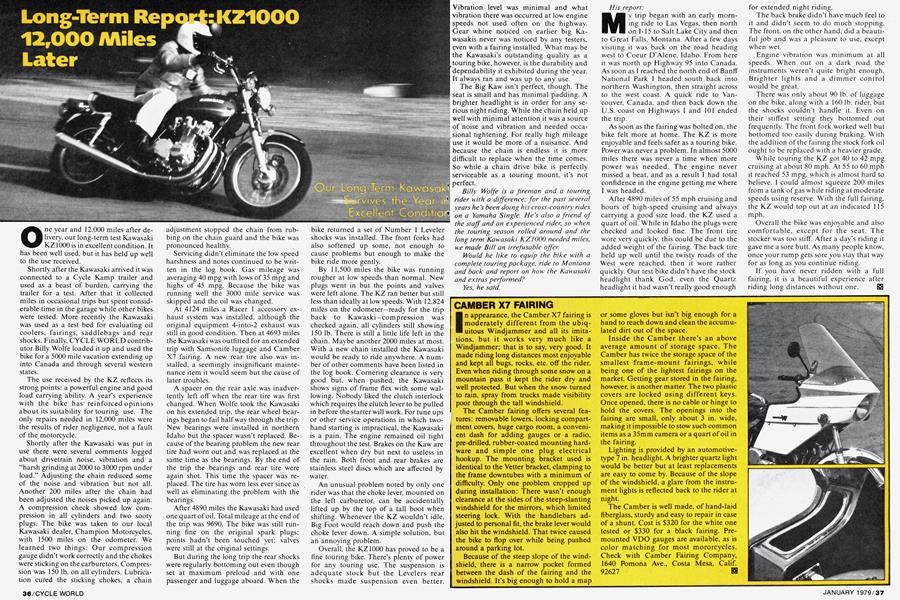
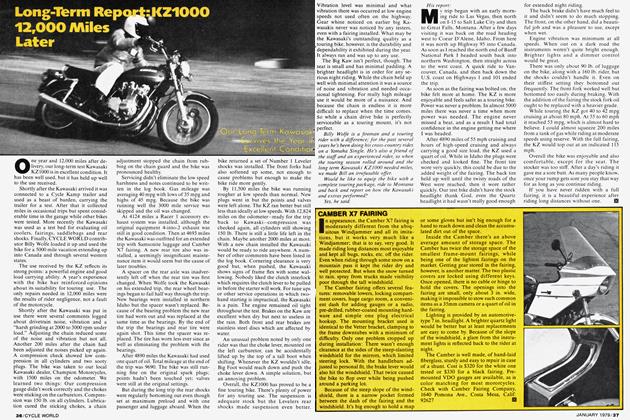
Long-Term Report:KZ1000 12,000 Miles Later
Our Long-Term Kawasaki Survives the Year in Excellent Condition
One year and 12,000 miles after delivery, our long-term test Kawasaki KZ 1000 is in excellent condition. It has been well used, but it has held up well to the use received.
Shortly after the Kawasaki arrived it was connected to a Cycle Kamp trailer and used as a beast of burden, carrying the trailer for a test. After that it collected miles in occasional trips but spent considerable time in the garage while other bikes were tested. More recently the Kawasaki was used as a test bed for evaluating oil coolers, fairings, saddlebags and rear shocks. Finally, CYCLE WORLD contributor Billy Wolfe loaded it up and used the bike for a 5000 mile vacation extending up into Canada and through several western states.
The use received by the KZ reflects its strong points: a powerful engine and good load carrying ability. A year’s experience with the bike has reinforced opinions about its suitability for touring use. The only repairs needed in 12,000 miles were the results of rider negligence, not a fault of the motorcycle.
Shortly after the Kawasaki was put in use there were several comments logged about drivetrain noise, vibration and a “harsh grinding at 2000 to 3000 rpm under load.” Adjusting the chain reduced some of the noise and vibration but not all. Another 200 miles after the chain had been adjusted the noises picked up again. A compression check showed low compression in all cylinders and two sooty plugs. The bike was taken to our local Kawasaki dealer, Champion Motorcycles, with 1500 miles on the odometer. We learned two things: Our compression gauge didn’t work correctly and the chokes were sticking on the carburetors. Compression was 150 lb. on all cylinders. Lubrication cured the sticking chokes, a chain adjustment stopped the chain from rubbing on the chain guard and the bike was pronounced healthy.
Servicing didn’t eliminate the low speed harshness and notes continued to be written in the log book. Gas mileage was averaging 40 mpg with lows of 35 mpg and highs of 45 mpg. Because the bike was running well the 3000 mile service was skipped and the oil was changed.
At 4124 miles a Racer 1 accessory exhaust system was installed, although the original equipment 4-into-2 exhaust was still in good condition. Then at 4693 miles the Kawasaki was outfitted for an extended trip with Samsonite luggage and Camber X7 fairing. A new rear tire also was installed, a seemingly insignificant maintenance item it would seem but the cause of later troubles.
A spacer on the rear axle was inadvertently left off when the rear tire was first changed. When Wolfe took the Kawasaki on his extended trip, the rear wheel bearings began to fail half way through the trip. New bearings were installed in northern Idaho but the spacer wasn’t replaced. Because of the bearing problem the new rear tire had worn out and was replaced at the same time as the bearings. By the end of the trip the bearings and rear tire were again shot. This time the spacer was replaced. The tire has worn less ever since as well as eliminating the problem with the bearings.
After 4890 miles the Kawasaki had used one quart of oil. Total mileage at the end of the trip was 9690. The bike was still running fine on the original spark plugs; points hadn’t been touched yet; valves were still at the original settings.
But during the long trip the rear shocks were regularly bottoming out even though set at maximum preload and with one passenger and luggage aboard. When the bike returned a set of Number 1 Leveler shocks was installed. The front forks had also softened up some, not enough to cause problems but enough to make the bike ride more gently.
By 11,500 miles the bike was running rougher at low speeds than normal. New plugs went in but the points and valves were left alone. The KZ ran better but still less than ideally at low speeds. With 12,824 miles on the odometer—ready for the trip back to Kawaski—compression was checked again, all cylinders still showing 150 lb. There is still a little life left in the chain. Maybe another 2000 miles at most. With a new chain installed the Kawasaki would be ready to ride anywhere. A number of other comments have been listed in the log book. Cornering clearance is very good but, when pushed, the Kawasaki shows signs of frame flex with some wallowing. Nobody liked the clutch interlock which requires the clutch lever to be pulled in before the starter will work. For tune ups or other service operations in which twohand starting is impractical, the Kawasaki is a pain. The engine remained oil tight throughout the test. Brakes on the Kaw are excellent when dry but next to useless in the rain. Both front and rear brakes are stainless steel discs which are affected by water.
An unusual problem noted by only one rider was that the choke lever, mounted on the left carburetor, can be accidentally lifted up by the top of a tall boot when shifting. Whenever the KZ wouldn’t idle, Big Foot would reach down and push the choke lever down. A simple solution, but an annoying problem.
Overall, the KZ1000 has proved to be a fine touring bike. There’s plenty of power for any touring use. The suspension is adequate stock but the Levelers rear shocks made suspension even better.
Vibration level was minimal and what vibration there was occurred at low engine speeds not used often on the highway. Gear whine noticed on earlier big Kawasakis never was noticed by any testers, even with a fairing installed. What may be the Kawasaki’s outstanding quality as a touring bike, however, is the durability and dependability it exhibited during the year.
It always ran and was up to any use.
The Big Kaw isn’t perfect, though. The seat is small and has minimal padding. A brighter headlight is in order for any serious night riding. While the chain held up well with minimal attention it was a source of noise and vibration and needed occasional tightening. For really high mileage use it would be more of a nuisance. And because the chain is endless it is more difficult to replace when the time comes. So while a chain drive bike is perfectly serviceable as a touring mount, it’s not perfect.
Billy Wolfe is a fireman and a touring rider with a difference; for the past several years he’s been doing his cross-country rides on a Yamaha Single. He’s also a friend of the staff and an experienced rider, so when the touring season rolled around and the long term Kawasaki KZ1000 needed miles, we made Bill an ir ref usable offer.
Would he like to equip the bike with a complete touring package, ride to Montana and back and report on how the Kawasaki and extras performed?
Yes, he said.
His report:
Mv ing trip ride began to Las with Vegas, an early then mornnorth on 1-15 to Salt Lake City and then to Great Falls, Montana. After a few days visiting it was back on the road heading west to Coeur D’Alene, Idaho. From here it was north up Highway 95 into Canada. As soon as I reached the north end of Banff National Park I headed south back into northern Washington, then straight across to the west coast. A quick ride to Vancouver, Canada, and then back down the U.S. coast on Highways 1 and 101 ended the trip.
As soon as the fairing was bolted on, the bike felt more at home. The KZ is more enjoyable and feels safer as a touring bike. Power was never a problem. In almost 5000 miles there was never a time when more power was needed. The engine never missed a beat, and as a result I had total confidence in the engine getting me where I was headed.
After 4890 miles of 55 mph cruising and hours of high-speed cruising and always carrying a good size load, the KZ used a quart of oil. While in Idaho the plugs were checked and looked fine. The front tire wore very quickly, this could be due to the added weight of the fairing. The back tire held up well until the twisty roads of the West were reached, then it wore rather quickly. Our test bike didn’t have the stock headlight thank God, even the Quartz headlight it had wasn’t really good enough for extended night riding.
The back brake didn’t have much feel to it and didn’t seem to do much stopping. The front, on the other hand, did a beautiful job and was a pleasure to use, except when wet.
Engine vibration was minimum at all speeds. When out on a dark road the instruments weren’t quite bright enough. Brighter lights and a dimmer control would be great.
There was only about 90 lb. of luggage on the bike, along with a 160 lb. rider, but the shocks couldn’t handle it. Even on their stiffest setting they bottomed out frequently. The front fork worked well but bottomed too easily during braking. With the addition of the fairing the stock fork oil ought to be replaced with a heavier grade.
While touring the KZ got 40 to 42 mpg cruising at about 80 mph. At 55 to 60 mph it reached 53 mpg, which is almost hard to believe. I could almost squeeze 200 miles from a tank of gas while riding at moderate speeds using reserve. With the full fairing, the KZ would top out at an indicated 115 mph.
Overall the bike was enjoyable and also comfortable, except for the seat. The stocker was too stiff. After a day’s riding it gave me a sore butt. As many people know, once your rump gets sore you stay that way for as long as you continue riding.
If you have never ridden with a full fairing, it is a beautiful experience after riding long distances without one. E3